Our patient had become increasingly socially withdrawn, emotionless, and impulsive. He had started falling with increasing frequency, not even bothering anymore to put out his hands to break his fall. And he had been taken to specialist after specialist, undergoing test after test. But each doctor was stumped as to what disease (or diseases) might be responsible. The patient had been referred to the clinic where I was observing, desperately seeking answers.
I largely watched as a more senior medical student conducted a lengthy and thorough interview and exam. By the end, both of us were leaning towards the same diagnosis: progressive supranuclear palsy. It is a progressive degenerative brain disease, and an insidious one at that. It causes dementia and impairs motor function, slowly paralyzing the muscles involved in gaze, talking, and swallowing, and causing frequent, spectacular falls. There is neither a cure nor an effective treatment (although some therapies are currently in development). Most patients die of complications from it within years. Very few doctors know about the disease or know how to pick up on the disease's subtle signs, often misdiagnosing it as Parkinson's. To be fair, the patient's condition was less advanced when she saw her previous physicians, which would have made the disease harder to recognize then.
The medical student presented to the attending physician, who became even more certain than we were that the patient had progressive supranuclear palsy. It was time to broach the news to the patient and his family. I thought that this would be a devastating moment: learning that you (or your loved one) are afflicted with an incurable, progressive, and tragic disease. In large part, the patient and his family responded as though a burden had been lifted. They had finally gotten a satisfying conclusion to their quest for a diagnosis, and now they could predict what might happen to the patient in the coming years. Above all, they were relieved that something finally explained what was going on: that a known disease was responsible for the befuddling combination of behavioral and motor problems that were increasingly affecting the patient. Within this tiny snapshot of time, the family responded bravely to the news of the diagnosis.
Getting the diagnosis here was a help for the family. Had the correct diagnosis been given earlier, the family could have avoided a lot of hassle, expense, and anxiety.
I'm considering neurology more seriously as a specialty, fully aware that many of the conditions I would be dealing with are largely incurable and untreatable. Where I think I could make a difference is in making the right diagnosis where others might stumble.
25 September 2012
19 September 2012
Where Are Today's Philosopher-Physicians?
I recently finished "The Man Who Mistook His Wife for a Hat", by neurologist and popular author Oliver Sacks. It is about the philosophical ramifications of his patients' diseases.
Sacks attended medical school in England and graduated in the late 1950s. I wonder, is my medical education engendering scholarly thought in a way that might produce writer-thinkers like Prof. Sacks? The answer is no. There are notable physician-writers of the present day (Atul Gawande, Danielle Ofri, Abraham Verghese, and Siddartha Mukherjee come to mind), but they strike me as an exception to the rule.
Part of the problem is medical education. We learn the mechanisms of disease and of treatment in thorough detail. But there is little discussion of the wider consequences of what we're learning. The humanities are virtually divorced from my medical education. My school spends about 2 hours of lecture on clinical ethics, with no opportunity to receive further instruction. We are not taught about the history of medicine, or of the philosophy of the mind-body problem, or of the mathematical underpinnings of diagnostic medicine. We learn little about the laws, corporations, and political systems that govern the practice of medicine, about other countries' medical systems, about ways to implement population-scale interventions that prevent disease in the first place. There is so much medicine to learn that we are reduced to learning it in a vacuum, isolated from the fascinating scholarly fields that border, affect, and inform medicine. In many respects, medical school feels like trade school, like learning how to repair cars. We are expected to be learners, but not scholars.
Aren't we missing something substantial? Authors, poets, and philosophers have spent millennia grappling with death and illness, understanding how to make sense of the human experience and how to understand our interactions with others and with ourselves. It offers something that science cannot (and I say this as an undergraduate science major): it offers resiliency, insight, and perspective. When our medical education teaches science at the expense of the humanities, doesn't it also untether itself from humanity? Is it wise for our healers to be ignorant in literature and philosophy? Indeed, can those ignorant of literature and philosophy even be healers?
Part of the problem too is the medical admissions process. Getting into medical school demands that one excel at conventionality. Prerequisites are science and math classes, and applicants are strongly encouraged to net publications and shadow physicians. It demands that an applicant check boxes well, and that they be a scientific kind of thinker. Yet the pre-med process boxes out creative and compassionate thinkers that could innovate the field. The medical profession is beginning to recognize this problem, and is retooling the MCAT to emphasize ethics and social sciences. At the end of the day, though, the MCAT is just a multiple-choice test. Multiple-choice tests demand uniformity of thought, which is the exact opposite of creative thought. Fittingly, virtually every exam I've taken as a medical student has been multiple-choice.
The question really comes down to our identity: what do doctors believe a physician should strive to be? I think most doctors would say, a physician works in a medical setting in the care and treatment of patients. Medical school is structured around this particular mission, and it tends to accept those applicants that abide by it.
My view of medicine's aims is more expansive. I believe that physicians should improve the plight of man, using a knowledge of science as well as whatever other tools are available to them. This could be through patient care, through politics, through education, through research—anything. If medical schools were to adopt this far-reaching mission, and to teach students through that lens, medical education would necessarily look dramatically different. I think our country would look dramatically different, too, and for the better.
I'm hardly the first to believe that medicine should broaden its "scope of practice". The field of pathology, a branch of medicine that involves little patient interaction, was partly founded by Rudolf Virchow. Virchow also founded "social medicine," a nearly nonexistent branch of medicine that studies and addresses the societal determinants of disease (like famine, war, and public policy). In his words, "The physicians are the natural attorneys of the poor, and social problems fall to a large extent within their jurisdiction." Though written over 150 years ago, I believe they hold quite true today.
- A patient with Korsakoff's Syndrome (severe damage to the memory-forming regions of the brain, due to a vitamin deficiency) lacks the ability to create new explicit memories. Decades after World War II has ended, he does not realize that time has passed beyond the year 1945. He knows himself only as a young man, and has entirely lost his own adult identity. Can someone really "live" if they don't know who they are, and if they have no ability to gain new knowledge or modify their personal narrative and sense of self?
- One patient with Tourette Syndrome finds that his nervous tics enhance his talent as a session drummer, forming the basis of wild improvisations that bring him musical acclaim. Since it is benefiting the patient, should Tourette Syndrome here be considered a disease? Should the Tourette Syndrome be treated? To what extent does Tourette Syndrome define the patient's personality?
- Another patient is mentally retarded but displays a remarkable spiritual and poetic wholeness that gives her life substance. Is it fair to consider her mental faculties as diminished? Are our psychological and neurological tests able to capture her strengths?
- An elderly patient's new-onset seizure disorder makes her to see vivid flashbacks of her forgotten early childhood, unearthing pleasant memories that had long been buried. During her seizures she can accurately picture her parents, who died when she was age 4, as never before. The memories of her halcyon days of youth put her at ease in her waning days. Her case, among others, suggests that humans have a virtually unlimited faculty for storing memory. We seem to be limited only in our ability to recall those memories, an ability that can be paradoxically enhanced by debilitating diseases.
Sacks attended medical school in England and graduated in the late 1950s. I wonder, is my medical education engendering scholarly thought in a way that might produce writer-thinkers like Prof. Sacks? The answer is no. There are notable physician-writers of the present day (Atul Gawande, Danielle Ofri, Abraham Verghese, and Siddartha Mukherjee come to mind), but they strike me as an exception to the rule.
Part of the problem is medical education. We learn the mechanisms of disease and of treatment in thorough detail. But there is little discussion of the wider consequences of what we're learning. The humanities are virtually divorced from my medical education. My school spends about 2 hours of lecture on clinical ethics, with no opportunity to receive further instruction. We are not taught about the history of medicine, or of the philosophy of the mind-body problem, or of the mathematical underpinnings of diagnostic medicine. We learn little about the laws, corporations, and political systems that govern the practice of medicine, about other countries' medical systems, about ways to implement population-scale interventions that prevent disease in the first place. There is so much medicine to learn that we are reduced to learning it in a vacuum, isolated from the fascinating scholarly fields that border, affect, and inform medicine. In many respects, medical school feels like trade school, like learning how to repair cars. We are expected to be learners, but not scholars.
Aren't we missing something substantial? Authors, poets, and philosophers have spent millennia grappling with death and illness, understanding how to make sense of the human experience and how to understand our interactions with others and with ourselves. It offers something that science cannot (and I say this as an undergraduate science major): it offers resiliency, insight, and perspective. When our medical education teaches science at the expense of the humanities, doesn't it also untether itself from humanity? Is it wise for our healers to be ignorant in literature and philosophy? Indeed, can those ignorant of literature and philosophy even be healers?
Part of the problem too is the medical admissions process. Getting into medical school demands that one excel at conventionality. Prerequisites are science and math classes, and applicants are strongly encouraged to net publications and shadow physicians. It demands that an applicant check boxes well, and that they be a scientific kind of thinker. Yet the pre-med process boxes out creative and compassionate thinkers that could innovate the field. The medical profession is beginning to recognize this problem, and is retooling the MCAT to emphasize ethics and social sciences. At the end of the day, though, the MCAT is just a multiple-choice test. Multiple-choice tests demand uniformity of thought, which is the exact opposite of creative thought. Fittingly, virtually every exam I've taken as a medical student has been multiple-choice.
The question really comes down to our identity: what do doctors believe a physician should strive to be? I think most doctors would say, a physician works in a medical setting in the care and treatment of patients. Medical school is structured around this particular mission, and it tends to accept those applicants that abide by it.
My view of medicine's aims is more expansive. I believe that physicians should improve the plight of man, using a knowledge of science as well as whatever other tools are available to them. This could be through patient care, through politics, through education, through research—anything. If medical schools were to adopt this far-reaching mission, and to teach students through that lens, medical education would necessarily look dramatically different. I think our country would look dramatically different, too, and for the better.
I'm hardly the first to believe that medicine should broaden its "scope of practice". The field of pathology, a branch of medicine that involves little patient interaction, was partly founded by Rudolf Virchow. Virchow also founded "social medicine," a nearly nonexistent branch of medicine that studies and addresses the societal determinants of disease (like famine, war, and public policy). In his words, "The physicians are the natural attorneys of the poor, and social problems fall to a large extent within their jurisdiction." Though written over 150 years ago, I believe they hold quite true today.


12 September 2012
Card-ology
Although I've only played poker once in the past three years, I entered a (free) campus Texas Hold'em poker tournament and won handily. It was shocking. My competitors were devoted poker fans who spoke in poker lingo and followed the competitive poker scene. I, on other hand, was so rusty that I had to ask players to remind me of the order of poker hands. As of writing, I still don't recall if a straight is worth more than a flush. And yet, everything worked. I accurately predicted when to fold, succeeded every time I bluffed, and subtly pressured my opponents into making unwise decisions that I ultimately collected on.
My performance differed from how I fared the few times I had ever played poker, and I wonder if my victory can be attiributed to my transformation into a medical student. Medicine and poker involve managing uncertainty, and most elements of my poker strategy involve skills that I have been honing in medical school.
-----
I've mentioned some of the ways that becoming a physician seems to be changing me, and not always for better. At the same time, though, medical school is maturing and strengthening some parts of my personality and my thinking. Strange that it was a poker tournament that reminded me of that.
My performance differed from how I fared the few times I had ever played poker, and I wonder if my victory can be attiributed to my transformation into a medical student. Medicine and poker involve managing uncertainty, and most elements of my poker strategy involve skills that I have been honing in medical school.
-----
Anchoring: One of the most common pitfalls in making a diagnosis is that we tend to anchor ourselves too strongly to our initial hunches, even in the face of data to the contrary. It's not just physicians who anchor.
For example, you might ask someone: "How many calories are in an apple?"
You might ask a second person: "How many calories are in an apple? 250? 300?"
The second person will tend to give a higher number than the first. An apple actually has about 100 calories. But by suggesting caloric values of 250 and 300, you have subconsciously anchored them to values near those numbers.
Fast-food chains and stores like Walmart use this trick all of the time. The Subway chain prominently advertises how certain subs on its menu are low in fat. But many of their other subs are actually quite high in fat. By advertising that some of their subs are low-fat, they anchor people to the unwarranted belief that Subway subs generally are low in fat. The effect of Subway's advertising is explored in the wonderful book "Mindless Eating", which I previously reviewed.
Doctors must make sure not to follow their initial hunch too doggedly. While playing poker, I was cognizant of how I mustn't get too attached to my hand, even if I've already bet a substantial amount on it. Several times I resisted the urge to keep betting and folded.
Probability and Bayesian inference: In an intriguing case mentioned in a New England Journal of Medicine case report, a neurologist examined a patient who had been diagnosed with multiple sclerosis. Upon questioning, the patient mentioned that both of his brothers had been diagnosed with multiple sclerosis (MS) as well. The neurologist immediately doubted that the disease was MS, because MS is not a very heritable disease. The neurologist knew that if one's sibling has multiple sclerosis, one's odds of having it are only 1 in 25. For all three brothers to have MS was virtually impossible. Sure enough, the neurologist found that what the brothers had was not MS, but instead a rare (autosomal dominant) genetic disease called CADASIL. Probability led to the correct diagnosis.
In poker, if I am one of eight players at the table, I know that in each round there is a 1/8 chance that I have been dealt that round's best hand. This knowledge makes me fold often.
During each round, I ask myself: probabilistically, how strong are my cards relative to the others'? If someone had been dealt a better hand than me, what is the likelihood that they have folded by now? If there were still a person in this round who has better cards than me, what is the likelihood that I could make them fold? Is the way that a particular person is acting consistent with their having a better hand than me?-----
These same types of conditional probability questions are what underpin Bayesian inference, a branch of statistics that impacts decision-making. The best diagnosticians use Bayesian inference, consciously or unconsciously, to arrive at the correct diagnoses.
Reading people and interacting with people: Interacting with patients in clinic is helping me with reading people generally. When I ask a patient if they smoke tobacco and they hesitate, I know that no matter what they say afterwards, they smoke tobacco. I'm learning how to make a patient feel more calm, which means that, by extension, I'm learning how I could make them feel bothered.
In poker, I frustrated one of my opponents by intentionally placing a needlessly high bet against her early in a round. I correctly predicted that she wasn't confident enough in her cards to call my bet, and she angrily folded. Her reaction suggested to me that she would want retribution, and that the next time I placed a large bet she would call. Sure enough, when I placed another large bet against her, she called and lost on a weak hand. A few hands later, she went "all-in" against me to try to get me to fold. I suspected that her hand was probably weaker than mine, and I called. She lost and had to give me all of her chips. Her frustration in the face of mounting pressure got the better of her.
I've mentioned some of the ways that becoming a physician seems to be changing me, and not always for better. At the same time, though, medical school is maturing and strengthening some parts of my personality and my thinking. Strange that it was a poker tournament that reminded me of that.
05 September 2012
Trying patients
While shadowing a headache specialist in clinic:
-----
-----
Patient: All you neurologists keep saying the same thing about my headaches. I mean, there has to be someone who actually specializes in headaches. Maybe I need to go see them instead.
Headache specialist: I am a headache specialist.
Patient's wife: Yeah, but I'll bet you only see people with migraines. Not real headaches like his.
29 August 2012
Less than perfect: Harrison's Ch. 104 "Disorders of Hemoglobin"
Note: While I attempt to read the 397 chapters of Harrison's Principles of Internal Medicine, I am writing occasional reflections.
Paradoxically, some parts of our body work best when they fail under stress.
-----
An illustrative story from my freshman year of college:
I decided to buy a wheelie chair for my (miniscule) dorm room from a student who lived 1.5 miles away. How could I transport the chair across campus when I didn't have a car?
I didn't feel like wasting an hour walking there and then walking the chair back. Instead, I elected to waste three hours dreaming up and building an alternative. I decided I would tow the chair with my bicycle by running a rope between them. The only rope I could find, though, was an Ethernet cable that was too short. I improvised, tying the cable to my bike rack and then lengthening the contraption by adding some plastic hangers as a kind of towing hitch. A friend grabbed a chair and took it for a test ride (below).

After a few modifications, the setup worked surprisingly well. So long as I didn't decelerate or turn suddenly, the chair trailed the bike by a comfortable four feet.
I bought the wheelie chair and sped it through the streets and paths of campus, dodging parked cars and drawing whistles and shouts of approval from onlookers. Two-thirds of the way through my journey, though, things went wrong. I steered my bike to the left of a bollard, and the chair instead traveled to the bollard's right. I watched helplessly as the line went taut and then snapped, pulverizing the hangers into a shower of plastic shards.
While cleaning up the mess, I realized with a shudder that my originally-intended design (a simple rope connecting chair to bike) could have seriously injured me. The plastic hangers had dissipated the tremendous shock by shattering and by disconnecting my bike from the chair. Had nothing been there to absorb the shock, my bike would have been flipped backwards, throwing me onto the cement headfirst and onto my back. Oddly enough, my design flaw saved me.
-----
A similar phenomenon, of the "useful design flaw," underlies some of the disorders of hemoglobin. Hemoglobin is the critical enzyme in our red blood cells that carries oxygen to our tissues and carries carbon dioxide to our lungs. Hemoglobin disorders such as sickle-cell trait and thalassemia minor are particularly prevalent in areas endemic to malaria, and for good reason. Put simply, in these diseases hemoglobin is either mutated or unevenly manufactured, weakening the red blood cell. These weak blood cells are less hospitable to infection by the parasite (Plasmodium falciparum) that causes the most lethal form of malaria. And so, for those living in areas plagued by malaria, having weak blood cells is adaptive and life-prolonging.
Examples of other helpful design flaws abound in nature. Hepatitis C and HIV replicate their genomes with significantly lower fidelity than do humans. The numerous mutations generated by these replication errors help the viruses elude our immune systems and frustrate our attempts at making a vaccine.
My classmates and I are striving to become physicians who don't make mistakes. Nature, though, doesn't have to set so high of a bar for itself. Sometimes, less than perfect is just right.
Paradoxically, some parts of our body work best when they fail under stress.
-----
An illustrative story from my freshman year of college:
I decided to buy a wheelie chair for my (miniscule) dorm room from a student who lived 1.5 miles away. How could I transport the chair across campus when I didn't have a car?
I didn't feel like wasting an hour walking there and then walking the chair back. Instead, I elected to waste three hours dreaming up and building an alternative. I decided I would tow the chair with my bicycle by running a rope between them. The only rope I could find, though, was an Ethernet cable that was too short. I improvised, tying the cable to my bike rack and then lengthening the contraption by adding some plastic hangers as a kind of towing hitch. A friend grabbed a chair and took it for a test ride (below).

After a few modifications, the setup worked surprisingly well. So long as I didn't decelerate or turn suddenly, the chair trailed the bike by a comfortable four feet.
I bought the wheelie chair and sped it through the streets and paths of campus, dodging parked cars and drawing whistles and shouts of approval from onlookers. Two-thirds of the way through my journey, though, things went wrong. I steered my bike to the left of a bollard, and the chair instead traveled to the bollard's right. I watched helplessly as the line went taut and then snapped, pulverizing the hangers into a shower of plastic shards.
While cleaning up the mess, I realized with a shudder that my originally-intended design (a simple rope connecting chair to bike) could have seriously injured me. The plastic hangers had dissipated the tremendous shock by shattering and by disconnecting my bike from the chair. Had nothing been there to absorb the shock, my bike would have been flipped backwards, throwing me onto the cement headfirst and onto my back. Oddly enough, my design flaw saved me.
-----
A similar phenomenon, of the "useful design flaw," underlies some of the disorders of hemoglobin. Hemoglobin is the critical enzyme in our red blood cells that carries oxygen to our tissues and carries carbon dioxide to our lungs. Hemoglobin disorders such as sickle-cell trait and thalassemia minor are particularly prevalent in areas endemic to malaria, and for good reason. Put simply, in these diseases hemoglobin is either mutated or unevenly manufactured, weakening the red blood cell. These weak blood cells are less hospitable to infection by the parasite (Plasmodium falciparum) that causes the most lethal form of malaria. And so, for those living in areas plagued by malaria, having weak blood cells is adaptive and life-prolonging.
Examples of other helpful design flaws abound in nature. Hepatitis C and HIV replicate their genomes with significantly lower fidelity than do humans. The numerous mutations generated by these replication errors help the viruses elude our immune systems and frustrate our attempts at making a vaccine.
My classmates and I are striving to become physicians who don't make mistakes. Nature, though, doesn't have to set so high of a bar for itself. Sometimes, less than perfect is just right.
26 August 2012
Harrison's Ch. 27: "Sleep Disorders"
Note: While I attempt to read the 397 chapters of Harrison's Principles of Internal Medicine, I am writing occasional reflections.
From Harrison's Ch. 27 ("Sleep Disorders"):
From Harrison's Ch. 27 ("Sleep Disorders"):
Driving is particularly hazardous for patients with increased sleepiness. Reaction time is equally impaired by 24 h of sleep loss as by a blood alcohol level of 0.10 g/dL. More than half of Americans admit to having fallen asleep while driving. An estimated 250,000 motor vehicle crashes per year are due to drowsy drivers, causing about 20% of all serious crash injuries and deaths....Failure to recognize and treat [sleep apnea] appropriately may lead to impairment of daytime alertness, increased risk of sleep-related motor vehicle accidents, hypertension and other serious cardiovascular complications, and increased mortality. Sleep apnea is particularly prevalent in overweight men and in the elderly, yet it is estimated to remain undiagnosed in 80–90% of affected individuals. This is unfortunate since effective treatments are available.
Traditionally, doctors and patients haven't given terribly much thought to the health impact of the third or so of our lives we spend in bed. But as
we become more overweight (causing sleep problems) and as we better
understand the health burden of sleep problems, perhaps there will be a
renewed focus on sleep.
When I was seeing patients in a primary-care clinic, I asked some of them whether they felt well-rested during the day. Most said they were sleepy all the time. When I then administered the Epworth Sleepiness Scale, a standard test to assess risk for sleep apnea, some of the results were startling. One patient scored a 21 out of a possible 24, with 9 being the cutoff for urgent referral to a sleep expert. Patients were falling asleep during business meetings and while driving. I dutifully referred them for a home sleep study. I regret not having asked more patients about their sleeping habits, because I'm sure that many of them had undiagnosed sleep apnea. I vividly recall years ago hearing a sleep expert call sleep apnea a "walking time bomb."
I also saw a handful of patients who had been diagnosed with sleep apnea and who were on treatment (typically CPAP, a mask worn at night that supplies air). They said they felt like new people.
When I was seeing patients in a primary-care clinic, I asked some of them whether they felt well-rested during the day. Most said they were sleepy all the time. When I then administered the Epworth Sleepiness Scale, a standard test to assess risk for sleep apnea, some of the results were startling. One patient scored a 21 out of a possible 24, with 9 being the cutoff for urgent referral to a sleep expert. Patients were falling asleep during business meetings and while driving. I dutifully referred them for a home sleep study. I regret not having asked more patients about their sleeping habits, because I'm sure that many of them had undiagnosed sleep apnea. I vividly recall years ago hearing a sleep expert call sleep apnea a "walking time bomb."
I also saw a handful of patients who had been diagnosed with sleep apnea and who were on treatment (typically CPAP, a mask worn at night that supplies air). They said they felt like new people.
I recently came across the excellent "Anonymous Doc" blog, written by a medical resident. He writes about a time he was very sleepy.
Harrison's discusses the phenomenon of tired medical residents in the chapter:
Harrison's discusses the phenomenon of tired medical residents in the chapter:
Resident physicians constitute another group of workers at risk for accidents and other adverse consequences of lack of sleep and misalignment of the circadian rhythm. Recurrent scheduling of resident physicians to work shifts of 24 h or more consecutive hours impairs psychomotor performance to a degree that is comparable to alcohol intoxication, doubles the risk of attentional failures among intensive care unit interns working at night, and significantly increases the risk of serious medical errors in intensive care units, including a fivefold increase in the risk of serious diagnostic mistakes. Some 20% of hospital interns report making a fatigue-related mistake that injured a patient, and 5% admit making a fatigue-related mistake that results in the death of a patient. Moreover, working for >24 h consecutively increases the risk of percutaneous injuries and more than doubles the risk of motor vehicle crashes on the commute home.
Uh-oh.
|
22 August 2012
Rare
I saw a patient with Menkes Disease, a rare and serious disease in which the body cannot adequately absorb copper from the diet. Most doctors know this disease only as a paragraph in one of their
textbooks, or as the subject of twenty seconds of one medical school
lecture. Although it is tragic to see a patient with an incurable disease, encountering the flesh-and-blood embodiment of this rare entity felt something like a stroke of luck. I now am among the privileged few to have seen the real thing up close.
19 August 2012
'Medicine in Translation: Journeys with My Patients', by Danielle Ofri
In "Medicine in Translation: Journeys with My Patients", Dr. Danielle Ofri retells the remarkable stories of about a dozen of her patients. Dr. Ofri is an attending physician at Bellevue Hospital in New York City, the nation's first public hospital. Dr. Ofri's stories are about moving to a new country: her patients are immigrants who are trying to maintain their identity in the American melting pot. One patient was left horribly disfigured by a politically-motivated attack in his home country. Another needs a heart transplant but cannot obtain one because of her undocumented status. They persevere in the face of tremendous obstacles.
Dr. Ofri tries to bridge the cultural and language barriers that separate her from her patients. She decides to become an immigrant of sorts: she relocates her family to Costa Rica for a year as a break from medicine and as a way of acquainting herself with the culture and language of some of her Hispanic patients.
It is a touching little book. Dr. Ofri cares for her patients and cares about them, too. Her writing captures how she learns from her patients and uses their example to better herself.
Dr. Ofri tries to bridge the cultural and language barriers that separate her from her patients. She decides to become an immigrant of sorts: she relocates her family to Costa Rica for a year as a break from medicine and as a way of acquainting herself with the culture and language of some of her Hispanic patients.
It is a touching little book. Dr. Ofri cares for her patients and cares about them, too. Her writing captures how she learns from her patients and uses their example to better herself.
18 August 2012
Happy anniversary!
From my first blog entry, on August 18, 2011:
To my surprise, more and more people have been stopping by. Since November, readers from 70 countries have visited. Within the United States, visitors came from 47 states plus the District of Columbia. The blog comes up on the first page of search results when one types "reflex hammer" into Google. The American College of Physicians featured the blog on its website, as a "Notable Voice of Internal Medicine." It has been an electrifying feeling. When I started, I figured the only people who would read my writing would be my family and a few friends.
I'm grateful to readers like you for allowing me to share my story. Thanks very much!
115 entries and one year later, I mark the anniversary of this blog.Science only gets the doctor so far. We understand the biochemical mechanism of hypertension, we understand how deadly it is, we can easily diagnose it, and we know how to cheaply and effectively treat and even prevent it. Yet hypertension still afflicts a third of adults in the U.S. and kills a substantial fraction of them. We can't escape the fact that patients are people, with people's foibles, strengths, and shortcomings. This makes treating chronic illness frustrating and sometimes ineffectual. But that I am dealing not just with kidneys and arteries and hearts, but with people, is what also makes clinical medicine intensely rewarding.
To my surprise, more and more people have been stopping by. Since November, readers from 70 countries have visited. Within the United States, visitors came from 47 states plus the District of Columbia. The blog comes up on the first page of search results when one types "reflex hammer" into Google. The American College of Physicians featured the blog on its website, as a "Notable Voice of Internal Medicine." It has been an electrifying feeling. When I started, I figured the only people who would read my writing would be my family and a few friends.
I'm grateful to readers like you for allowing me to share my story. Thanks very much!
15 August 2012
Harrison's Ch. 392: "Alcohol and Alcoholism"
Note: While I attempt to read the 397 chapters of Harrison's Principles of Internal Medicine, I am writing occasional reflections.
In Lysistrata, by the ancient Greek playwright Euripides, the wives of the warring Athenians and Spartans revolt. The women collectively agree to withhold sexual privileges from their husbands and lovers until the men of the two cities make peace. A peace conference quickly follows. A treaty is successfully negotiated, thanks in part to the hefty amount of alcohol consumed by the ambassadors on both sides:
From even before the time of the Greeks, alcohol consumption has been a part of our literature and a part of our lifestyle.
The time I am spending on the hospital wards is showing me another side of alcohol: the terrible toll that it exacts from some of its consumers. One such patient who was in her twenties had suffered complete liver failure because of heavy alcohol consumption. As such, she was badly jaundiced. The whites of her eyes were now a dark yellow and her fair skin was now a dark green-brown. Her chances of being alive in 3 months' time were under 15%. Another patient had lost the ability to walk or sit up unassisted because of alcohol-induced degeneration of the part of his brain (the cerebellum) that regulates balance. According to Harrison's:
Alcohol consumption is increasing in the United Kingdom and Russia and is surging in new markets like India and China. As an increasing number of people worldwide try alcohol for the first time, more will abuse alcohol, with the concomitant problems that alcohol wreaks on the body and the mind.
Although treatment for alcohol addiction is in its infancy, doctors are getting a better sense of what interventions are effective. There even are a few medications, such as naltrexone, that seem to blunt cravings. The outsized public health impact of alcohol consumption also means that medical innovations in this field will have an outsized effect on people's well-being.
In Lysistrata, by the ancient Greek playwright Euripides, the wives of the warring Athenians and Spartans revolt. The women collectively agree to withhold sexual privileges from their husbands and lovers until the men of the two cities make peace. A peace conference quickly follows. A treaty is successfully negotiated, thanks in part to the hefty amount of alcohol consumed by the ambassadors on both sides:
1ST ATHENIAN
I've never known such a pleasant banquet before,
And what delightful fellows the Spartans are.
When we are warm with wine, how wise we grow.
2ND ATHENIAN
That's only fair, since sober we're such fools:
This is the advice I'd give the Athenians—
See our ambassadors are always drunk.
For when we visit Sparta sober, then
We're on the alert for trickery all the while
So that we miss half of the things they say,
And misinterpret things that were never said,
And then report the muddle back to Athens.
But now we're charmed with each other. They might cap
With the Telamon-catch instead of the Cleitagora,
["they could perform Spartan poetry instead of Athenian poetry"]
And we'd applaud and praise them just the same;
We're not too scrupulous in weighing words.
The time I am spending on the hospital wards is showing me another side of alcohol: the terrible toll that it exacts from some of its consumers. One such patient who was in her twenties had suffered complete liver failure because of heavy alcohol consumption. As such, she was badly jaundiced. The whites of her eyes were now a dark yellow and her fair skin was now a dark green-brown. Her chances of being alive in 3 months' time were under 15%. Another patient had lost the ability to walk or sit up unassisted because of alcohol-induced degeneration of the part of his brain (the cerebellum) that regulates balance. According to Harrison's:
As much as I enjoy having a beer, I've started to see alcohol as a poison above all else. Although you might think that doctors would know better, Harrison's also points out that "the lifetime risk for alcoholism among physicians is similar to that of the general population."Because80% of people in Western countries have consumed alcohol, and two-thirds have been drunk in the prior year, the lifetime risk for serious, repetitive alcohol problems is almost 20% for men and 10% for women, regardless of a person's education or income. While low doses of alcohol have some healthful benefits, the intake of more than three standard drinks per day on a regular basis enhances the risk for cancer and vascular disease, and alcohol use disorders decrease the life span by about 10 years.
Alcohol consumption is increasing in the United Kingdom and Russia and is surging in new markets like India and China. As an increasing number of people worldwide try alcohol for the first time, more will abuse alcohol, with the concomitant problems that alcohol wreaks on the body and the mind.
Although treatment for alcohol addiction is in its infancy, doctors are getting a better sense of what interventions are effective. There even are a few medications, such as naltrexone, that seem to blunt cravings. The outsized public health impact of alcohol consumption also means that medical innovations in this field will have an outsized effect on people's well-being.
12 August 2012
Going zebra-hunting
The aphorism handed down to medical students like myself goes: "When you hear hoofbeats behind you, don't expect to see a zebra." In medical parlance, "zebras" are rare diseases. Zebras are those obscure diseases that a doctor learns about in medical school and then never encounters again.
Recently I went zebra-hunting on the hospital wards. While the professor showing me around checked on an ill patient with a failing organ, I noticed at the patient's bedside table a large tub of fancy imported licorice. Some of the licorice had already been eaten. I asked the patient if she likes licorice. She responded that she loves the stuff, and eats a substantial amount every day.
What the patient didn't know was that a compound in licorice, glycyrrhizic acid, inhibits an important enzyme found in the adrenal glands. Consuming moderate-to-severe amounts of licorice can cause certain medical problems (like hypertension and fluid retention) that would have been particularly harmful for this patient. I brought this up to the medical team, and they told her to stop eating licorice.
Another patient had episodes of disabling, unremitting headaches that would last for weeks. I suspected hemicrania continua, a rare headache disorder that seemed to fit the case quite nicely.
I had read somewhere that those most likely to diagnose rare diseases are old doctors (because they've seen everything) and those still in training (because they spend a disproportionate amount of their time learning about rare diseases). I am still early in my training. It's not clear to me whether the reason I am finding zebras is because my eye is keen or because I don't know what I'm doing. I'm becoming increasingly confident that it is the former.
Housekeeping note: If you follow the blog, I recommend doing so via RSS feed. RSS allows you to follow your favorite blogs without having to visit the websites individually. A brief primer on RSS feeds is available here.
Recently I went zebra-hunting on the hospital wards. While the professor showing me around checked on an ill patient with a failing organ, I noticed at the patient's bedside table a large tub of fancy imported licorice. Some of the licorice had already been eaten. I asked the patient if she likes licorice. She responded that she loves the stuff, and eats a substantial amount every day.
What the patient didn't know was that a compound in licorice, glycyrrhizic acid, inhibits an important enzyme found in the adrenal glands. Consuming moderate-to-severe amounts of licorice can cause certain medical problems (like hypertension and fluid retention) that would have been particularly harmful for this patient. I brought this up to the medical team, and they told her to stop eating licorice.
Another patient had episodes of disabling, unremitting headaches that would last for weeks. I suspected hemicrania continua, a rare headache disorder that seemed to fit the case quite nicely.
I had read somewhere that those most likely to diagnose rare diseases are old doctors (because they've seen everything) and those still in training (because they spend a disproportionate amount of their time learning about rare diseases). I am still early in my training. It's not clear to me whether the reason I am finding zebras is because my eye is keen or because I don't know what I'm doing. I'm becoming increasingly confident that it is the former.
Housekeeping note: If you follow the blog, I recommend doing so via RSS feed. RSS allows you to follow your favorite blogs without having to visit the websites individually. A brief primer on RSS feeds is available here.
08 August 2012
Piano Sonata No. 16 in C Major, K. 545
In a secluded room on the top floor of our medical school is a piano by a window. I consider this spot my little birds' nest. Although I only remember how to play a handful of songs, every once in a while I dart upstairs and tap out a tune while overlooking the world below.
Recently, a surprise awaited me atop the piano. Someone had left a book of classical sheet music. I quickly set to work on a lovely Mozart piano sonata that I had always wanted to learn (performed by a professional musician in the video below).
Some academic pursuits directly involve the act of creation. Art students create sculptures, computer science students write programs, creative writing students compose stories, and doctoral students craft theses.
Medical school, by comparison, does not demand that we create. It demands that we accumulate and regurgitate knowledge, in the hope that it might help us someday assist patients. The fruits of our labors will come years down the line, in nebulous and intangible ways. I recently read an article about the ethics of harvesting the eggs from a brain-dead patient and then using them for in-vitro fertilization. Will it ever make a difference that I spent those 10 minutes reading that article instead of watching TV? It's hard to say. I doubt I'll ever know. When I go to lecture or read a textbook chapter, it's not immediately clear what I am accomplishing, if anything. Our quest for medical knowledge often lacks a human element. Our examinations are entirely multiple-choice. Selecting from one of five given answers precludes individuality, emotion, and expression.
And so, I find my respite in playing the piano. I hit a key, and instantly it sounds. Sometimes my fingers effortlessly flit across the keyboard: it's as though my hands already know how to play the tune, and my brain's job is simply to sit back and enjoy. There is the technical challenge of obeying the sheet music and getting my hands in position for the notes still to come. Then comes the artistic exercise of making the music have feeling. The payoff is gratifyingly fast. Each time I play the sonata, it sounds better. Not only am I creating, but I am creating something beautiful.
Recently, a surprise awaited me atop the piano. Someone had left a book of classical sheet music. I quickly set to work on a lovely Mozart piano sonata that I had always wanted to learn (performed by a professional musician in the video below).
Some academic pursuits directly involve the act of creation. Art students create sculptures, computer science students write programs, creative writing students compose stories, and doctoral students craft theses.
Medical school, by comparison, does not demand that we create. It demands that we accumulate and regurgitate knowledge, in the hope that it might help us someday assist patients. The fruits of our labors will come years down the line, in nebulous and intangible ways. I recently read an article about the ethics of harvesting the eggs from a brain-dead patient and then using them for in-vitro fertilization. Will it ever make a difference that I spent those 10 minutes reading that article instead of watching TV? It's hard to say. I doubt I'll ever know. When I go to lecture or read a textbook chapter, it's not immediately clear what I am accomplishing, if anything. Our quest for medical knowledge often lacks a human element. Our examinations are entirely multiple-choice. Selecting from one of five given answers precludes individuality, emotion, and expression.
And so, I find my respite in playing the piano. I hit a key, and instantly it sounds. Sometimes my fingers effortlessly flit across the keyboard: it's as though my hands already know how to play the tune, and my brain's job is simply to sit back and enjoy. There is the technical challenge of obeying the sheet music and getting my hands in position for the notes still to come. Then comes the artistic exercise of making the music have feeling. The payoff is gratifyingly fast. Each time I play the sonata, it sounds better. Not only am I creating, but I am creating something beautiful.
05 August 2012
Among the less fortunate
I joined a professor as he rounded on patients in the adult hospital wards. As always, the patients we saw on the wards were quite sick, suffering from several chronic diseases with little chance of cure.
Although some patients were in a bad way of their own volition (alcoholism leading to liver failure, smoking leading to lung problems), some were there because of bad fortune. One patient's spine had been injured in a car crash when she was a teenager, paralyzing her legs, limiting movement in her arms, impairing her breathing, and leaving her incontinent of urine. Her impairments left her vulnerable to infection, and a particularly nasty one had landed her in the hospital. Just one car crash had altered her life's trajectory.
Another patient was a nurse with liver failure because of Hepatitis C infection. Although it wasn't clear how she contracted the virus, her exposure probably came from one of the patients she had cared for.
Why were myself and the physician the ones in the white coats and the patients the ones in the beds? In large part, because of chance. It boggles the mind.
Although some patients were in a bad way of their own volition (alcoholism leading to liver failure, smoking leading to lung problems), some were there because of bad fortune. One patient's spine had been injured in a car crash when she was a teenager, paralyzing her legs, limiting movement in her arms, impairing her breathing, and leaving her incontinent of urine. Her impairments left her vulnerable to infection, and a particularly nasty one had landed her in the hospital. Just one car crash had altered her life's trajectory.
Another patient was a nurse with liver failure because of Hepatitis C infection. Although it wasn't clear how she contracted the virus, her exposure probably came from one of the patients she had cared for.
Why were myself and the physician the ones in the white coats and the patients the ones in the beds? In large part, because of chance. It boggles the mind.
01 August 2012
Attraction
One evening years ago, I happened to be studying in the law library of one of the most prestigious law schools nationwide. I was dressed nicely. It was getting late, and the library was nearly empty.
Imagine my surprise, then, when an attractive sorority girl in heels and a rather short skirt plunked down next to me and struck up a conversation. She seemed keenly interested in anything I said. After flirting with me for a couple of minutes, she asked what I was reading.
"It's a textbook on evolutionary biology." I said. "It's fascinating stuff!"
"Huh," she replied. "Why is a law student reading about evolution?"
"Oh, I'm not a law student. I'm an undergrad."
Her disappointment was palpable. Moments later, she was gone.
Before plunging back into my textbook, I mused: what would have transpired just then had I actually been a law student?
Now, years later, I am a medical student. Although my status as a second-year medical student carries little cachet, occasionally it affects how a person interacts with me. A few months back, while traveling between clinics, I had to dart into a market while wearing my white coat. The girl working the checkout stand was my age and started chatting me up. She seemed to be taking a deliberately long time to ring up my order. Sometimes when I've rotated in clinics, members of the ancillary staff have pulled me aside. They have asked me a few times how old I am and even whether I'm single. Some mothers have tried to give me their daughters' cell phone numbers.
At some level, it is nice feeling wanted and appreciated. Yet it bothers me that what garners attention usually doesn't seem to be me or my personality, but simply my belonging to the medical profession. I feel like these interactions sometimes don't happen for the right reasons. It makes me more guarded and suspicious of people's intentions. Part of me prefers the anonymity of when I was nothing more than a wide-eyed undergrad.
Our professors warn us to be cognizant of romantic advances, especially in the clinical setting. An otolaryngologist (ear, nose, and throat doctor) recounted to me one of the first patients he saw as an attending physician. An attractive female patient had come in with an ear complaint. During his examination, she loosened her gown, exposing her breasts. He was dismayed and terrified. No chaperone was present and the patient's state of undress could have given the appearance of something unseemly. Interestingly, a psychiatrist advised us that certain personality disorders make patients particularly prone to pushing the boundary between doctor and patient.
I imagine that as I progress towards becoming an attending physician, the effect I've noticed will become more pronounced. Being a physician will make some people more inclined to befriend me, and others less inclined to befriend me. Regardless, it will become increasingly difficult to dissociate my personal identity and my interpersonal relationships from my professional calling. Is this a good thing?
Medical school is dramatically altering the way I think and the way I perceive people. Perhaps it's only fair that it will alter the way some people see me, for better or for worse.
Imagine my surprise, then, when an attractive sorority girl in heels and a rather short skirt plunked down next to me and struck up a conversation. She seemed keenly interested in anything I said. After flirting with me for a couple of minutes, she asked what I was reading.
"It's a textbook on evolutionary biology." I said. "It's fascinating stuff!"
"Huh," she replied. "Why is a law student reading about evolution?"
"Oh, I'm not a law student. I'm an undergrad."
Her disappointment was palpable. Moments later, she was gone.
Before plunging back into my textbook, I mused: what would have transpired just then had I actually been a law student?
Now, years later, I am a medical student. Although my status as a second-year medical student carries little cachet, occasionally it affects how a person interacts with me. A few months back, while traveling between clinics, I had to dart into a market while wearing my white coat. The girl working the checkout stand was my age and started chatting me up. She seemed to be taking a deliberately long time to ring up my order. Sometimes when I've rotated in clinics, members of the ancillary staff have pulled me aside. They have asked me a few times how old I am and even whether I'm single. Some mothers have tried to give me their daughters' cell phone numbers.
At some level, it is nice feeling wanted and appreciated. Yet it bothers me that what garners attention usually doesn't seem to be me or my personality, but simply my belonging to the medical profession. I feel like these interactions sometimes don't happen for the right reasons. It makes me more guarded and suspicious of people's intentions. Part of me prefers the anonymity of when I was nothing more than a wide-eyed undergrad.
Our professors warn us to be cognizant of romantic advances, especially in the clinical setting. An otolaryngologist (ear, nose, and throat doctor) recounted to me one of the first patients he saw as an attending physician. An attractive female patient had come in with an ear complaint. During his examination, she loosened her gown, exposing her breasts. He was dismayed and terrified. No chaperone was present and the patient's state of undress could have given the appearance of something unseemly. Interestingly, a psychiatrist advised us that certain personality disorders make patients particularly prone to pushing the boundary between doctor and patient.
I imagine that as I progress towards becoming an attending physician, the effect I've noticed will become more pronounced. Being a physician will make some people more inclined to befriend me, and others less inclined to befriend me. Regardless, it will become increasingly difficult to dissociate my personal identity and my interpersonal relationships from my professional calling. Is this a good thing?
Medical school is dramatically altering the way I think and the way I perceive people. Perhaps it's only fair that it will alter the way some people see me, for better or for worse.
28 July 2012
Landmarks
 |
| Median view of the brain (nose would be on the right) |
The brain is valuable real estate, its compact structures multifaceted and intricate. By necessity our maps of the brain are exquisitely detailed.
Admittedly, it is a chore to be learning several hundred unique structures of the brain: their functions, their interconnections, and their relative positions. But it also is fabulous traveling this well-trod ground. It reminds me of looking up at the night sky and rediscovering the constellations traced out by those of old.
25 July 2012
The reflex hammer
Perhaps the title of my blog will become a self-fulfilling prophecy.
I named my blog "The Reflex Hammer" as a nod to "The Lancet," a prominent British medical journal. Reflex hammers have always intrigued me. How is that the doctor tapping just below my knee causes my leg to swing out wildly? Although a humble instrument, the reflex hammer is so powerful that it briefly usurps a person's ability to control the movement of their own limbs. Because reflex hammers test the function of the nervous system, they are of particular importance to neurologists.
What I didn't realize when I picked the title of the blog was how exciting I would find neurology. The brain and spinal cord are composed of complicated neural pathways that each carry particular types of information. One part of the spinal cord carries sensory input about temperature. Another part of the spinal cord carries directions that go to muscles. Another part carries sensory input about proprioception, the position of the parts of the body in space. The pathways each travel a confusing and unique course, wending this way and that as they traverse the spinal cord and the regions of the brain.
When something goes wrong (for example, a patient loses the ability to look upwards), the neurologist must visualize the various neural pathways to reason through where the problem lies. Upon identifying the physical location of the lesion, he also must figure out what caused the lesion in the first place. Was it a stroke? A tumor? An infectious disease? Neurology has a reputation of being highly intellectual and of requiring studiousness, cleverness, organization, and careful thought. I think it suits my personality better than most fields.
As with most medical students, I am constantly testing the waters of different specialties to see which I like the most (and which I like the least). No longer will I reflexively rule neurology out.
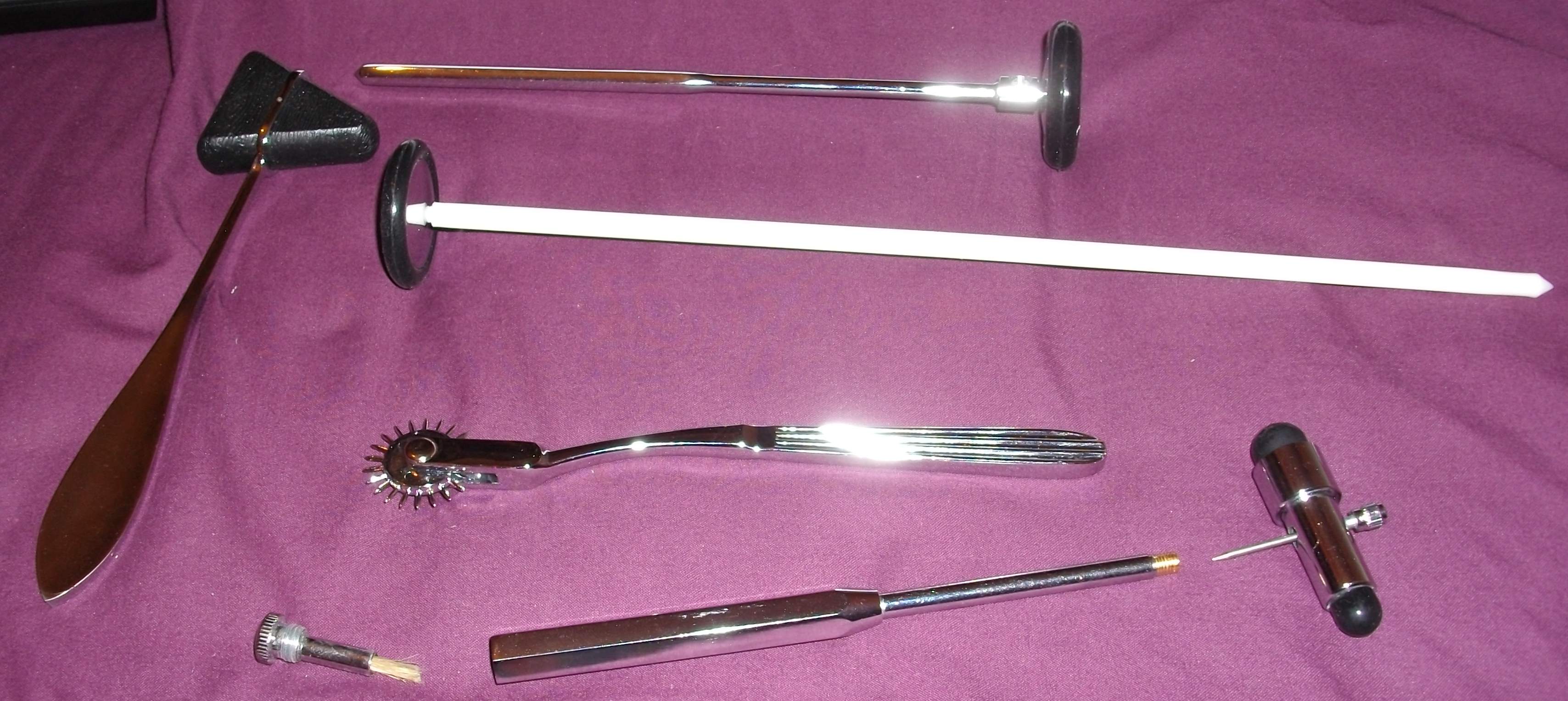 |
| Assorted neurological physical exam tools |
What I didn't realize when I picked the title of the blog was how exciting I would find neurology. The brain and spinal cord are composed of complicated neural pathways that each carry particular types of information. One part of the spinal cord carries sensory input about temperature. Another part of the spinal cord carries directions that go to muscles. Another part carries sensory input about proprioception, the position of the parts of the body in space. The pathways each travel a confusing and unique course, wending this way and that as they traverse the spinal cord and the regions of the brain.
When something goes wrong (for example, a patient loses the ability to look upwards), the neurologist must visualize the various neural pathways to reason through where the problem lies. Upon identifying the physical location of the lesion, he also must figure out what caused the lesion in the first place. Was it a stroke? A tumor? An infectious disease? Neurology has a reputation of being highly intellectual and of requiring studiousness, cleverness, organization, and careful thought. I think it suits my personality better than most fields.
As with most medical students, I am constantly testing the waters of different specialties to see which I like the most (and which I like the least). No longer will I reflexively rule neurology out.
22 July 2012
But that's crazy talk!
Part of our psychiatry class involves interviewing a psychiatric patient. We know nothing about the patient when we start the interview.
I joined two classmates in interviewing one such patient. One classmate went first, and for his 15 minutes he did a good job laying a foundation. He got an overview of the patient's life story, social history, and medical history. The patient struck us as a bit odd, but his answers seemed credible and he seemed to be an ordinary guy who had fallen on hard times.
Then it was my turn, and my job was to assess his psychiatric state. I quickly managed to open the floodgates. He revealed his delusions about being the son of god, that within a few months everyone's eye color would change, that he was adopted but that his birth family is profoundly wealthy and runs the American government. His story contradicted itself, showing that his thoughts were not only unhinged from reality but disorganized as well.
It took longer than I expected for us to uncover this patient's profound psychiatric disorder, even though we knew he was a psychiatric patient. First impressions can be deceiving.
I joined two classmates in interviewing one such patient. One classmate went first, and for his 15 minutes he did a good job laying a foundation. He got an overview of the patient's life story, social history, and medical history. The patient struck us as a bit odd, but his answers seemed credible and he seemed to be an ordinary guy who had fallen on hard times.
Then it was my turn, and my job was to assess his psychiatric state. I quickly managed to open the floodgates. He revealed his delusions about being the son of god, that within a few months everyone's eye color would change, that he was adopted but that his birth family is profoundly wealthy and runs the American government. His story contradicted itself, showing that his thoughts were not only unhinged from reality but disorganized as well.
It took longer than I expected for us to uncover this patient's profound psychiatric disorder, even though we knew he was a psychiatric patient. First impressions can be deceiving.
18 July 2012
Case in point
Wednesday is fast becoming my favorite day of the week, because it's the day when the New England Journal of Medicine (a prominent medical journal) releases its newest issue. I immediately look at the latest installment of "Case Records of the Massachusetts General Hospital." It is a write-up of an interesting medical case seen in Harvard's main teaching hospital.
"Case Records" has been published continuously since 1924, and I think it is one of the most effective ways of learning medicine. A detailed write-up of the patient's history is presented. Then, a physician comes up with a differential diagnosis, predicts what disease he thinks it is, and explains his reasoning. Finally, the true diagnosis and outcome of the case are revealed, and an expert explains to the reader the mechanism of the disease at hand.
Reading through a case is rather engaging. After reading the patient history, I try to guess the diagnosis and then compare my reasoning to the physician's. The thrill of untangling the mystery of each case makes me want to learn about the disease. That there's a real human story behind each case makes the cases stick in my memory. By my tally, I've completed about 70 cases thus far.
Unfortunately, the cases take up an inordinate amount of time. Each one takes me anywhere from twenty minutes to four hours, because I try to read pertinent chapters in my textbooks as I go along. Some of my buddies poke fun at how ridiculous I look when I review a case in the med school library--I occupy a whole table, with all kinds of random medical books splayed about. Despite my best efforts, I haven't succeeded in getting my classmates to share my enthusiasm. After all, time spent studying cases is time not spent studying what will be on the test. It's not immediately obvious how I benefit.
Sometimes I present a professor with a case and ask them to explain a part that I didn't fully grasp. A handful of them have broken into a smile and revealed to me that they, too, used to study "Case Records" in their spare time when they were medical students. Now when I sit in the library poring over a case, I feel connected to an invisible community of eager medical students who, over the decades, have stolen off to the library to perform this same ritual, learning for learning's sake.
"Case Records" has been published continuously since 1924, and I think it is one of the most effective ways of learning medicine. A detailed write-up of the patient's history is presented. Then, a physician comes up with a differential diagnosis, predicts what disease he thinks it is, and explains his reasoning. Finally, the true diagnosis and outcome of the case are revealed, and an expert explains to the reader the mechanism of the disease at hand.
Reading through a case is rather engaging. After reading the patient history, I try to guess the diagnosis and then compare my reasoning to the physician's. The thrill of untangling the mystery of each case makes me want to learn about the disease. That there's a real human story behind each case makes the cases stick in my memory. By my tally, I've completed about 70 cases thus far.
Unfortunately, the cases take up an inordinate amount of time. Each one takes me anywhere from twenty minutes to four hours, because I try to read pertinent chapters in my textbooks as I go along. Some of my buddies poke fun at how ridiculous I look when I review a case in the med school library--I occupy a whole table, with all kinds of random medical books splayed about. Despite my best efforts, I haven't succeeded in getting my classmates to share my enthusiasm. After all, time spent studying cases is time not spent studying what will be on the test. It's not immediately obvious how I benefit.
Sometimes I present a professor with a case and ask them to explain a part that I didn't fully grasp. A handful of them have broken into a smile and revealed to me that they, too, used to study "Case Records" in their spare time when they were medical students. Now when I sit in the library poring over a case, I feel connected to an invisible community of eager medical students who, over the decades, have stolen off to the library to perform this same ritual, learning for learning's sake.
15 July 2012
Harrison's Ch. 97: "Gynecologic Malignancies"
While I attempt to read the 397 chapters of Harrison's Principles of Internal Medicine, I am writing occasional reflections.
Cervical cancer is not so scary to Americans anymore because of the Pap smear. Pap smears are good at detecting pre-cancerous cervical cells, and over the past 50 years its widespread adoption has dramatically reduced cervical cancer diagnoses and deaths in the developed world. Unlike most cancers, cervical cancer is usually caused by a viral infection. Certain strains of the human papilloma virus (HPV) predispose cervical cells they infect to malignancy. Now that vaccination against some of these HPV strains is available in the U.S., we can expect the cervical cancer rate to drop even further. It is a triumph of preventive medicine.
These triumphs have barely helped the developing world, though. One of the most preventable forms of cancer still kills surprisingly many.
A handful of researchers are trying to help. Doctors in the U.S. sometimes apply vinegar (acetic acid) to the cervix so that they can visualize cervical cancer cells with the naked eye. The acid turns the cancer cells white. It seems that vinegar could be similarly used in the developing world as a low-cost replacement for the Pap smear. If the health worker sees white lesions, he can freeze them off with a simple metal rod cooled by liquid carbon dioxide.
I think it's incumbent upon us to translate our high-tech scientific advances into low-tech tools that can benefit all.
Cervical cancer is not so scary to Americans anymore because of the Pap smear. Pap smears are good at detecting pre-cancerous cervical cells, and over the past 50 years its widespread adoption has dramatically reduced cervical cancer diagnoses and deaths in the developed world. Unlike most cancers, cervical cancer is usually caused by a viral infection. Certain strains of the human papilloma virus (HPV) predispose cervical cells they infect to malignancy. Now that vaccination against some of these HPV strains is available in the U.S., we can expect the cervical cancer rate to drop even further. It is a triumph of preventive medicine.
These triumphs have barely helped the developing world, though. One of the most preventable forms of cancer still kills surprisingly many.
A handful of researchers are trying to help. Doctors in the U.S. sometimes apply vinegar (acetic acid) to the cervix so that they can visualize cervical cancer cells with the naked eye. The acid turns the cancer cells white. It seems that vinegar could be similarly used in the developing world as a low-cost replacement for the Pap smear. If the health worker sees white lesions, he can freeze them off with a simple metal rod cooled by liquid carbon dioxide.
I think it's incumbent upon us to translate our high-tech scientific advances into low-tech tools that can benefit all.
11 July 2012
When it rains, it pours
In 17th- and 18th-century England, milkmaids had a reputation for having pretty faces. This was because they rarely seemed to get smallpox, which left pockmarks on the skin of its survivors. Milkmaids did, however, catch from their cows a milder, related disease known as cowpox. English physician Edward Jenner famously hypothesized that the milkmaids' contracting cowpox made them immune to smallpox. Using this observation, he successfully created the first vaccine. This is where we get the word "vaccine": in Latin, vacca means "cow."
And so, having a disease (cowpox) sometimes protects you from another (smallpox). For example, getting oral herpes can sometimes offer slight protection against genital herpes. Although being born with no spleen (congenital asplenia) can cause problems, it does eliminate the chance of a ruptured spleen (which can be a life-threatening complication of a motor-vehicle accident).
Unfortunately, the opposite usually holds: most diseases simply invite more disease.
This used to depress me, but I've started seeing it differently. If I can diagnose a disease promptly and treat it appropriately, the patient will stand less of a risk of contracting the additional diseases that may follow. It's like a two-for-one.
And so, having a disease (cowpox) sometimes protects you from another (smallpox). For example, getting oral herpes can sometimes offer slight protection against genital herpes. Although being born with no spleen (congenital asplenia) can cause problems, it does eliminate the chance of a ruptured spleen (which can be a life-threatening complication of a motor-vehicle accident).
Unfortunately, the opposite usually holds: most diseases simply invite more disease.
- Myasthenia gravis is a disease of muscle weakness. Some patients have difficulty swallowing (dysphagia) and aspirate their food, leading to pneumonia.
- Untreated gonorrhea inflames the lining of the vagina in a way that makes a woman more susceptible to HIV infection.
- Hypertension, diabetes, tobacco use, and smoking all lead to a host of ills.
- Being in the hospital exposes patients to a whole host of nosocomial (hospital-acquired) infectious diseases, like C. difficile, a bacterium that causes persistent diarrhea.
- Autistic patients are more likely to have nutritional deficiencies because they tend to be picky eaters.
This used to depress me, but I've started seeing it differently. If I can diagnose a disease promptly and treat it appropriately, the patient will stand less of a risk of contracting the additional diseases that may follow. It's like a two-for-one.
Hypocrisy
New York City's mayor, Michael Bloomberg, has championed a proposal to ban the sale of sugary drinks larger than 16 ounces in regulated food establishments. Unsurprisingly, the beverage and movie theater industries are pushing back. From the New York Times City Room blog:
Robert Sunshine, a lobbyist for the movie theater industry in New York State, said that while his clients agreed that obesity was an epidemic, “we believe it should be handled through education.”
Oh really? Then what gives your clients the right to tell moviegoers that they can't talk on cell phones during films? Yeesh.“No one,” he added, “should be told what they can do and what they can’t do.”
08 July 2012
A happier kind of math
A patient I saw in free clinic was overdue for her breast and colon cancer screening, because she had lost her health insurance years ago. This is so commonplace that by now I am shocked when patients at our clinic are current on their screening. It's a shame, too, because cancer screening is one of the most effective health interventions we can provide a patient population. For example, by undergoing regular Pap smears, women increase their life expectancy by 2 to 3 months. Then again, since our patients are uninsured, few of them could manage to receive treatment if a screening test came back positive.
As for my patient, our clinic doesn't perform mammograms, which are the standard screening test for breast cancer. That left the doctor and me in the familiar position of estimating whether our patient should spend her own money on a mammogram at an outside clinic. On the one hand, our patient said she was short on cash. On the other hand, she had a family history that placed her at substantially higher risk of breast cancer. Had enough time elapsed since her last test to justify the expense of a new mammogram? We decided, probably not. It's a grim calculus, the sort of mathematics that I hate having to perform.
Yet this week, the discussion was different. The question was whether our patient could hold off until 2014, when the remaining provisions of President Obama's Affordable Care Act (ACA) take effect. Under the ACA, our patient's cancer screening will be fully covered. She won't even be charged a co-pay. I don't think I've ever finished a day in clinic feeling so optimistic.
Medical school has introduced me to patients in desperate straits. One of my first patients appeared to have a hormone-secreting tumor that had set her body's electrolyte balance awry. Surgically removing the tumor probably would have cured her. But she couldn't afford it. She couldn't even afford the imaging study that would have confirmed the presence of the tumor. Instead, when I had seen her, her electrolyte levels were so skewed as to be nearly incompatible with life. By now she is probably dead. I couldn't help but ask myself: why must this be?
I used to talk about "the uninsured" as an abstraction. Now I examine them in the exam room, and I am increasingly entrusted with their care. They are people, just like you and me. Their hearts beat and their stomachs growl. I feel responsible for them. I want to see them lead happy lives.
My recent experience in clinic was the moment when it truly sunk in: many of the uninsured patients I see are entering a new era. It won't be a perfect era. But it will be an era where I'll get to perform a happier kind of math.
Update: A classmate informs me that, thanks to a grant, a nearby clinic will perform patients' mammograms for free of charge.
As for my patient, our clinic doesn't perform mammograms, which are the standard screening test for breast cancer. That left the doctor and me in the familiar position of estimating whether our patient should spend her own money on a mammogram at an outside clinic. On the one hand, our patient said she was short on cash. On the other hand, she had a family history that placed her at substantially higher risk of breast cancer. Had enough time elapsed since her last test to justify the expense of a new mammogram? We decided, probably not. It's a grim calculus, the sort of mathematics that I hate having to perform.
Yet this week, the discussion was different. The question was whether our patient could hold off until 2014, when the remaining provisions of President Obama's Affordable Care Act (ACA) take effect. Under the ACA, our patient's cancer screening will be fully covered. She won't even be charged a co-pay. I don't think I've ever finished a day in clinic feeling so optimistic.
Medical school has introduced me to patients in desperate straits. One of my first patients appeared to have a hormone-secreting tumor that had set her body's electrolyte balance awry. Surgically removing the tumor probably would have cured her. But she couldn't afford it. She couldn't even afford the imaging study that would have confirmed the presence of the tumor. Instead, when I had seen her, her electrolyte levels were so skewed as to be nearly incompatible with life. By now she is probably dead. I couldn't help but ask myself: why must this be?
I used to talk about "the uninsured" as an abstraction. Now I examine them in the exam room, and I am increasingly entrusted with their care. They are people, just like you and me. Their hearts beat and their stomachs growl. I feel responsible for them. I want to see them lead happy lives.
My recent experience in clinic was the moment when it truly sunk in: many of the uninsured patients I see are entering a new era. It won't be a perfect era. But it will be an era where I'll get to perform a happier kind of math.
Update: A classmate informs me that, thanks to a grant, a nearby clinic will perform patients' mammograms for free of charge.
04 July 2012
Getting the patient on board
I spent
several weeks seeing patients in an internal medicine clinic. Often the diagnosis and treatment were obvious, and the challenge was
motivating the patients to take their medications and keep a healthy
lifestyle. How could this be accomplished?
Interestingly enough, the patient interview can be used to encourage the patient to change their behavior for the better. "Motivational interviewing" involves structuring questions in a way that encourages the patient to alter their behavior for the better. If a patient smokes, I ask them if they have ever tried to quit. If they say yes (and nearly all of them do), I ask them why they had felt motivated to quit at the time. My follow-up question is whether the reasons they had back then still apply today. I might also ask the patient what their first step would be if they were to try quitting again. This line of questioning makes the patient more prepared to attempt to quit once more. Motivational interviewing is more pleasant and effective than simply admonishing patients that they need to stop smoking. [As a side note, the same concept underlies the contemptible practice of "push polling."]
During my interview, I like chatting to patients about their job, their hobbies, their kids, and their travels. Not only is it fun to get to know them, but it usually tells me things that I can later use to encourage them to adhere to their treatment plan.
One patient was the star running back of his high school football squad. For reasons that his doctor wasn't able to determine, his blood pressure was quite high. The high blood pressure had persisted for years, because the patient didn't feel like taking his blood pressure medications. He is hardly alone. It's particularly difficult to convince people to take their blood pressure medication. The side effects from the pills are immediate, but the injuries caused by high blood pressure often take decades to manifest. Most patients prefer feeling better now to the vague promise of feeling better later. How could the doctor convince this teenager to take his medication? Some chatting revealed an answer. The patient was angling to get a scholarship to a top football program. The doctor pointed out that until the patient brought his blood pressure under control, he would fail the medical clearances necessary for recruitment. Problem solved.
A diabetic teenager seen in clinic stubbornly refused to control his blood sugar. His girlfriend was with him in the exam room. The doctor casually mentioned that diabetes causes vascular problems that can disrupt several body parts: the kidneys, the toes, the penis, the retina, the fingers. The patient turned white as a sheet. "What happens to people's penises?" the patient asked. After the doctor discussed erectile dysfunction, the patient became much more keen on learning how to use his insulin.
The effective primary-care doctor apparently has to be something of a salesman.
Interestingly enough, the patient interview can be used to encourage the patient to change their behavior for the better. "Motivational interviewing" involves structuring questions in a way that encourages the patient to alter their behavior for the better. If a patient smokes, I ask them if they have ever tried to quit. If they say yes (and nearly all of them do), I ask them why they had felt motivated to quit at the time. My follow-up question is whether the reasons they had back then still apply today. I might also ask the patient what their first step would be if they were to try quitting again. This line of questioning makes the patient more prepared to attempt to quit once more. Motivational interviewing is more pleasant and effective than simply admonishing patients that they need to stop smoking. [As a side note, the same concept underlies the contemptible practice of "push polling."]
During my interview, I like chatting to patients about their job, their hobbies, their kids, and their travels. Not only is it fun to get to know them, but it usually tells me things that I can later use to encourage them to adhere to their treatment plan.
One patient was the star running back of his high school football squad. For reasons that his doctor wasn't able to determine, his blood pressure was quite high. The high blood pressure had persisted for years, because the patient didn't feel like taking his blood pressure medications. He is hardly alone. It's particularly difficult to convince people to take their blood pressure medication. The side effects from the pills are immediate, but the injuries caused by high blood pressure often take decades to manifest. Most patients prefer feeling better now to the vague promise of feeling better later. How could the doctor convince this teenager to take his medication? Some chatting revealed an answer. The patient was angling to get a scholarship to a top football program. The doctor pointed out that until the patient brought his blood pressure under control, he would fail the medical clearances necessary for recruitment. Problem solved.
A diabetic teenager seen in clinic stubbornly refused to control his blood sugar. His girlfriend was with him in the exam room. The doctor casually mentioned that diabetes causes vascular problems that can disrupt several body parts: the kidneys, the toes, the penis, the retina, the fingers. The patient turned white as a sheet. "What happens to people's penises?" the patient asked. After the doctor discussed erectile dysfunction, the patient became much more keen on learning how to use his insulin.
The effective primary-care doctor apparently has to be something of a salesman.
01 July 2012
Blocked thought
Years ago, I spotted an acquaintance I hadn't seen in a while. The conversation was odd. A few times, I would ask a question and he would begin to respond, only to trail off into silence and stare blankly into space. He would remain frozen until the moment I said something else, whereupon he would act normally. He seemed completely oblivious to the fact that he had trailed off and had never answered my question. Indeed, he didn't seem to remember that I had asked him a question at all.
These episodes felt interminable--in one instance I waited a good 30 seconds before catching his attention and changing the subject. I wondered for how many minutes he would have remained "paused" if I had never said anything.
I had forgotten this conversation until I came across a passage in our psychiatry textbook describing this exact phenomenon. It is called "thought blocking," and many patients who have it are schizophrenic. Intrigued, I asked a psychiatry professor about it (one of the perks of being in medical school). He told me that blocking sometimes happens because a hallucination distracts the patient. It also can be because certain impulses in the brain fail to arrive at their proper destinations. For example, one part of the brain is responsible for keeping the brain focused on certain tasks, like tying a knot to completion or answering a question in a conversation. This part of the brain might have had a faulty neural connection with the regions of the brain responsible for formulating and vocalizing the answer to my question. It's fascinating.
Currently in anatomy class, we are dissecting the brain. It is not a particularly large organ (perhaps it's the size of a cantaloupe?), nor is it terribly heavy (about three pounds). Yet it contains everything that makes us human. This pink blob is not only what makes us see and breathe, but also what underlies envy and love, music and literature, war and civilization. Discovering new things about the brain makes it all the more inscrutable: how is it that two almond-sized regions of the brain contain our most visceral emotions and fears? It's baffling. One of my textbooks points out that the number of neuron cells in one's brain approximates the number of stars in the Milky Way.
Wonderment at the splendor of the human brain goes back as far as Plato. Yet today, not only do we understand much more about the human brain, but the rate at which we are unlocking the mysteries of the mind continues to accelerate.
I often dwell on the sacrifices that medical school entails--financial, social, personal, relational, and emotional. But, we get to study the brain. We even get to marvel at it by picking it up and holding it in our own hands. It reminds me yet again that this enterprise of becoming a physician is a rare privilege.
These episodes felt interminable--in one instance I waited a good 30 seconds before catching his attention and changing the subject. I wondered for how many minutes he would have remained "paused" if I had never said anything.
I had forgotten this conversation until I came across a passage in our psychiatry textbook describing this exact phenomenon. It is called "thought blocking," and many patients who have it are schizophrenic. Intrigued, I asked a psychiatry professor about it (one of the perks of being in medical school). He told me that blocking sometimes happens because a hallucination distracts the patient. It also can be because certain impulses in the brain fail to arrive at their proper destinations. For example, one part of the brain is responsible for keeping the brain focused on certain tasks, like tying a knot to completion or answering a question in a conversation. This part of the brain might have had a faulty neural connection with the regions of the brain responsible for formulating and vocalizing the answer to my question. It's fascinating.
Currently in anatomy class, we are dissecting the brain. It is not a particularly large organ (perhaps it's the size of a cantaloupe?), nor is it terribly heavy (about three pounds). Yet it contains everything that makes us human. This pink blob is not only what makes us see and breathe, but also what underlies envy and love, music and literature, war and civilization. Discovering new things about the brain makes it all the more inscrutable: how is it that two almond-sized regions of the brain contain our most visceral emotions and fears? It's baffling. One of my textbooks points out that the number of neuron cells in one's brain approximates the number of stars in the Milky Way.
Wonderment at the splendor of the human brain goes back as far as Plato. Yet today, not only do we understand much more about the human brain, but the rate at which we are unlocking the mysteries of the mind continues to accelerate.
I often dwell on the sacrifices that medical school entails--financial, social, personal, relational, and emotional. But, we get to study the brain. We even get to marvel at it by picking it up and holding it in our own hands. It reminds me yet again that this enterprise of becoming a physician is a rare privilege.
28 June 2012
Victory lap
Paul Krugman reminds us who the real winners are of today's Supreme Court decision: Americans.
Supreme court decision
What would have happened if the Supreme Court had struck down the health insurance mandate as unconstitutional? It would have set universal health care, in any form, back by decades.
It's been heart-breaking seeing patients whose lack of health insurance prevents them from getting the sometimes life-saving treatment they need. Everyone deserves health care. I'm elated that the Supreme Court stayed on the correct side of history.
It's been heart-breaking seeing patients whose lack of health insurance prevents them from getting the sometimes life-saving treatment they need. Everyone deserves health care. I'm elated that the Supreme Court stayed on the correct side of history.
27 June 2012
As goes dentistry, so goes medicine?
Frontline, my favorite television program, just aired an enlightening and dismaying hour-long documentary on America's broken dental safety net. It focuses on the poor's lack of access to quality dental care, as well as the proliferation of for-profit dentistry chains that sometimes derive revenue through shoddy work, unethical billing, and predatory lending.
It is strange seeing how the frightening changes described in the documentary are also manifesting themselves in American medical practice. Solo medical practices are becoming unprofitable, and in their stead are large health-care conglomerates that are often focused on their bottom line. Similarly to dentists, physicians feel threatened by the rise of so-called "mid-level providers," the physician assistants and nurses that are being granted increasingly wide scopes of practice. Not that these changes are unique to America: I recently read Nobel Laureate Alexander Solzhenitsyn's Cancer Ward, a semi-autobiographical novel set in a Soviet hospital. Although written 50 years ago, the doctors' complaints of the erosion of professional standards and the demise of the solo practice would just as easily apply to this country today.
The Frontline documentary portrays a badly-broken dental system, which causes grievous harm to children and adults and which has no clear solution on the horizon. As much as I'm partial to my profession, I have to wonder, is medicine today so different? And is medicine immune to the pressures bearing upon the dental profession?
On a side note, medical students find it easy to get jealous of dental students. Dental students can practice general dentistry after completing four years of dental school, whereas medical students must undergo additional training. Also, being a general dentist today is generally more lucrative than being a primary-care physician, especially because HMOs haven't completely taken over the dental field. Dentistry is an important medical field, as the documentary clearly demonstrates. Even so, I'm happy to be in a profession that permits me to focus on almost any part of the body.
It is strange seeing how the frightening changes described in the documentary are also manifesting themselves in American medical practice. Solo medical practices are becoming unprofitable, and in their stead are large health-care conglomerates that are often focused on their bottom line. Similarly to dentists, physicians feel threatened by the rise of so-called "mid-level providers," the physician assistants and nurses that are being granted increasingly wide scopes of practice. Not that these changes are unique to America: I recently read Nobel Laureate Alexander Solzhenitsyn's Cancer Ward, a semi-autobiographical novel set in a Soviet hospital. Although written 50 years ago, the doctors' complaints of the erosion of professional standards and the demise of the solo practice would just as easily apply to this country today.
The Frontline documentary portrays a badly-broken dental system, which causes grievous harm to children and adults and which has no clear solution on the horizon. As much as I'm partial to my profession, I have to wonder, is medicine today so different? And is medicine immune to the pressures bearing upon the dental profession?
On a side note, medical students find it easy to get jealous of dental students. Dental students can practice general dentistry after completing four years of dental school, whereas medical students must undergo additional training. Also, being a general dentist today is generally more lucrative than being a primary-care physician, especially because HMOs haven't completely taken over the dental field. Dentistry is an important medical field, as the documentary clearly demonstrates. Even so, I'm happy to be in a profession that permits me to focus on almost any part of the body.
24 June 2012
Smoking gun
Watching actors smoking cigarettes on screen makes young viewers more likely to smoke. The tobacco industry has known this maxim for quite a while, and decades ago they offered free lifetime supplies of cigarettes to actors and actresses.
Although tobacco companies are no longer allowed to expressly pay for product placement in American films, smoking still appears in a number of current movies. Movie studios claim that they need to be allowed to show smoking, in part so that they can maintain the historical accuracy of films set in the past. For example, the Oscar-winner "The Artist" is full of characters puffing away.
If studios cared about historical accuracy, they ought to also incorporate other elements into films set in the 1920s:
Although tobacco companies are no longer allowed to expressly pay for product placement in American films, smoking still appears in a number of current movies. Movie studios claim that they need to be allowed to show smoking, in part so that they can maintain the historical accuracy of films set in the past. For example, the Oscar-winner "The Artist" is full of characters puffing away.
If studios cared about historical accuracy, they ought to also incorporate other elements into films set in the 1920s:
-People were shorter than today, because nutrition was not as good. Hire shorter actors.Movie studios are selective about what they choose to include when they portray historical periods. I'm not sure why cigarettes should be so sacred.
-Orthodontia didn't really exist. Only hire actors with crooked teeth.
-Dentifrice (toothpaste) didn't whiten as effectively as today. Only hire actors with yellowed teeth.
20 June 2012
When politics and medicine mix
The C.I.A. hired a Pakistani physician, Dr. Shakil Afridi, to run a 2011 hepatitis B vaccination campaign in the Pakistani city of Abbottabad. The vaccination campaign was a front to investigate the Abbottabad residence where Osama bin Laden was thought to be hiding, and for Dr. Afridi to obtain DNA samples from the house's residents. Although Dr. Afridi did not manage to collect a DNA sample, his observations from visiting the house helped confirm that the house was bin Laden's. (In what appeared to be a politically-motivated verdict, the Pakistani government recently sentenced Dr. Afridi to 33 years in prison.)
Although the phony vaccination campaign helped kill bin Laden, it badly undermined the credibility of global health efforts. The New York Times reports that the Taliban is forbidding polio vaccinations in a Pakistani province that is one of the only remaining regions in the world where polio is endemic:
This is awful news. Polio kills and paralyzes. The global community had
gotten tantalizingly close to eradicating polio, convincing even those countries that feared ulterior motives to get on board. Vaccination drives have always attempted to separate themselves from wars and politics. During the successful smallpox eradication drive, some warring African nations even held ceasefires so that aid workers could vaccinate communities.
The C.I.A. program has ruined the credibility of vaccination drives, or at the very least has given cover to those who would use their participation in vaccination efforts as a bargaining chip. So long as North Waziristan refuses to vaccinate, it seems to me that polio cannot be eradicated.
There is a reason why the practice of medicine is supposed to be insulated from politics. In attempting to kill a terrorist, the C.I.A. violated this profession's core ethics and helped perpetuate another terror's reign.
See also a worthy New York Times news article about the ongoing impacts to international aid efforts stemming from the phony C.I.A. vaccination program.
Although the phony vaccination campaign helped kill bin Laden, it badly undermined the credibility of global health efforts. The New York Times reports that the Taliban is forbidding polio vaccinations in a Pakistani province that is one of the only remaining regions in the world where polio is endemic:
A Pakistani Taliban commander has banned polio vaccinations in North Waziristan, in the tribal belt, days before 161,000 children were to be inoculated. He linked the ban to American drone strikes and fears that the C.I.A. could use the polio campaign as cover for espionage, much as it did with Shakil Afridi, the Pakistani doctor who helped track Osama bin Laden.
The C.I.A. program has ruined the credibility of vaccination drives, or at the very least has given cover to those who would use their participation in vaccination efforts as a bargaining chip. So long as North Waziristan refuses to vaccinate, it seems to me that polio cannot be eradicated.
There is a reason why the practice of medicine is supposed to be insulated from politics. In attempting to kill a terrorist, the C.I.A. violated this profession's core ethics and helped perpetuate another terror's reign.
See also a worthy New York Times news article about the ongoing impacts to international aid efforts stemming from the phony C.I.A. vaccination program.
17 June 2012
Medicine by-the-book
I saw a patient who had injured his knee. I performed a handful of physical exam tests that I was familiar with: pulling on his leg to check the integrity of the anterior cruciate ligament (ACL), twisting his joint in a particular way to check some other ligaments known as the collateral ligaments. Still, I wasn't sure of a diagnosis. There were a handful of other tests that I wanted to perform which I had never done before. I didn't remember how they were done, and I didn't want to guess for fear of injuring the patient. So, with the patient in the room, I pulled out Sapira's, my gem of a physical exam textbook, and read for a bit of its section on the knee. Thanks to the exams it described, I was quickly able to pinpoint his injury to the posterior horn of his medial meniscus, without needing to take an X-ray or an MRI.
The patient seemed fine with my consulting a textbook mid-examination. "After all, you're just a student," he had said. But it felt uncomfortable. Bringing out the book was a tacit acknowledgment that I am falliable, that I don't know everything I need if I'm to help the patient. Most primary-care doctors I shadow excuse themselves from the room when they want to look something up. They don't mention to the patient that they're consulting other sources. For that matter, most primary-care doctors rarely consult outside sources when assessing and treating patients.
Should it be such a bad thing to consult a textbook with the patient present? Using a textbook conveys humility and demonstrates that the doctor cares. Double-checking against the textbook helps the doctor confirm that they're providing the most up-to-date and appropriate care.
I'm not sure that that's how patients feel, though. Patients want their doctors to be smarter than their textbooks. I'm willing to concede that, in some respects, the textbook knows more.
The patient seemed fine with my consulting a textbook mid-examination. "After all, you're just a student," he had said. But it felt uncomfortable. Bringing out the book was a tacit acknowledgment that I am falliable, that I don't know everything I need if I'm to help the patient. Most primary-care doctors I shadow excuse themselves from the room when they want to look something up. They don't mention to the patient that they're consulting other sources. For that matter, most primary-care doctors rarely consult outside sources when assessing and treating patients.
Should it be such a bad thing to consult a textbook with the patient present? Using a textbook conveys humility and demonstrates that the doctor cares. Double-checking against the textbook helps the doctor confirm that they're providing the most up-to-date and appropriate care.
I'm not sure that that's how patients feel, though. Patients want their doctors to be smarter than their textbooks. I'm willing to concede that, in some respects, the textbook knows more.
13 June 2012
A legal action
A patient came in because he was litigating a worker's compensation complaint and hoped his physician would support his case. Everything bad that had happened in his life over the past few years he attributed to an injury to a limb that he claimed he had suffered on the job.
The examination was quite uncomfortable for me, because the patient actively tried to sell me on just how injured he was. Things became adversarial at times: he asked me if I doubted that the injury was the only explanation for his medical problems. When I touched the affected extremity, the patient cowered in pain and admonished me. The affected extremity did look abnormal. Then again, he had stopped using it since the injury. When a part of the body isn't used, it atrophies, distorting the anatomical structures and its appearance.
Was he exaggerating his pain to sell me on his legal battle? Was his pain in part psychological, brought on by the perceived injustice of having suffered an injury on the job? To what extent was the original injury responsible for the pain, and to what extent was it due to atrophy after the patient decided to stop using it? Was this a rare pain disorder? Was this all an invention by the patient, in a nefarious bid to collect disability and retire early?
This was not the fun kind of medicine, especially because I was more referee than healer. Some physicians specialize in workers' compensation cases, and serving as an expert witness in legal cases pays quite well. It's not what I came into medicine for, though, and this case made me quickly decide that this type of medical practice is not for me.
The examination was quite uncomfortable for me, because the patient actively tried to sell me on just how injured he was. Things became adversarial at times: he asked me if I doubted that the injury was the only explanation for his medical problems. When I touched the affected extremity, the patient cowered in pain and admonished me. The affected extremity did look abnormal. Then again, he had stopped using it since the injury. When a part of the body isn't used, it atrophies, distorting the anatomical structures and its appearance.
Was he exaggerating his pain to sell me on his legal battle? Was his pain in part psychological, brought on by the perceived injustice of having suffered an injury on the job? To what extent was the original injury responsible for the pain, and to what extent was it due to atrophy after the patient decided to stop using it? Was this a rare pain disorder? Was this all an invention by the patient, in a nefarious bid to collect disability and retire early?
This was not the fun kind of medicine, especially because I was more referee than healer. Some physicians specialize in workers' compensation cases, and serving as an expert witness in legal cases pays quite well. It's not what I came into medicine for, though, and this case made me quickly decide that this type of medical practice is not for me.
10 June 2012
Patient follow-up
A patient came in complaining of a cough, shoulder pain, and vertigo. She was having difficulty walking and sitting up straight. I took some of the patient's history, and she complained how the last doctor refused to give her cough syrup with codeine, which is a heavily-regulated mild narcotic.
Although she was a bit dramatic and rubbed the doctor and me slightly the wrong way, her story seemed credible. The doctor prescribed her the codeine and wrote a note excusing her from work.
An hour later, I took my lunch break and walked to a restaurant a few blocks away. There, I spotted the patient (without her seeing me). She looked like a new person, ambling about in no apparent distress.
Long before I started my medical school applications, I knew that as an aspiring physician I would encounter lots of drug seekers. I did not expect the extent to which they would dim my view of humanity. No one likes feeling that they've been had. Drug seekers undermine the doctor-patient relationship, and they make doctors less likely to prescribe pain medication to those who truly need them.
Although she was a bit dramatic and rubbed the doctor and me slightly the wrong way, her story seemed credible. The doctor prescribed her the codeine and wrote a note excusing her from work.
An hour later, I took my lunch break and walked to a restaurant a few blocks away. There, I spotted the patient (without her seeing me). She looked like a new person, ambling about in no apparent distress.
Long before I started my medical school applications, I knew that as an aspiring physician I would encounter lots of drug seekers. I did not expect the extent to which they would dim my view of humanity. No one likes feeling that they've been had. Drug seekers undermine the doctor-patient relationship, and they make doctors less likely to prescribe pain medication to those who truly need them.
06 June 2012
Harrison's Ch. 148: "Pertussis and Other Bordetella Infections"
While I read the 397 chapters of Harrison's Principles of Internal Medicine, I am writing reflections.
From Chapter 148:
In two weeks, I examined two patients who I was rather certain had pertussis. They had recently begun having coughing fits lasting several minutes. Their lungs sounded clear, and neither was feverish. The fits were so severe that it kept them up at night, and sometimes the force of the coughing fits made them vomit. This last feature, known as post-tussive emesis (literally, vomiting after coughing), is a trademark of pertussis. Whooping cough wasn't a perfect fit--both patients had been vaccinated against pertussis, and neither could recall being exposed to someone with the illness. But nothing else seemed to fit very well, either
We obtained a nasal swab from both patients and sent it to the lab. Both times, the test came back negative! This was quite aggravating. Did I go wrong somewhere?
It's important to note that no test is perfect. This particular test for pertussis has a 90% sensitivity, meaning that only 90% patients with pertussis would have a positive result. Still, this means that the likelihood of two patients having pertussis both getting negative test results is only 1%.
Maybe the specimens weren't collected properly? I reviewed the CDC's guidelines. I hadn't left the swab in one patient's nose for as long as recommended. The swabs weren't refrigerated during transport, which could have potentially caused problems. But even these potential missteps don't seem like they would change the tests' outcome by much.
So was it pertussis? Was it another disease that I didn't think of? Were my textbooks wrong?
These are not just philosophical questions. When a patient has pertussis, not only are they given heavy-duty antibiotics, but so is everyone living in their household. The antibiotics have side effects and can breed resistance. Proper treatment here requires knowing the probability that a patient has the disease.
Medicine is full of ambiguities. I don't know what my patients had, and therefore, I don't know whether the treatment helped them or made things worse. In most cases, I have to learn to be OK with that.
From Chapter 148:
Pertussis is an acute infection of the respiratory tract caused by Bordetella pertussis. The name pertussis means "violent cough," which aptly describes the most consistent and prominent feature of the illness. The inspiratory sound made at the end of an episode of paroxysmal coughing gives rise to the common name for the illness, "whooping cough."...The Chinese name for pertussis is "the 100-day cough," which accurately describes the clinical course of the illness.
In two weeks, I examined two patients who I was rather certain had pertussis. They had recently begun having coughing fits lasting several minutes. Their lungs sounded clear, and neither was feverish. The fits were so severe that it kept them up at night, and sometimes the force of the coughing fits made them vomit. This last feature, known as post-tussive emesis (literally, vomiting after coughing), is a trademark of pertussis. Whooping cough wasn't a perfect fit--both patients had been vaccinated against pertussis, and neither could recall being exposed to someone with the illness. But nothing else seemed to fit very well, either
We obtained a nasal swab from both patients and sent it to the lab. Both times, the test came back negative! This was quite aggravating. Did I go wrong somewhere?
It's important to note that no test is perfect. This particular test for pertussis has a 90% sensitivity, meaning that only 90% patients with pertussis would have a positive result. Still, this means that the likelihood of two patients having pertussis both getting negative test results is only 1%.
Maybe the specimens weren't collected properly? I reviewed the CDC's guidelines. I hadn't left the swab in one patient's nose for as long as recommended. The swabs weren't refrigerated during transport, which could have potentially caused problems. But even these potential missteps don't seem like they would change the tests' outcome by much.
So was it pertussis? Was it another disease that I didn't think of? Were my textbooks wrong?
These are not just philosophical questions. When a patient has pertussis, not only are they given heavy-duty antibiotics, but so is everyone living in their household. The antibiotics have side effects and can breed resistance. Proper treatment here requires knowing the probability that a patient has the disease.
Medicine is full of ambiguities. I don't know what my patients had, and therefore, I don't know whether the treatment helped them or made things worse. In most cases, I have to learn to be OK with that.
03 June 2012
What's in a name?
Such a variety of diseases bring patients in to see their doctor that I find it quite significant when I see two patients with the same disease. Recently, I've seen two patients with inflammation of the eyelids, or blepharitis. What makes blepharitis so fun is not just its zany name but the zany names used to further describe it.
Blepharitis can manifest as an infection of the glands of Moll or the glands of Zeis, which are the sebaceous (oil-secreting) glands located at the margin of the eyelid. Such an infection is called a stye, or hordeolum. Blepharitis can also lead to the formation of a cyst in the eyelid, known as a chalazion. The reason is chronic inflammation of the meibomian gland.
These words seem more appropriate in a Dr. Seuss book than in a medical textbook. Then again, now that Dartmouth's medical school is named after Dr. Seuss, the two might no longer be so distinct.
Blepharitis can manifest as an infection of the glands of Moll or the glands of Zeis, which are the sebaceous (oil-secreting) glands located at the margin of the eyelid. Such an infection is called a stye, or hordeolum. Blepharitis can also lead to the formation of a cyst in the eyelid, known as a chalazion. The reason is chronic inflammation of the meibomian gland.
These words seem more appropriate in a Dr. Seuss book than in a medical textbook. Then again, now that Dartmouth's medical school is named after Dr. Seuss, the two might no longer be so distinct.
30 May 2012
In memoriam
I recently learned the sorry news that my childhood pediatrician has died. Not only was he my pediatrician, but he was also my father's pediatrician. Our family became rather close to him over the years.
He came from a different generation of doctors, one that made house calls, that served in wars abroad, and that learned how to diagnose patients in the days before MRIs and CT scans. Even though I was little while I was his patient, I clearly remember how much he relied upon the physical examination and upon instruments like the reflex hammer and the tuning fork that few doctors carry today.
Most striking was his unwavering dedication to his patients. Although today's aspiring physicians (myself included) seek "work/life balance," his work pretty much was his life. Even on weekends and nights, he was working tirelessly for his patients, visiting his charges at home and in the hospital. To him, medicine was not a job, but truly a calling. Although old age forced him to give up his practice, it did not seem like he ever retired. I saw him frequently at the medical school's weekly pediatrics grand rounds, always sitting in the front row.
He was one of my main inspirations for wanting to become a physician. I grew up feeling indebted to him for having looked after me with such care, and it saddens me considerably for him to be gone. I hope to live up to his example, although I doubt I will come close to emulating his commitment to this profession. As my father remarked, "they don't make doctors like him anymore."
Although this past year of medical school, my first, has better acquainted me with illness and death, it hasn't taken any of the sting out of the loss of a loved one. Entering medicine has eased, though, the inevitable soul-searching that accompanies such sad news. In mourning, I ask myself, what is my purpose here on earth? How will I leave my mark? How can I best honor the memory of the deceased? It was my pediatrician who had first offered me some of the answers. Medicine can be a noble line of work, and by taking it seriously I hope to repay my debt to him and my obligation to humanity.
May he rest in peace.
He came from a different generation of doctors, one that made house calls, that served in wars abroad, and that learned how to diagnose patients in the days before MRIs and CT scans. Even though I was little while I was his patient, I clearly remember how much he relied upon the physical examination and upon instruments like the reflex hammer and the tuning fork that few doctors carry today.
Most striking was his unwavering dedication to his patients. Although today's aspiring physicians (myself included) seek "work/life balance," his work pretty much was his life. Even on weekends and nights, he was working tirelessly for his patients, visiting his charges at home and in the hospital. To him, medicine was not a job, but truly a calling. Although old age forced him to give up his practice, it did not seem like he ever retired. I saw him frequently at the medical school's weekly pediatrics grand rounds, always sitting in the front row.
He was one of my main inspirations for wanting to become a physician. I grew up feeling indebted to him for having looked after me with such care, and it saddens me considerably for him to be gone. I hope to live up to his example, although I doubt I will come close to emulating his commitment to this profession. As my father remarked, "they don't make doctors like him anymore."
Although this past year of medical school, my first, has better acquainted me with illness and death, it hasn't taken any of the sting out of the loss of a loved one. Entering medicine has eased, though, the inevitable soul-searching that accompanies such sad news. In mourning, I ask myself, what is my purpose here on earth? How will I leave my mark? How can I best honor the memory of the deceased? It was my pediatrician who had first offered me some of the answers. Medicine can be a noble line of work, and by taking it seriously I hope to repay my debt to him and my obligation to humanity.
May he rest in peace.
27 May 2012
Ain't that the truth?
It is unfortunate that one must be slightly skeptical of what patients say. Although the doctor-patient relationship is premised on mutual trust and truth-telling, some patients lie.
Mr. Williams came into clinic because he had lacerated his arm on a dirty, rusty metal fence. Dr. X and I were concerned about the risk of tetanus infection, which although potentially deadly is completely preventable through vaccination.
Ultimately, the doctor didn't pressure the patient into getting the tetanus shot. Telling the truth at the outset would have been the best policy.
Mr. Williams came into clinic because he had lacerated his arm on a dirty, rusty metal fence. Dr. X and I were concerned about the risk of tetanus infection, which although potentially deadly is completely preventable through vaccination.
Dr. X: Did you get a tetanus shot in the past five years?I didn't believe him and happened to have his chart in front of me.
Mr. Williams: Yeah, I'm covered. I got the tetanus shot last year.
Me: Dr. X, you might want to have someone check if there's a problem with your electronic medical record system! It doesn't show any record of Mr. Williams's having received any tetanus shots for at least the past 18 years--Although the lie was harmless, I found its brazenness upsetting. Everyone deserves medical care, but it is frustrating working to help those who do not take you seriously and who you cannot fully trust.
Mr. Williams: All right, I lied. I didn't get tetanus. I just hate getting shots.
Ultimately, the doctor didn't pressure the patient into getting the tetanus shot. Telling the truth at the outset would have been the best policy.
24 May 2012
The difficult conversation
A patient I examined had an unexpected, rapidly-progressive, and unquestionably-fatal disease that gave her perhaps weeks to live. A number of opportunistic diseases were ravaging her body because her
immune system was compromised by her treatment. The patient was weak and in great distress. Her medical problems were extensive and complex.
For whatever reason, the patient and her family had tried to avoid the gravity of the situation. The patient had not crafted an advanced directive. Although home help, assisted-mobility devices, hospice care, and psychotherapy would all have been helpful and appropriate, either they hadn't been offered or the patient had not taken advantage of them. The emotional strain and the difficulty of caring for someone so ill had taken a toll on the family. What were the goals of care for these last few weeks of this patient's life? I didn't know, and neither did the patient or the patient's family. The result was a rudderless ship whose addled crew was adrift at sea.
A difficult conversation needed to have taken place. A doctor needed to sit down with the patient and ask: do you want to be fed artificially, even if this will substantially prolong your pain and suffering? Will you sign on to hospice care, so that you can relieve some of the burden on your family? What do you hope to accomplish during these last precious days on earth, and how can we best assist you with those goals?
I decided that it was inappropriate for me to be the one to have that conversation. I was only an observer, and I knew little about the patient's history, disease, and prognosis. And yet, I joined the ranks of all the other medical providers that this patient had seen, each of them hoping that someone else would someday perform that delicate, sorrowful, yet necessary task of plotting the future with one whose days are numbered.
For whatever reason, the patient and her family had tried to avoid the gravity of the situation. The patient had not crafted an advanced directive. Although home help, assisted-mobility devices, hospice care, and psychotherapy would all have been helpful and appropriate, either they hadn't been offered or the patient had not taken advantage of them. The emotional strain and the difficulty of caring for someone so ill had taken a toll on the family. What were the goals of care for these last few weeks of this patient's life? I didn't know, and neither did the patient or the patient's family. The result was a rudderless ship whose addled crew was adrift at sea.
A difficult conversation needed to have taken place. A doctor needed to sit down with the patient and ask: do you want to be fed artificially, even if this will substantially prolong your pain and suffering? Will you sign on to hospice care, so that you can relieve some of the burden on your family? What do you hope to accomplish during these last precious days on earth, and how can we best assist you with those goals?
I decided that it was inappropriate for me to be the one to have that conversation. I was only an observer, and I knew little about the patient's history, disease, and prognosis. And yet, I joined the ranks of all the other medical providers that this patient had seen, each of them hoping that someone else would someday perform that delicate, sorrowful, yet necessary task of plotting the future with one whose days are numbered.
21 May 2012
Power of deduction
From one of my blog posts in October 2011:
Sapira's, my favorite book on physical diagnosis, reminds the reader that a clinician's examination of a patient begins the moment he opens the door to the exam room.
An English physician, Arthur Conan Doyle, was taken by the outstanding powers of observation of one of his professors, Dr. Joseph Bell. Doyle later became an author, and Bell became the basis for Doyle's celebrated detective, Sherlock Holmes.
While wrapping up an examination of a patient, I glanced into the exam room's
wastebasket. Inside were several paper towels that were dotted with blood. I
asked if the blood was the patient's (it was),
and what part of the body the blood was issuing from (the patient's nose). That the
patient had frequent, severe nosebleeds ended up being an important
finding when we crafted our treatment plan.
Perhaps "one man's trash is another man's treasure," after all.
Perhaps "one man's trash is another man's treasure," after all.
20 May 2012
Teaching
I had the opportunity to teach a large audience of pre-meds about the patient interview and about how to generate and hone a differential diagnosis. It is a blast looking back and seeing how much I've learned in the past year. I now feel familiar enough with some of the concepts of medical practice that I feel comfortable teaching others what I know.
The joy of getting in front of an audience, cracking jokes, and presenting my thoughts in a fun, interactive way reminds me that I would love to teach in some capacity once I finally become a physician. Teaching medicine seems just as exciting as practicing it.
The joy of getting in front of an audience, cracking jokes, and presenting my thoughts in a fun, interactive way reminds me that I would love to teach in some capacity once I finally become a physician. Teaching medicine seems just as exciting as practicing it.
18 May 2012
Waste
A phone bank I toured was staffed by several nurses. The nurses' job was to fulfill a legal obligation that an insurance provider placed on their corporation: to call certain patients annually, to ask them a lengthy set of questions, and then to generate a detailed health plan. The nurses estimated that they spent an average of half an hour on each patient. A medical assistant spent her days organizing databases that catalog these annual health plans. Much of her workload (such as removing the leading zeroes from medical record numbers) could have been automated with a simple computer script that would have taken me a couple of hours to write.
Once the detailed health plans were generated, who saw them? Because of a change in policy, almost no one. Most simply were filed away. A small number were sent to the patients' primary-care physicians, who usually ignored them.
Two thoughts:
1. How would you feel if you spent each day dutifully generating products that you knew that virtually no one will ever use?
2. 18% of our country's GDP goes towards health-care spending. This is shockingly and unsustainably high, especially considering how we haven't even insured all of our citizens. Our health care system is filled with inequities and inefficiencies, and I got to see this one tiny inefficiency close-up.
Once the detailed health plans were generated, who saw them? Because of a change in policy, almost no one. Most simply were filed away. A small number were sent to the patients' primary-care physicians, who usually ignored them.
Two thoughts:
1. How would you feel if you spent each day dutifully generating products that you knew that virtually no one will ever use?
2. 18% of our country's GDP goes towards health-care spending. This is shockingly and unsustainably high, especially considering how we haven't even insured all of our citizens. Our health care system is filled with inequities and inefficiencies, and I got to see this one tiny inefficiency close-up.
17 May 2012
Harrison's Ch. 80: "Involuntary Weight Loss"
Perhaps you watched the film "Julie and Julia"
a few years ago. It is partly about a blogger, Julie Powell, who spent a
year making every recipe in Julia Child's best-known cookbook.
I am doing something similar (albeit less tasty and less likely to be made into a feature film starring Meryl Streep). I am in the process of reading Harrison's Principles of Internal Medicine in its entirety. Harrison's is a dense, 3,600-page, two-volume tome that is the closest thing to a bible in clinical medicine. I am reflecting upon some of its chapters during the year or so it takes me to finish.
From Ch. 80 ("Involuntary Weight Loss"):
Involuntary weight loss (IWL) is frequently insidious and can have important implications, often serving as a harbinger of serious underlying disease. Clinically important weight loss is defined as the loss of 10 pounds (4.5 kg) or >5% of one's body weight over a period of 6–12 months. IWL is encountered in up to 8% of all adult outpatients and 27% of frail persons age 65 years and older. There is no identifiable cause in up to one-quarter of patients despite extensive investigation....Weight loss in older persons is associated with a variety of deleterious effects, including hip fracture, pressure ulcers, impaired immune function, decreased functional status, and death. Not surprisingly, significant weight loss is associated with increased mortality, which can range from 9% to as high as 38% within 1 to 2.5 years in the absence of clinical awareness and attention.
The patient seemed healthy enough. In her 60s, she had stopped smoking 10 years ago and loved doing aerobics. She was getting over a cold. Although she was being treated for hypertension, her blood pressure now was substantially below 120/80 (i.e. her blood pressure was not high).
The doctor asked her how she had managed to get her blood pressure so dramatically in check. "I've lost a lot of weight," she beamed. "I used to be overweight, but now I've really slimmed down."
"How did you manage that?"
"I dunno. Recently I haven't had much of an appetite." The doctor and I looked at the chart, and the woman had lost about 20% of her body weight over the past year. She had been slightly overweight before and her weight now was the low end of normal.
Upon seeing the numbers the doctor and I shuddered almost imperceptibly. While the patient thought her weight loss was good news, we felt the opposite. We now had to order a variety of lab tests and a chest X-ray, checking in particular for cancer. The doctor cautioned that if this initial battery of tests came back clean, he would have to order yet another panel of tests and imaging studies.
Lots of things can cause weight loss in the elderly, some of them deadly and some of them not. How hard should we be looking for the underlying cause? If we ordered every medical test known to man, we still might not have a clue of what was causing the weight loss.
Part of the art of medicine is deciding how far to pursue leads. How long should a doctor take the patient's history? How many tests should we order? How extensive should a surgery be? There are no clear answers, and part of the burden and challenge of being a medical provider is that it falls to them to make these impossible judgment calls.
15 May 2012
The spitting image
The two images on the left are from one of my textbooks. They are theoretical readouts from a spirometer, a simple yet important machine that measures how quickly air flows in and out of the lungs while the patient takes the deepest breath they can. At top left is a hypothetical normal patient; at bottom left is a hypothetical patient with obstructive lung disease (a common outcome of cigarette smoking). The diseased lungs are especially bad at exhalation.
Now for the part that fascinated me. Look at the readout on the right, from a patient in clinic today. Then look at the image at bottom left. Compare the outlines of both, as well as where the outlines reside on the x- and y-axes (you can ignore the noisy lines inside). Even without knowing a thing about pulmonology, you can see that they're virtually identical.
Even though each person is complex and unique, diseases can be consistent and predictable in the way they present. Today's case was one of these "textbook" examples.
Now for the part that fascinated me. Look at the readout on the right, from a patient in clinic today. Then look at the image at bottom left. Compare the outlines of both, as well as where the outlines reside on the x- and y-axes (you can ignore the noisy lines inside). Even without knowing a thing about pulmonology, you can see that they're virtually identical.


Even though each person is complex and unique, diseases can be consistent and predictable in the way they present. Today's case was one of these "textbook" examples.
14 May 2012
Harrison's Ch. 251: "Approach to the Patient with Disease of the Respiratory System"
Perhaps you watched the film "Julie and Julia"
a few years ago. It is partly about a blogger, Julie Powell, who spent a
year making every recipe in Julia Child's best-known cookbook.
I am doing something similar (albeit less tasty and less likely to be
made into a feature film starring Meryl Streep). I am in the process of reading Harrison's Principles of Internal Medicine in its entirety. Harrison's
is a dense, 3,600-page, two-volume tome that is the closest thing to a
bible in clinical medicine. I am reflecting upon some of its chapters during the year or so it takes me to finish.
Although I should have been asleep, last night I was determined to get through another chapter of Harrison's. On a whim, I read "Approach to the Patient with Disease of the Respiratory System." The chapter describes the mechanisms of certain respiratory illnesses and instructs the doctor in how to use physical examination techniques and diagnostic tests to inform his diagnosis.
In a stroke of good fortune, today I evaluated a patient with a nasty cough that began a week ago. It hurt when she breathed deeply. I suspected pneumonia and pleuritis (inflammation of the outer surface of the lung).
I took a lengthy history, and posed some questions that must the patient must have found strange. I asked for a domestic travel history, to rule out the endemic mycoses (three pneumonia-causing fungi found only in particular parts of the country). I asked for her history of international travel, to rule out tuberculosis. I asked if she had pets, to rule out psittacosis (a pneumonia-causing bacterium transmitted from birds).
Then I performed my physical examination, paying particular attention to the lungs. My leading diagnosis became even more specific: a bacterial pneumonia of the left lower lobe of the lung, with pleuritis. My calling which lobe of the lung was affected is a bit like a billiards player calling the pocket where he's going to send the 8-ball. My confidence stemmed partly from my having read the relevant section in Harrison's the night before.
We took a chest X-ray, and sure enough, my diagnosis was on the money.
It was a proud moment because it was a big milestone. I've seen many patients, and I've suggested many diagnoses, but never before have I been able to learn whether my diagnosis was ultimately correct. The number of diseases I'm familiar with grows by the day. My hunches are becoming more accurate, and I'm asking patients the right questions more often.
It's fun to compare how I feel about my skill level now to what I wrote just four months ago. Although I still am far from being a doctor, I'm definitely getting the hang of this.
Subscribe to:
Posts (Atom)