One evening years ago, I happened to be studying in the law library of one of the most prestigious law schools nationwide. I was dressed nicely. It was getting late, and the library was nearly empty.
Imagine my surprise, then, when an attractive sorority girl in heels and a rather short skirt plunked down next to me and struck up a conversation. She seemed keenly interested in anything I said. After flirting with me for a couple of minutes, she asked what I was reading.
"It's a textbook on evolutionary biology." I said. "It's fascinating stuff!"
"Huh," she replied. "Why is a law student reading about evolution?"
"Oh, I'm not a law student. I'm an undergrad."
Her disappointment was palpable. Moments later, she was gone.
Before plunging back into my textbook, I mused: what would have transpired just then had I actually been a law student?
Now, years later, I am a medical student. Although my status as a second-year medical student carries little cachet, occasionally it affects how a person interacts with me. A few months back, while traveling between clinics, I had to dart into a market while wearing my white coat. The girl working the checkout stand was my age and started chatting me up. She seemed to be taking a deliberately long time to ring up my order. Sometimes when I've rotated in clinics, members of the ancillary staff have pulled me aside. They have asked me a few times how old I am and even whether I'm single. Some mothers have tried to give me their daughters' cell phone numbers.
At some level, it is nice feeling wanted and appreciated. Yet it bothers me that what garners attention usually doesn't seem to be me or my personality, but simply my belonging to the medical profession. I feel like these interactions sometimes don't happen for the right reasons. It makes me more guarded and suspicious of people's intentions. Part of me prefers the anonymity of when I was nothing more than a wide-eyed undergrad.
Our professors warn us to be cognizant of romantic advances, especially in the clinical setting. An otolaryngologist (ear, nose, and throat doctor) recounted to me one of the first patients he saw as an attending physician. An attractive female patient had come in with an ear complaint. During his examination, she loosened her gown, exposing her breasts. He was dismayed and terrified. No chaperone was present and the patient's state of undress could have given the appearance of something unseemly. Interestingly, a psychiatrist advised us that certain personality disorders make patients particularly prone to pushing the boundary between doctor and patient.
I imagine that as I progress towards becoming an attending physician, the effect I've noticed will become more pronounced. Being a physician will make some people more inclined
to befriend me, and others less inclined to befriend me. Regardless, it will become increasingly difficult to dissociate my personal identity and my interpersonal relationships from my professional calling. Is this a good thing?
Medical school is dramatically altering the way I think and the way I perceive people. Perhaps it's only fair that it will alter the way some people see me, for better or for worse.
01 August 2012
28 July 2012
Landmarks
 |
| Median view of the brain (nose would be on the right) |
The brain is valuable real estate, its compact structures multifaceted and intricate. By necessity our maps of the brain are exquisitely detailed.
Admittedly, it is a chore to be learning several hundred unique structures of the brain: their functions, their interconnections, and their relative positions. But it also is fabulous traveling this well-trod ground. It reminds me of looking up at the night sky and rediscovering the constellations traced out by those of old.


25 July 2012
The reflex hammer
Perhaps the title of my blog will become a self-fulfilling prophecy.
I named my blog "The Reflex Hammer" as a nod to "The Lancet," a prominent British medical journal. Reflex hammers have always intrigued me. How is that the doctor tapping just below my knee causes my leg to swing out wildly? Although a humble instrument, the reflex hammer is so powerful that it briefly usurps a person's ability to control the movement of their own limbs. Because reflex hammers test the function of the nervous system, they are of particular importance to neurologists.
What I didn't realize when I picked the title of the blog was how exciting I would find neurology. The brain and spinal cord are composed of complicated neural pathways that each carry particular types of information. One part of the spinal cord carries sensory input about temperature. Another part of the spinal cord carries directions that go to muscles. Another part carries sensory input about proprioception, the position of the parts of the body in space. The pathways each travel a confusing and unique course, wending this way and that as they traverse the spinal cord and the regions of the brain.
When something goes wrong (for example, a patient loses the ability to look upwards), the neurologist must visualize the various neural pathways to reason through where the problem lies. Upon identifying the physical location of the lesion, he also must figure out what caused the lesion in the first place. Was it a stroke? A tumor? An infectious disease? Neurology has a reputation of being highly intellectual and of requiring studiousness, cleverness, organization, and careful thought. I think it suits my personality better than most fields.
As with most medical students, I am constantly testing the waters of different specialties to see which I like the most (and which I like the least). No longer will I reflexively rule neurology out.
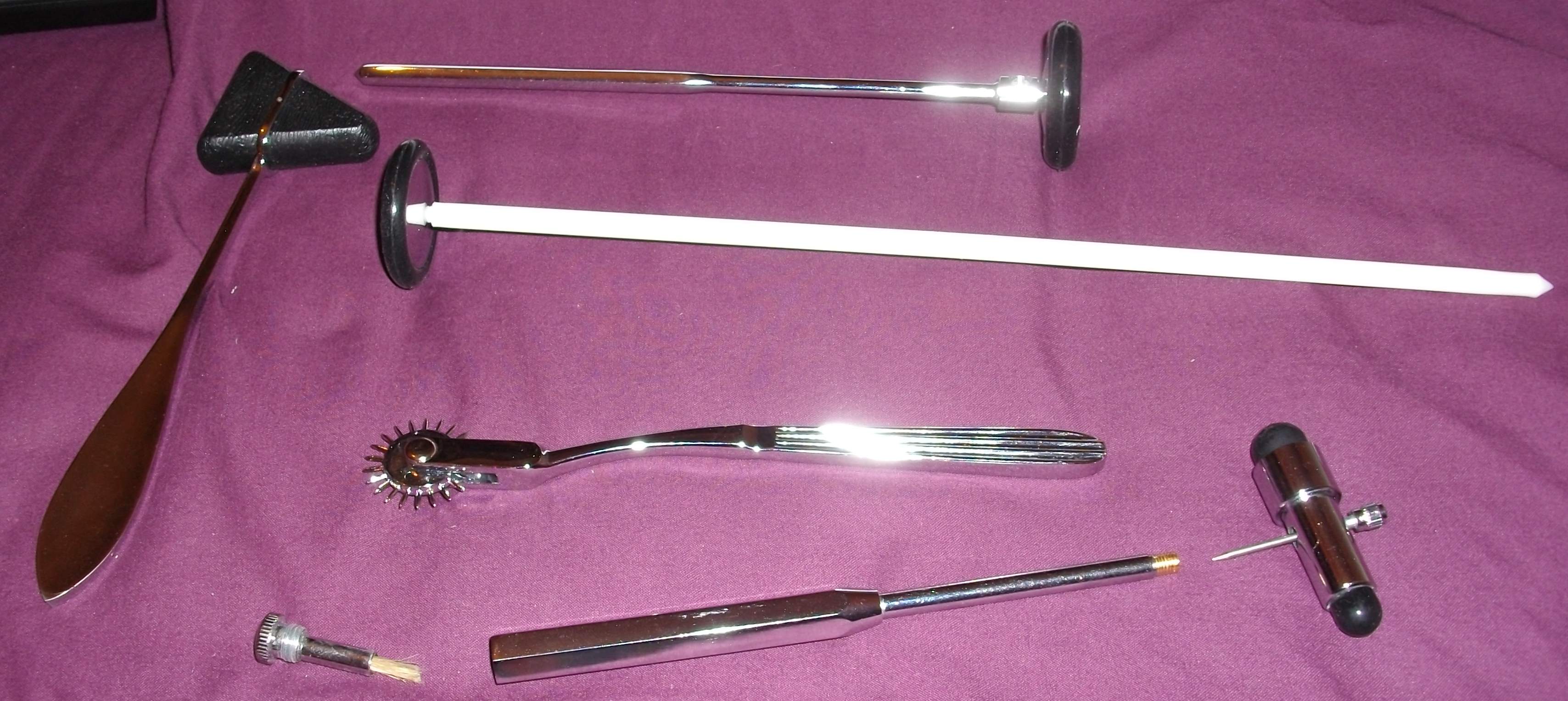 |
| Assorted neurological physical exam tools |
What I didn't realize when I picked the title of the blog was how exciting I would find neurology. The brain and spinal cord are composed of complicated neural pathways that each carry particular types of information. One part of the spinal cord carries sensory input about temperature. Another part of the spinal cord carries directions that go to muscles. Another part carries sensory input about proprioception, the position of the parts of the body in space. The pathways each travel a confusing and unique course, wending this way and that as they traverse the spinal cord and the regions of the brain.
When something goes wrong (for example, a patient loses the ability to look upwards), the neurologist must visualize the various neural pathways to reason through where the problem lies. Upon identifying the physical location of the lesion, he also must figure out what caused the lesion in the first place. Was it a stroke? A tumor? An infectious disease? Neurology has a reputation of being highly intellectual and of requiring studiousness, cleverness, organization, and careful thought. I think it suits my personality better than most fields.
As with most medical students, I am constantly testing the waters of different specialties to see which I like the most (and which I like the least). No longer will I reflexively rule neurology out.
22 July 2012
But that's crazy talk!
Part of our psychiatry class involves interviewing a psychiatric patient. We know nothing about the patient when we start the interview.
I joined two classmates in interviewing one such patient. One classmate went first, and for his 15 minutes he did a good job laying a foundation. He got an overview of the patient's life story, social history, and medical history. The patient struck us as a bit odd, but his answers seemed credible and he seemed to be an ordinary guy who had fallen on hard times.
Then it was my turn, and my job was to assess his psychiatric state. I quickly managed to open the floodgates. He revealed his delusions about being the son of god, that within a few months everyone's eye color would change, that he was adopted but that his birth family is profoundly wealthy and runs the American government. His story contradicted itself, showing that his thoughts were not only unhinged from reality but disorganized as well.
It took longer than I expected for us to uncover this patient's profound psychiatric disorder, even though we knew he was a psychiatric patient. First impressions can be deceiving.
I joined two classmates in interviewing one such patient. One classmate went first, and for his 15 minutes he did a good job laying a foundation. He got an overview of the patient's life story, social history, and medical history. The patient struck us as a bit odd, but his answers seemed credible and he seemed to be an ordinary guy who had fallen on hard times.
Then it was my turn, and my job was to assess his psychiatric state. I quickly managed to open the floodgates. He revealed his delusions about being the son of god, that within a few months everyone's eye color would change, that he was adopted but that his birth family is profoundly wealthy and runs the American government. His story contradicted itself, showing that his thoughts were not only unhinged from reality but disorganized as well.
It took longer than I expected for us to uncover this patient's profound psychiatric disorder, even though we knew he was a psychiatric patient. First impressions can be deceiving.
18 July 2012
Case in point
Wednesday is fast becoming my favorite day of the week, because it's the day when the New England Journal of Medicine (a prominent medical journal) releases its newest issue. I immediately look at the latest installment of "Case Records of the Massachusetts General Hospital." It is a write-up of an interesting medical case seen in Harvard's main teaching hospital.
"Case Records" has been published continuously since 1924, and I think it is one of the most effective ways of learning medicine. A detailed write-up of the patient's history is presented. Then, a physician comes up with a differential diagnosis, predicts what disease he thinks it is, and explains his reasoning. Finally, the true diagnosis and outcome of the case are revealed, and an expert explains to the reader the mechanism of the disease at hand.
Reading through a case is rather engaging. After reading the patient history, I try to guess the diagnosis and then compare my reasoning to the physician's. The thrill of untangling the mystery of each case makes me want to learn about the disease. That there's a real human story behind each case makes the cases stick in my memory. By my tally, I've completed about 70 cases thus far.
Unfortunately, the cases take up an inordinate amount of time. Each one takes me anywhere from twenty minutes to four hours, because I try to read pertinent chapters in my textbooks as I go along. Some of my buddies poke fun at how ridiculous I look when I review a case in the med school library--I occupy a whole table, with all kinds of random medical books splayed about. Despite my best efforts, I haven't succeeded in getting my classmates to share my enthusiasm. After all, time spent studying cases is time not spent studying what will be on the test. It's not immediately obvious how I benefit.
Sometimes I present a professor with a case and ask them to explain a part that I didn't fully grasp. A handful of them have broken into a smile and revealed to me that they, too, used to study "Case Records" in their spare time when they were medical students. Now when I sit in the library poring over a case, I feel connected to an invisible community of eager medical students who, over the decades, have stolen off to the library to perform this same ritual, learning for learning's sake.
"Case Records" has been published continuously since 1924, and I think it is one of the most effective ways of learning medicine. A detailed write-up of the patient's history is presented. Then, a physician comes up with a differential diagnosis, predicts what disease he thinks it is, and explains his reasoning. Finally, the true diagnosis and outcome of the case are revealed, and an expert explains to the reader the mechanism of the disease at hand.
Reading through a case is rather engaging. After reading the patient history, I try to guess the diagnosis and then compare my reasoning to the physician's. The thrill of untangling the mystery of each case makes me want to learn about the disease. That there's a real human story behind each case makes the cases stick in my memory. By my tally, I've completed about 70 cases thus far.
Unfortunately, the cases take up an inordinate amount of time. Each one takes me anywhere from twenty minutes to four hours, because I try to read pertinent chapters in my textbooks as I go along. Some of my buddies poke fun at how ridiculous I look when I review a case in the med school library--I occupy a whole table, with all kinds of random medical books splayed about. Despite my best efforts, I haven't succeeded in getting my classmates to share my enthusiasm. After all, time spent studying cases is time not spent studying what will be on the test. It's not immediately obvious how I benefit.
Sometimes I present a professor with a case and ask them to explain a part that I didn't fully grasp. A handful of them have broken into a smile and revealed to me that they, too, used to study "Case Records" in their spare time when they were medical students. Now when I sit in the library poring over a case, I feel connected to an invisible community of eager medical students who, over the decades, have stolen off to the library to perform this same ritual, learning for learning's sake.
15 July 2012
Harrison's Ch. 97: "Gynecologic Malignancies"
While I attempt to read the 397 chapters of Harrison's Principles of Internal Medicine, I am writing occasional reflections.
Cervical cancer is not so scary to Americans anymore because of the Pap smear. Pap smears are good at detecting pre-cancerous cervical cells, and over the past 50 years its widespread adoption has dramatically reduced cervical cancer diagnoses and deaths in the developed world. Unlike most cancers, cervical cancer is usually caused by a viral infection. Certain strains of the human papilloma virus (HPV) predispose cervical cells they infect to malignancy. Now that vaccination against some of these HPV strains is available in the U.S., we can expect the cervical cancer rate to drop even further. It is a triumph of preventive medicine.
These triumphs have barely helped the developing world, though. One of the most preventable forms of cancer still kills surprisingly many.
A handful of researchers are trying to help. Doctors in the U.S. sometimes apply vinegar (acetic acid) to the cervix so that they can visualize cervical cancer cells with the naked eye. The acid turns the cancer cells white. It seems that vinegar could be similarly used in the developing world as a low-cost replacement for the Pap smear. If the health worker sees white lesions, he can freeze them off with a simple metal rod cooled by liquid carbon dioxide.
I think it's incumbent upon us to translate our high-tech scientific advances into low-tech tools that can benefit all.
Cervical cancer is not so scary to Americans anymore because of the Pap smear. Pap smears are good at detecting pre-cancerous cervical cells, and over the past 50 years its widespread adoption has dramatically reduced cervical cancer diagnoses and deaths in the developed world. Unlike most cancers, cervical cancer is usually caused by a viral infection. Certain strains of the human papilloma virus (HPV) predispose cervical cells they infect to malignancy. Now that vaccination against some of these HPV strains is available in the U.S., we can expect the cervical cancer rate to drop even further. It is a triumph of preventive medicine.
These triumphs have barely helped the developing world, though. One of the most preventable forms of cancer still kills surprisingly many.
A handful of researchers are trying to help. Doctors in the U.S. sometimes apply vinegar (acetic acid) to the cervix so that they can visualize cervical cancer cells with the naked eye. The acid turns the cancer cells white. It seems that vinegar could be similarly used in the developing world as a low-cost replacement for the Pap smear. If the health worker sees white lesions, he can freeze them off with a simple metal rod cooled by liquid carbon dioxide.
I think it's incumbent upon us to translate our high-tech scientific advances into low-tech tools that can benefit all.
11 July 2012
When it rains, it pours
In 17th- and 18th-century England, milkmaids had a reputation for having pretty faces. This was because they rarely seemed to get smallpox, which left pockmarks on the skin of its survivors. Milkmaids did, however, catch from their cows a milder, related disease known as cowpox. English physician Edward Jenner famously hypothesized that the milkmaids' contracting cowpox made them immune to smallpox. Using this observation, he successfully created the first vaccine. This is where we get the word "vaccine": in Latin, vacca means "cow."
And so, having a disease (cowpox) sometimes protects you from another (smallpox). For example, getting oral herpes can sometimes offer slight protection against genital herpes. Although being born with no spleen (congenital asplenia) can cause problems, it does eliminate the chance of a ruptured spleen (which can be a life-threatening complication of a motor-vehicle accident).
Unfortunately, the opposite usually holds: most diseases simply invite more disease.
This used to depress me, but I've started seeing it differently. If I can diagnose a disease promptly and treat it appropriately, the patient will stand less of a risk of contracting the additional diseases that may follow. It's like a two-for-one.
And so, having a disease (cowpox) sometimes protects you from another (smallpox). For example, getting oral herpes can sometimes offer slight protection against genital herpes. Although being born with no spleen (congenital asplenia) can cause problems, it does eliminate the chance of a ruptured spleen (which can be a life-threatening complication of a motor-vehicle accident).
Unfortunately, the opposite usually holds: most diseases simply invite more disease.
- Myasthenia gravis is a disease of muscle weakness. Some patients have difficulty swallowing (dysphagia) and aspirate their food, leading to pneumonia.
- Untreated gonorrhea inflames the lining of the vagina in a way that makes a woman more susceptible to HIV infection.
- Hypertension, diabetes, tobacco use, and smoking all lead to a host of ills.
- Being in the hospital exposes patients to a whole host of nosocomial (hospital-acquired) infectious diseases, like C. difficile, a bacterium that causes persistent diarrhea.
- Autistic patients are more likely to have nutritional deficiencies because they tend to be picky eaters.
This used to depress me, but I've started seeing it differently. If I can diagnose a disease promptly and treat it appropriately, the patient will stand less of a risk of contracting the additional diseases that may follow. It's like a two-for-one.
Hypocrisy
New York City's mayor, Michael Bloomberg, has championed a proposal to ban the sale of sugary drinks larger than 16 ounces in regulated food establishments. Unsurprisingly, the beverage and movie theater industries are pushing back. From the New York Times City Room blog:
Robert Sunshine, a lobbyist for the movie theater industry in New York State, said that while his clients agreed that obesity was an epidemic, “we believe it should be handled through education.”
Oh really? Then what gives your clients the right to tell moviegoers that they can't talk on cell phones during films? Yeesh.“No one,” he added, “should be told what they can do and what they can’t do.”
08 July 2012
A happier kind of math
A patient I saw in free clinic was overdue for her breast and colon cancer screening, because she had lost her health insurance years ago. This is so commonplace that by now I am shocked when patients at our clinic are current on their screening. It's a shame, too, because cancer screening is one of the most effective health interventions we can provide a patient population. For example, by undergoing regular Pap smears, women increase their life expectancy by 2 to 3 months. Then again, since our patients are uninsured, few of them could manage to receive treatment if a screening test came back positive.
As for my patient, our clinic doesn't perform mammograms, which are the standard screening test for breast cancer. That left the doctor and me in the familiar position of estimating whether our patient should spend her own money on a mammogram at an outside clinic. On the one hand, our patient said she was short on cash. On the other hand, she had a family history that placed her at substantially higher risk of breast cancer. Had enough time elapsed since her last test to justify the expense of a new mammogram? We decided, probably not. It's a grim calculus, the sort of mathematics that I hate having to perform.
Yet this week, the discussion was different. The question was whether our patient could hold off until 2014, when the remaining provisions of President Obama's Affordable Care Act (ACA) take effect. Under the ACA, our patient's cancer screening will be fully covered. She won't even be charged a co-pay. I don't think I've ever finished a day in clinic feeling so optimistic.
Medical school has introduced me to patients in desperate straits. One of my first patients appeared to have a hormone-secreting tumor that had set her body's electrolyte balance awry. Surgically removing the tumor probably would have cured her. But she couldn't afford it. She couldn't even afford the imaging study that would have confirmed the presence of the tumor. Instead, when I had seen her, her electrolyte levels were so skewed as to be nearly incompatible with life. By now she is probably dead. I couldn't help but ask myself: why must this be?
I used to talk about "the uninsured" as an abstraction. Now I examine them in the exam room, and I am increasingly entrusted with their care. They are people, just like you and me. Their hearts beat and their stomachs growl. I feel responsible for them. I want to see them lead happy lives.
My recent experience in clinic was the moment when it truly sunk in: many of the uninsured patients I see are entering a new era. It won't be a perfect era. But it will be an era where I'll get to perform a happier kind of math.
Update: A classmate informs me that, thanks to a grant, a nearby clinic will perform patients' mammograms for free of charge.
As for my patient, our clinic doesn't perform mammograms, which are the standard screening test for breast cancer. That left the doctor and me in the familiar position of estimating whether our patient should spend her own money on a mammogram at an outside clinic. On the one hand, our patient said she was short on cash. On the other hand, she had a family history that placed her at substantially higher risk of breast cancer. Had enough time elapsed since her last test to justify the expense of a new mammogram? We decided, probably not. It's a grim calculus, the sort of mathematics that I hate having to perform.
Yet this week, the discussion was different. The question was whether our patient could hold off until 2014, when the remaining provisions of President Obama's Affordable Care Act (ACA) take effect. Under the ACA, our patient's cancer screening will be fully covered. She won't even be charged a co-pay. I don't think I've ever finished a day in clinic feeling so optimistic.
Medical school has introduced me to patients in desperate straits. One of my first patients appeared to have a hormone-secreting tumor that had set her body's electrolyte balance awry. Surgically removing the tumor probably would have cured her. But she couldn't afford it. She couldn't even afford the imaging study that would have confirmed the presence of the tumor. Instead, when I had seen her, her electrolyte levels were so skewed as to be nearly incompatible with life. By now she is probably dead. I couldn't help but ask myself: why must this be?
I used to talk about "the uninsured" as an abstraction. Now I examine them in the exam room, and I am increasingly entrusted with their care. They are people, just like you and me. Their hearts beat and their stomachs growl. I feel responsible for them. I want to see them lead happy lives.
My recent experience in clinic was the moment when it truly sunk in: many of the uninsured patients I see are entering a new era. It won't be a perfect era. But it will be an era where I'll get to perform a happier kind of math.
Update: A classmate informs me that, thanks to a grant, a nearby clinic will perform patients' mammograms for free of charge.
04 July 2012
Getting the patient on board
I spent
several weeks seeing patients in an internal medicine clinic. Often the diagnosis and treatment were obvious, and the challenge was
motivating the patients to take their medications and keep a healthy
lifestyle. How could this be accomplished?
Interestingly enough, the patient interview can be used to encourage the patient to change their behavior for the better. "Motivational interviewing" involves structuring questions in a way that encourages the patient to alter their behavior for the better. If a patient smokes, I ask them if they have ever tried to quit. If they say yes (and nearly all of them do), I ask them why they had felt motivated to quit at the time. My follow-up question is whether the reasons they had back then still apply today. I might also ask the patient what their first step would be if they were to try quitting again. This line of questioning makes the patient more prepared to attempt to quit once more. Motivational interviewing is more pleasant and effective than simply admonishing patients that they need to stop smoking. [As a side note, the same concept underlies the contemptible practice of "push polling."]
During my interview, I like chatting to patients about their job, their hobbies, their kids, and their travels. Not only is it fun to get to know them, but it usually tells me things that I can later use to encourage them to adhere to their treatment plan.
One patient was the star running back of his high school football squad. For reasons that his doctor wasn't able to determine, his blood pressure was quite high. The high blood pressure had persisted for years, because the patient didn't feel like taking his blood pressure medications. He is hardly alone. It's particularly difficult to convince people to take their blood pressure medication. The side effects from the pills are immediate, but the injuries caused by high blood pressure often take decades to manifest. Most patients prefer feeling better now to the vague promise of feeling better later. How could the doctor convince this teenager to take his medication? Some chatting revealed an answer. The patient was angling to get a scholarship to a top football program. The doctor pointed out that until the patient brought his blood pressure under control, he would fail the medical clearances necessary for recruitment. Problem solved.
A diabetic teenager seen in clinic stubbornly refused to control his blood sugar. His girlfriend was with him in the exam room. The doctor casually mentioned that diabetes causes vascular problems that can disrupt several body parts: the kidneys, the toes, the penis, the retina, the fingers. The patient turned white as a sheet. "What happens to people's penises?" the patient asked. After the doctor discussed erectile dysfunction, the patient became much more keen on learning how to use his insulin.
The effective primary-care doctor apparently has to be something of a salesman.
Interestingly enough, the patient interview can be used to encourage the patient to change their behavior for the better. "Motivational interviewing" involves structuring questions in a way that encourages the patient to alter their behavior for the better. If a patient smokes, I ask them if they have ever tried to quit. If they say yes (and nearly all of them do), I ask them why they had felt motivated to quit at the time. My follow-up question is whether the reasons they had back then still apply today. I might also ask the patient what their first step would be if they were to try quitting again. This line of questioning makes the patient more prepared to attempt to quit once more. Motivational interviewing is more pleasant and effective than simply admonishing patients that they need to stop smoking. [As a side note, the same concept underlies the contemptible practice of "push polling."]
During my interview, I like chatting to patients about their job, their hobbies, their kids, and their travels. Not only is it fun to get to know them, but it usually tells me things that I can later use to encourage them to adhere to their treatment plan.
One patient was the star running back of his high school football squad. For reasons that his doctor wasn't able to determine, his blood pressure was quite high. The high blood pressure had persisted for years, because the patient didn't feel like taking his blood pressure medications. He is hardly alone. It's particularly difficult to convince people to take their blood pressure medication. The side effects from the pills are immediate, but the injuries caused by high blood pressure often take decades to manifest. Most patients prefer feeling better now to the vague promise of feeling better later. How could the doctor convince this teenager to take his medication? Some chatting revealed an answer. The patient was angling to get a scholarship to a top football program. The doctor pointed out that until the patient brought his blood pressure under control, he would fail the medical clearances necessary for recruitment. Problem solved.
A diabetic teenager seen in clinic stubbornly refused to control his blood sugar. His girlfriend was with him in the exam room. The doctor casually mentioned that diabetes causes vascular problems that can disrupt several body parts: the kidneys, the toes, the penis, the retina, the fingers. The patient turned white as a sheet. "What happens to people's penises?" the patient asked. After the doctor discussed erectile dysfunction, the patient became much more keen on learning how to use his insulin.
The effective primary-care doctor apparently has to be something of a salesman.
01 July 2012
Blocked thought
Years ago, I spotted an acquaintance I hadn't seen in a while. The conversation was odd. A few times, I would ask a question and he would begin to respond, only to trail off into silence and stare blankly into space. He would remain frozen until the moment I said something else, whereupon he would act normally. He seemed completely oblivious to the fact that he had trailed off and had never answered my question. Indeed, he didn't seem to remember that I had asked him a question at all.
These episodes felt interminable--in one instance I waited a good 30 seconds before catching his attention and changing the subject. I wondered for how many minutes he would have remained "paused" if I had never said anything.
I had forgotten this conversation until I came across a passage in our psychiatry textbook describing this exact phenomenon. It is called "thought blocking," and many patients who have it are schizophrenic. Intrigued, I asked a psychiatry professor about it (one of the perks of being in medical school). He told me that blocking sometimes happens because a hallucination distracts the patient. It also can be because certain impulses in the brain fail to arrive at their proper destinations. For example, one part of the brain is responsible for keeping the brain focused on certain tasks, like tying a knot to completion or answering a question in a conversation. This part of the brain might have had a faulty neural connection with the regions of the brain responsible for formulating and vocalizing the answer to my question. It's fascinating.
Currently in anatomy class, we are dissecting the brain. It is not a particularly large organ (perhaps it's the size of a cantaloupe?), nor is it terribly heavy (about three pounds). Yet it contains everything that makes us human. This pink blob is not only what makes us see and breathe, but also what underlies envy and love, music and literature, war and civilization. Discovering new things about the brain makes it all the more inscrutable: how is it that two almond-sized regions of the brain contain our most visceral emotions and fears? It's baffling. One of my textbooks points out that the number of neuron cells in one's brain approximates the number of stars in the Milky Way.
Wonderment at the splendor of the human brain goes back as far as Plato. Yet today, not only do we understand much more about the human brain, but the rate at which we are unlocking the mysteries of the mind continues to accelerate.
I often dwell on the sacrifices that medical school entails--financial, social, personal, relational, and emotional. But, we get to study the brain. We even get to marvel at it by picking it up and holding it in our own hands. It reminds me yet again that this enterprise of becoming a physician is a rare privilege.
These episodes felt interminable--in one instance I waited a good 30 seconds before catching his attention and changing the subject. I wondered for how many minutes he would have remained "paused" if I had never said anything.
I had forgotten this conversation until I came across a passage in our psychiatry textbook describing this exact phenomenon. It is called "thought blocking," and many patients who have it are schizophrenic. Intrigued, I asked a psychiatry professor about it (one of the perks of being in medical school). He told me that blocking sometimes happens because a hallucination distracts the patient. It also can be because certain impulses in the brain fail to arrive at their proper destinations. For example, one part of the brain is responsible for keeping the brain focused on certain tasks, like tying a knot to completion or answering a question in a conversation. This part of the brain might have had a faulty neural connection with the regions of the brain responsible for formulating and vocalizing the answer to my question. It's fascinating.
Currently in anatomy class, we are dissecting the brain. It is not a particularly large organ (perhaps it's the size of a cantaloupe?), nor is it terribly heavy (about three pounds). Yet it contains everything that makes us human. This pink blob is not only what makes us see and breathe, but also what underlies envy and love, music and literature, war and civilization. Discovering new things about the brain makes it all the more inscrutable: how is it that two almond-sized regions of the brain contain our most visceral emotions and fears? It's baffling. One of my textbooks points out that the number of neuron cells in one's brain approximates the number of stars in the Milky Way.
Wonderment at the splendor of the human brain goes back as far as Plato. Yet today, not only do we understand much more about the human brain, but the rate at which we are unlocking the mysteries of the mind continues to accelerate.
I often dwell on the sacrifices that medical school entails--financial, social, personal, relational, and emotional. But, we get to study the brain. We even get to marvel at it by picking it up and holding it in our own hands. It reminds me yet again that this enterprise of becoming a physician is a rare privilege.
28 June 2012
Victory lap
Paul Krugman reminds us who the real winners are of today's Supreme Court decision: Americans.
Supreme court decision
What would have happened if the Supreme Court had struck down the health insurance mandate as unconstitutional? It would have set universal health care, in any form, back by decades.
It's been heart-breaking seeing patients whose lack of health insurance prevents them from getting the sometimes life-saving treatment they need. Everyone deserves health care. I'm elated that the Supreme Court stayed on the correct side of history.
It's been heart-breaking seeing patients whose lack of health insurance prevents them from getting the sometimes life-saving treatment they need. Everyone deserves health care. I'm elated that the Supreme Court stayed on the correct side of history.
27 June 2012
As goes dentistry, so goes medicine?
Frontline, my favorite television program, just aired an enlightening and dismaying hour-long documentary on America's broken dental safety net. It focuses on the poor's lack of access to quality dental care, as well as the proliferation of for-profit dentistry chains that sometimes derive revenue through shoddy work, unethical billing, and predatory lending.
It is strange seeing how the frightening changes described in the documentary are also manifesting themselves in American medical practice. Solo medical practices are becoming unprofitable, and in their stead are large health-care conglomerates that are often focused on their bottom line. Similarly to dentists, physicians feel threatened by the rise of so-called "mid-level providers," the physician assistants and nurses that are being granted increasingly wide scopes of practice. Not that these changes are unique to America: I recently read Nobel Laureate Alexander Solzhenitsyn's Cancer Ward, a semi-autobiographical novel set in a Soviet hospital. Although written 50 years ago, the doctors' complaints of the erosion of professional standards and the demise of the solo practice would just as easily apply to this country today.
The Frontline documentary portrays a badly-broken dental system, which causes grievous harm to children and adults and which has no clear solution on the horizon. As much as I'm partial to my profession, I have to wonder, is medicine today so different? And is medicine immune to the pressures bearing upon the dental profession?
On a side note, medical students find it easy to get jealous of dental students. Dental students can practice general dentistry after completing four years of dental school, whereas medical students must undergo additional training. Also, being a general dentist today is generally more lucrative than being a primary-care physician, especially because HMOs haven't completely taken over the dental field. Dentistry is an important medical field, as the documentary clearly demonstrates. Even so, I'm happy to be in a profession that permits me to focus on almost any part of the body.
It is strange seeing how the frightening changes described in the documentary are also manifesting themselves in American medical practice. Solo medical practices are becoming unprofitable, and in their stead are large health-care conglomerates that are often focused on their bottom line. Similarly to dentists, physicians feel threatened by the rise of so-called "mid-level providers," the physician assistants and nurses that are being granted increasingly wide scopes of practice. Not that these changes are unique to America: I recently read Nobel Laureate Alexander Solzhenitsyn's Cancer Ward, a semi-autobiographical novel set in a Soviet hospital. Although written 50 years ago, the doctors' complaints of the erosion of professional standards and the demise of the solo practice would just as easily apply to this country today.
The Frontline documentary portrays a badly-broken dental system, which causes grievous harm to children and adults and which has no clear solution on the horizon. As much as I'm partial to my profession, I have to wonder, is medicine today so different? And is medicine immune to the pressures bearing upon the dental profession?
On a side note, medical students find it easy to get jealous of dental students. Dental students can practice general dentistry after completing four years of dental school, whereas medical students must undergo additional training. Also, being a general dentist today is generally more lucrative than being a primary-care physician, especially because HMOs haven't completely taken over the dental field. Dentistry is an important medical field, as the documentary clearly demonstrates. Even so, I'm happy to be in a profession that permits me to focus on almost any part of the body.
24 June 2012
Smoking gun
Watching actors smoking cigarettes on screen makes young viewers more likely to smoke. The tobacco industry has known this maxim for quite a while, and decades ago they offered free lifetime supplies of cigarettes to actors and actresses.
Although tobacco companies are no longer allowed to expressly pay for product placement in American films, smoking still appears in a number of current movies. Movie studios claim that they need to be allowed to show smoking, in part so that they can maintain the historical accuracy of films set in the past. For example, the Oscar-winner "The Artist" is full of characters puffing away.
If studios cared about historical accuracy, they ought to also incorporate other elements into films set in the 1920s:
Although tobacco companies are no longer allowed to expressly pay for product placement in American films, smoking still appears in a number of current movies. Movie studios claim that they need to be allowed to show smoking, in part so that they can maintain the historical accuracy of films set in the past. For example, the Oscar-winner "The Artist" is full of characters puffing away.
If studios cared about historical accuracy, they ought to also incorporate other elements into films set in the 1920s:
-People were shorter than today, because nutrition was not as good. Hire shorter actors.Movie studios are selective about what they choose to include when they portray historical periods. I'm not sure why cigarettes should be so sacred.
-Orthodontia didn't really exist. Only hire actors with crooked teeth.
-Dentifrice (toothpaste) didn't whiten as effectively as today. Only hire actors with yellowed teeth.
20 June 2012
When politics and medicine mix
The C.I.A. hired a Pakistani physician, Dr. Shakil Afridi, to run a 2011 hepatitis B vaccination campaign in the Pakistani city of Abbottabad. The vaccination campaign was a front to investigate the Abbottabad residence where Osama bin Laden was thought to be hiding, and for Dr. Afridi to obtain DNA samples from the house's residents. Although Dr. Afridi did not manage to collect a DNA sample, his observations from visiting the house helped confirm that the house was bin Laden's. (In what appeared to be a politically-motivated verdict, the Pakistani government recently sentenced Dr. Afridi to 33 years in prison.)
Although the phony vaccination campaign helped kill bin Laden, it badly undermined the credibility of global health efforts. The New York Times reports that the Taliban is forbidding polio vaccinations in a Pakistani province that is one of the only remaining regions in the world where polio is endemic:
This is awful news. Polio kills and paralyzes. The global community had
gotten tantalizingly close to eradicating polio, convincing even those countries that feared ulterior motives to get on board. Vaccination drives have always attempted to separate themselves from wars and politics. During the successful smallpox eradication drive, some warring African nations even held ceasefires so that aid workers could vaccinate communities.
The C.I.A. program has ruined the credibility of vaccination drives, or at the very least has given cover to those who would use their participation in vaccination efforts as a bargaining chip. So long as North Waziristan refuses to vaccinate, it seems to me that polio cannot be eradicated.
There is a reason why the practice of medicine is supposed to be insulated from politics. In attempting to kill a terrorist, the C.I.A. violated this profession's core ethics and helped perpetuate another terror's reign.
See also a worthy New York Times news article about the ongoing impacts to international aid efforts stemming from the phony C.I.A. vaccination program.
Although the phony vaccination campaign helped kill bin Laden, it badly undermined the credibility of global health efforts. The New York Times reports that the Taliban is forbidding polio vaccinations in a Pakistani province that is one of the only remaining regions in the world where polio is endemic:
A Pakistani Taliban commander has banned polio vaccinations in North Waziristan, in the tribal belt, days before 161,000 children were to be inoculated. He linked the ban to American drone strikes and fears that the C.I.A. could use the polio campaign as cover for espionage, much as it did with Shakil Afridi, the Pakistani doctor who helped track Osama bin Laden.
The C.I.A. program has ruined the credibility of vaccination drives, or at the very least has given cover to those who would use their participation in vaccination efforts as a bargaining chip. So long as North Waziristan refuses to vaccinate, it seems to me that polio cannot be eradicated.
There is a reason why the practice of medicine is supposed to be insulated from politics. In attempting to kill a terrorist, the C.I.A. violated this profession's core ethics and helped perpetuate another terror's reign.
See also a worthy New York Times news article about the ongoing impacts to international aid efforts stemming from the phony C.I.A. vaccination program.
17 June 2012
Medicine by-the-book
I saw a patient who had injured his knee. I performed a handful of physical exam tests that I was familiar with: pulling on his leg to check the integrity of the anterior cruciate ligament (ACL), twisting his joint in a particular way to check some other ligaments known as the collateral ligaments. Still, I wasn't sure of a diagnosis. There were a handful of other tests that I wanted to perform which I had never done before. I didn't remember how they were done, and I didn't want to guess for fear of injuring the patient. So, with the patient in the room, I pulled out Sapira's, my gem of a physical exam textbook, and read for a bit of its section on the knee. Thanks to the exams it described, I was quickly able to pinpoint his injury to the posterior horn of his medial meniscus, without needing to take an X-ray or an MRI.
The patient seemed fine with my consulting a textbook mid-examination. "After all, you're just a student," he had said. But it felt uncomfortable. Bringing out the book was a tacit acknowledgment that I am falliable, that I don't know everything I need if I'm to help the patient. Most primary-care doctors I shadow excuse themselves from the room when they want to look something up. They don't mention to the patient that they're consulting other sources. For that matter, most primary-care doctors rarely consult outside sources when assessing and treating patients.
Should it be such a bad thing to consult a textbook with the patient present? Using a textbook conveys humility and demonstrates that the doctor cares. Double-checking against the textbook helps the doctor confirm that they're providing the most up-to-date and appropriate care.
I'm not sure that that's how patients feel, though. Patients want their doctors to be smarter than their textbooks. I'm willing to concede that, in some respects, the textbook knows more.
The patient seemed fine with my consulting a textbook mid-examination. "After all, you're just a student," he had said. But it felt uncomfortable. Bringing out the book was a tacit acknowledgment that I am falliable, that I don't know everything I need if I'm to help the patient. Most primary-care doctors I shadow excuse themselves from the room when they want to look something up. They don't mention to the patient that they're consulting other sources. For that matter, most primary-care doctors rarely consult outside sources when assessing and treating patients.
Should it be such a bad thing to consult a textbook with the patient present? Using a textbook conveys humility and demonstrates that the doctor cares. Double-checking against the textbook helps the doctor confirm that they're providing the most up-to-date and appropriate care.
I'm not sure that that's how patients feel, though. Patients want their doctors to be smarter than their textbooks. I'm willing to concede that, in some respects, the textbook knows more.
13 June 2012
A legal action
A patient came in because he was litigating a worker's compensation complaint and hoped his physician would support his case. Everything bad that had happened in his life over the past few years he attributed to an injury to a limb that he claimed he had suffered on the job.
The examination was quite uncomfortable for me, because the patient actively tried to sell me on just how injured he was. Things became adversarial at times: he asked me if I doubted that the injury was the only explanation for his medical problems. When I touched the affected extremity, the patient cowered in pain and admonished me. The affected extremity did look abnormal. Then again, he had stopped using it since the injury. When a part of the body isn't used, it atrophies, distorting the anatomical structures and its appearance.
Was he exaggerating his pain to sell me on his legal battle? Was his pain in part psychological, brought on by the perceived injustice of having suffered an injury on the job? To what extent was the original injury responsible for the pain, and to what extent was it due to atrophy after the patient decided to stop using it? Was this a rare pain disorder? Was this all an invention by the patient, in a nefarious bid to collect disability and retire early?
This was not the fun kind of medicine, especially because I was more referee than healer. Some physicians specialize in workers' compensation cases, and serving as an expert witness in legal cases pays quite well. It's not what I came into medicine for, though, and this case made me quickly decide that this type of medical practice is not for me.
The examination was quite uncomfortable for me, because the patient actively tried to sell me on just how injured he was. Things became adversarial at times: he asked me if I doubted that the injury was the only explanation for his medical problems. When I touched the affected extremity, the patient cowered in pain and admonished me. The affected extremity did look abnormal. Then again, he had stopped using it since the injury. When a part of the body isn't used, it atrophies, distorting the anatomical structures and its appearance.
Was he exaggerating his pain to sell me on his legal battle? Was his pain in part psychological, brought on by the perceived injustice of having suffered an injury on the job? To what extent was the original injury responsible for the pain, and to what extent was it due to atrophy after the patient decided to stop using it? Was this a rare pain disorder? Was this all an invention by the patient, in a nefarious bid to collect disability and retire early?
This was not the fun kind of medicine, especially because I was more referee than healer. Some physicians specialize in workers' compensation cases, and serving as an expert witness in legal cases pays quite well. It's not what I came into medicine for, though, and this case made me quickly decide that this type of medical practice is not for me.
10 June 2012
Patient follow-up
A patient came in complaining of a cough, shoulder pain, and vertigo. She was having difficulty walking and sitting up straight. I took some of the patient's history, and she complained how the last doctor refused to give her cough syrup with codeine, which is a heavily-regulated mild narcotic.
Although she was a bit dramatic and rubbed the doctor and me slightly the wrong way, her story seemed credible. The doctor prescribed her the codeine and wrote a note excusing her from work.
An hour later, I took my lunch break and walked to a restaurant a few blocks away. There, I spotted the patient (without her seeing me). She looked like a new person, ambling about in no apparent distress.
Long before I started my medical school applications, I knew that as an aspiring physician I would encounter lots of drug seekers. I did not expect the extent to which they would dim my view of humanity. No one likes feeling that they've been had. Drug seekers undermine the doctor-patient relationship, and they make doctors less likely to prescribe pain medication to those who truly need them.
Although she was a bit dramatic and rubbed the doctor and me slightly the wrong way, her story seemed credible. The doctor prescribed her the codeine and wrote a note excusing her from work.
An hour later, I took my lunch break and walked to a restaurant a few blocks away. There, I spotted the patient (without her seeing me). She looked like a new person, ambling about in no apparent distress.
Long before I started my medical school applications, I knew that as an aspiring physician I would encounter lots of drug seekers. I did not expect the extent to which they would dim my view of humanity. No one likes feeling that they've been had. Drug seekers undermine the doctor-patient relationship, and they make doctors less likely to prescribe pain medication to those who truly need them.
06 June 2012
Harrison's Ch. 148: "Pertussis and Other Bordetella Infections"
While I read the 397 chapters of Harrison's Principles of Internal Medicine, I am writing reflections.
From Chapter 148:
In two weeks, I examined two patients who I was rather certain had pertussis. They had recently begun having coughing fits lasting several minutes. Their lungs sounded clear, and neither was feverish. The fits were so severe that it kept them up at night, and sometimes the force of the coughing fits made them vomit. This last feature, known as post-tussive emesis (literally, vomiting after coughing), is a trademark of pertussis. Whooping cough wasn't a perfect fit--both patients had been vaccinated against pertussis, and neither could recall being exposed to someone with the illness. But nothing else seemed to fit very well, either
We obtained a nasal swab from both patients and sent it to the lab. Both times, the test came back negative! This was quite aggravating. Did I go wrong somewhere?
It's important to note that no test is perfect. This particular test for pertussis has a 90% sensitivity, meaning that only 90% patients with pertussis would have a positive result. Still, this means that the likelihood of two patients having pertussis both getting negative test results is only 1%.
Maybe the specimens weren't collected properly? I reviewed the CDC's guidelines. I hadn't left the swab in one patient's nose for as long as recommended. The swabs weren't refrigerated during transport, which could have potentially caused problems. But even these potential missteps don't seem like they would change the tests' outcome by much.
So was it pertussis? Was it another disease that I didn't think of? Were my textbooks wrong?
These are not just philosophical questions. When a patient has pertussis, not only are they given heavy-duty antibiotics, but so is everyone living in their household. The antibiotics have side effects and can breed resistance. Proper treatment here requires knowing the probability that a patient has the disease.
Medicine is full of ambiguities. I don't know what my patients had, and therefore, I don't know whether the treatment helped them or made things worse. In most cases, I have to learn to be OK with that.
From Chapter 148:
Pertussis is an acute infection of the respiratory tract caused by Bordetella pertussis. The name pertussis means "violent cough," which aptly describes the most consistent and prominent feature of the illness. The inspiratory sound made at the end of an episode of paroxysmal coughing gives rise to the common name for the illness, "whooping cough."...The Chinese name for pertussis is "the 100-day cough," which accurately describes the clinical course of the illness.
In two weeks, I examined two patients who I was rather certain had pertussis. They had recently begun having coughing fits lasting several minutes. Their lungs sounded clear, and neither was feverish. The fits were so severe that it kept them up at night, and sometimes the force of the coughing fits made them vomit. This last feature, known as post-tussive emesis (literally, vomiting after coughing), is a trademark of pertussis. Whooping cough wasn't a perfect fit--both patients had been vaccinated against pertussis, and neither could recall being exposed to someone with the illness. But nothing else seemed to fit very well, either
We obtained a nasal swab from both patients and sent it to the lab. Both times, the test came back negative! This was quite aggravating. Did I go wrong somewhere?
It's important to note that no test is perfect. This particular test for pertussis has a 90% sensitivity, meaning that only 90% patients with pertussis would have a positive result. Still, this means that the likelihood of two patients having pertussis both getting negative test results is only 1%.
Maybe the specimens weren't collected properly? I reviewed the CDC's guidelines. I hadn't left the swab in one patient's nose for as long as recommended. The swabs weren't refrigerated during transport, which could have potentially caused problems. But even these potential missteps don't seem like they would change the tests' outcome by much.
So was it pertussis? Was it another disease that I didn't think of? Were my textbooks wrong?
These are not just philosophical questions. When a patient has pertussis, not only are they given heavy-duty antibiotics, but so is everyone living in their household. The antibiotics have side effects and can breed resistance. Proper treatment here requires knowing the probability that a patient has the disease.
Medicine is full of ambiguities. I don't know what my patients had, and therefore, I don't know whether the treatment helped them or made things worse. In most cases, I have to learn to be OK with that.
03 June 2012
What's in a name?
Such a variety of diseases bring patients in to see their doctor that I find it quite significant when I see two patients with the same disease. Recently, I've seen two patients with inflammation of the eyelids, or blepharitis. What makes blepharitis so fun is not just its zany name but the zany names used to further describe it.
Blepharitis can manifest as an infection of the glands of Moll or the glands of Zeis, which are the sebaceous (oil-secreting) glands located at the margin of the eyelid. Such an infection is called a stye, or hordeolum. Blepharitis can also lead to the formation of a cyst in the eyelid, known as a chalazion. The reason is chronic inflammation of the meibomian gland.
These words seem more appropriate in a Dr. Seuss book than in a medical textbook. Then again, now that Dartmouth's medical school is named after Dr. Seuss, the two might no longer be so distinct.
Blepharitis can manifest as an infection of the glands of Moll or the glands of Zeis, which are the sebaceous (oil-secreting) glands located at the margin of the eyelid. Such an infection is called a stye, or hordeolum. Blepharitis can also lead to the formation of a cyst in the eyelid, known as a chalazion. The reason is chronic inflammation of the meibomian gland.
These words seem more appropriate in a Dr. Seuss book than in a medical textbook. Then again, now that Dartmouth's medical school is named after Dr. Seuss, the two might no longer be so distinct.
30 May 2012
In memoriam
I recently learned the sorry news that my childhood pediatrician has died. Not only was he my pediatrician, but he was also my father's pediatrician. Our family became rather close to him over the years.
He came from a different generation of doctors, one that made house calls, that served in wars abroad, and that learned how to diagnose patients in the days before MRIs and CT scans. Even though I was little while I was his patient, I clearly remember how much he relied upon the physical examination and upon instruments like the reflex hammer and the tuning fork that few doctors carry today.
Most striking was his unwavering dedication to his patients. Although today's aspiring physicians (myself included) seek "work/life balance," his work pretty much was his life. Even on weekends and nights, he was working tirelessly for his patients, visiting his charges at home and in the hospital. To him, medicine was not a job, but truly a calling. Although old age forced him to give up his practice, it did not seem like he ever retired. I saw him frequently at the medical school's weekly pediatrics grand rounds, always sitting in the front row.
He was one of my main inspirations for wanting to become a physician. I grew up feeling indebted to him for having looked after me with such care, and it saddens me considerably for him to be gone. I hope to live up to his example, although I doubt I will come close to emulating his commitment to this profession. As my father remarked, "they don't make doctors like him anymore."
Although this past year of medical school, my first, has better acquainted me with illness and death, it hasn't taken any of the sting out of the loss of a loved one. Entering medicine has eased, though, the inevitable soul-searching that accompanies such sad news. In mourning, I ask myself, what is my purpose here on earth? How will I leave my mark? How can I best honor the memory of the deceased? It was my pediatrician who had first offered me some of the answers. Medicine can be a noble line of work, and by taking it seriously I hope to repay my debt to him and my obligation to humanity.
May he rest in peace.
He came from a different generation of doctors, one that made house calls, that served in wars abroad, and that learned how to diagnose patients in the days before MRIs and CT scans. Even though I was little while I was his patient, I clearly remember how much he relied upon the physical examination and upon instruments like the reflex hammer and the tuning fork that few doctors carry today.
Most striking was his unwavering dedication to his patients. Although today's aspiring physicians (myself included) seek "work/life balance," his work pretty much was his life. Even on weekends and nights, he was working tirelessly for his patients, visiting his charges at home and in the hospital. To him, medicine was not a job, but truly a calling. Although old age forced him to give up his practice, it did not seem like he ever retired. I saw him frequently at the medical school's weekly pediatrics grand rounds, always sitting in the front row.
He was one of my main inspirations for wanting to become a physician. I grew up feeling indebted to him for having looked after me with such care, and it saddens me considerably for him to be gone. I hope to live up to his example, although I doubt I will come close to emulating his commitment to this profession. As my father remarked, "they don't make doctors like him anymore."
Although this past year of medical school, my first, has better acquainted me with illness and death, it hasn't taken any of the sting out of the loss of a loved one. Entering medicine has eased, though, the inevitable soul-searching that accompanies such sad news. In mourning, I ask myself, what is my purpose here on earth? How will I leave my mark? How can I best honor the memory of the deceased? It was my pediatrician who had first offered me some of the answers. Medicine can be a noble line of work, and by taking it seriously I hope to repay my debt to him and my obligation to humanity.
May he rest in peace.
27 May 2012
Ain't that the truth?
It is unfortunate that one must be slightly skeptical of what patients say. Although the doctor-patient relationship is premised on mutual trust and truth-telling, some patients lie.
Mr. Williams came into clinic because he had lacerated his arm on a dirty, rusty metal fence. Dr. X and I were concerned about the risk of tetanus infection, which although potentially deadly is completely preventable through vaccination.
Ultimately, the doctor didn't pressure the patient into getting the tetanus shot. Telling the truth at the outset would have been the best policy.
Mr. Williams came into clinic because he had lacerated his arm on a dirty, rusty metal fence. Dr. X and I were concerned about the risk of tetanus infection, which although potentially deadly is completely preventable through vaccination.
Dr. X: Did you get a tetanus shot in the past five years?I didn't believe him and happened to have his chart in front of me.
Mr. Williams: Yeah, I'm covered. I got the tetanus shot last year.
Me: Dr. X, you might want to have someone check if there's a problem with your electronic medical record system! It doesn't show any record of Mr. Williams's having received any tetanus shots for at least the past 18 years--Although the lie was harmless, I found its brazenness upsetting. Everyone deserves medical care, but it is frustrating working to help those who do not take you seriously and who you cannot fully trust.
Mr. Williams: All right, I lied. I didn't get tetanus. I just hate getting shots.
Ultimately, the doctor didn't pressure the patient into getting the tetanus shot. Telling the truth at the outset would have been the best policy.
24 May 2012
The difficult conversation
A patient I examined had an unexpected, rapidly-progressive, and unquestionably-fatal disease that gave her perhaps weeks to live. A number of opportunistic diseases were ravaging her body because her
immune system was compromised by her treatment. The patient was weak and in great distress. Her medical problems were extensive and complex.
For whatever reason, the patient and her family had tried to avoid the gravity of the situation. The patient had not crafted an advanced directive. Although home help, assisted-mobility devices, hospice care, and psychotherapy would all have been helpful and appropriate, either they hadn't been offered or the patient had not taken advantage of them. The emotional strain and the difficulty of caring for someone so ill had taken a toll on the family. What were the goals of care for these last few weeks of this patient's life? I didn't know, and neither did the patient or the patient's family. The result was a rudderless ship whose addled crew was adrift at sea.
A difficult conversation needed to have taken place. A doctor needed to sit down with the patient and ask: do you want to be fed artificially, even if this will substantially prolong your pain and suffering? Will you sign on to hospice care, so that you can relieve some of the burden on your family? What do you hope to accomplish during these last precious days on earth, and how can we best assist you with those goals?
I decided that it was inappropriate for me to be the one to have that conversation. I was only an observer, and I knew little about the patient's history, disease, and prognosis. And yet, I joined the ranks of all the other medical providers that this patient had seen, each of them hoping that someone else would someday perform that delicate, sorrowful, yet necessary task of plotting the future with one whose days are numbered.
For whatever reason, the patient and her family had tried to avoid the gravity of the situation. The patient had not crafted an advanced directive. Although home help, assisted-mobility devices, hospice care, and psychotherapy would all have been helpful and appropriate, either they hadn't been offered or the patient had not taken advantage of them. The emotional strain and the difficulty of caring for someone so ill had taken a toll on the family. What were the goals of care for these last few weeks of this patient's life? I didn't know, and neither did the patient or the patient's family. The result was a rudderless ship whose addled crew was adrift at sea.
A difficult conversation needed to have taken place. A doctor needed to sit down with the patient and ask: do you want to be fed artificially, even if this will substantially prolong your pain and suffering? Will you sign on to hospice care, so that you can relieve some of the burden on your family? What do you hope to accomplish during these last precious days on earth, and how can we best assist you with those goals?
I decided that it was inappropriate for me to be the one to have that conversation. I was only an observer, and I knew little about the patient's history, disease, and prognosis. And yet, I joined the ranks of all the other medical providers that this patient had seen, each of them hoping that someone else would someday perform that delicate, sorrowful, yet necessary task of plotting the future with one whose days are numbered.
21 May 2012
Power of deduction
From one of my blog posts in October 2011:
Sapira's, my favorite book on physical diagnosis, reminds the reader that a clinician's examination of a patient begins the moment he opens the door to the exam room.
An English physician, Arthur Conan Doyle, was taken by the outstanding powers of observation of one of his professors, Dr. Joseph Bell. Doyle later became an author, and Bell became the basis for Doyle's celebrated detective, Sherlock Holmes.
While wrapping up an examination of a patient, I glanced into the exam room's
wastebasket. Inside were several paper towels that were dotted with blood. I
asked if the blood was the patient's (it was),
and what part of the body the blood was issuing from (the patient's nose). That the
patient had frequent, severe nosebleeds ended up being an important
finding when we crafted our treatment plan.
Perhaps "one man's trash is another man's treasure," after all.
Perhaps "one man's trash is another man's treasure," after all.
20 May 2012
Teaching
I had the opportunity to teach a large audience of pre-meds about the patient interview and about how to generate and hone a differential diagnosis. It is a blast looking back and seeing how much I've learned in the past year. I now feel familiar enough with some of the concepts of medical practice that I feel comfortable teaching others what I know.
The joy of getting in front of an audience, cracking jokes, and presenting my thoughts in a fun, interactive way reminds me that I would love to teach in some capacity once I finally become a physician. Teaching medicine seems just as exciting as practicing it.
The joy of getting in front of an audience, cracking jokes, and presenting my thoughts in a fun, interactive way reminds me that I would love to teach in some capacity once I finally become a physician. Teaching medicine seems just as exciting as practicing it.
18 May 2012
Waste
A phone bank I toured was staffed by several nurses. The nurses' job was to fulfill a legal obligation that an insurance provider placed on their corporation: to call certain patients annually, to ask them a lengthy set of questions, and then to generate a detailed health plan. The nurses estimated that they spent an average of half an hour on each patient. A medical assistant spent her days organizing databases that catalog these annual health plans. Much of her workload (such as removing the leading zeroes from medical record numbers) could have been automated with a simple computer script that would have taken me a couple of hours to write.
Once the detailed health plans were generated, who saw them? Because of a change in policy, almost no one. Most simply were filed away. A small number were sent to the patients' primary-care physicians, who usually ignored them.
Two thoughts:
1. How would you feel if you spent each day dutifully generating products that you knew that virtually no one will ever use?
2. 18% of our country's GDP goes towards health-care spending. This is shockingly and unsustainably high, especially considering how we haven't even insured all of our citizens. Our health care system is filled with inequities and inefficiencies, and I got to see this one tiny inefficiency close-up.
Once the detailed health plans were generated, who saw them? Because of a change in policy, almost no one. Most simply were filed away. A small number were sent to the patients' primary-care physicians, who usually ignored them.
Two thoughts:
1. How would you feel if you spent each day dutifully generating products that you knew that virtually no one will ever use?
2. 18% of our country's GDP goes towards health-care spending. This is shockingly and unsustainably high, especially considering how we haven't even insured all of our citizens. Our health care system is filled with inequities and inefficiencies, and I got to see this one tiny inefficiency close-up.
17 May 2012
Harrison's Ch. 80: "Involuntary Weight Loss"
Perhaps you watched the film "Julie and Julia"
a few years ago. It is partly about a blogger, Julie Powell, who spent a
year making every recipe in Julia Child's best-known cookbook.
I am doing something similar (albeit less tasty and less likely to be made into a feature film starring Meryl Streep). I am in the process of reading Harrison's Principles of Internal Medicine in its entirety. Harrison's is a dense, 3,600-page, two-volume tome that is the closest thing to a bible in clinical medicine. I am reflecting upon some of its chapters during the year or so it takes me to finish.
From Ch. 80 ("Involuntary Weight Loss"):
Involuntary weight loss (IWL) is frequently insidious and can have important implications, often serving as a harbinger of serious underlying disease. Clinically important weight loss is defined as the loss of 10 pounds (4.5 kg) or >5% of one's body weight over a period of 6–12 months. IWL is encountered in up to 8% of all adult outpatients and 27% of frail persons age 65 years and older. There is no identifiable cause in up to one-quarter of patients despite extensive investigation....Weight loss in older persons is associated with a variety of deleterious effects, including hip fracture, pressure ulcers, impaired immune function, decreased functional status, and death. Not surprisingly, significant weight loss is associated with increased mortality, which can range from 9% to as high as 38% within 1 to 2.5 years in the absence of clinical awareness and attention.
The patient seemed healthy enough. In her 60s, she had stopped smoking 10 years ago and loved doing aerobics. She was getting over a cold. Although she was being treated for hypertension, her blood pressure now was substantially below 120/80 (i.e. her blood pressure was not high).
The doctor asked her how she had managed to get her blood pressure so dramatically in check. "I've lost a lot of weight," she beamed. "I used to be overweight, but now I've really slimmed down."
"How did you manage that?"
"I dunno. Recently I haven't had much of an appetite." The doctor and I looked at the chart, and the woman had lost about 20% of her body weight over the past year. She had been slightly overweight before and her weight now was the low end of normal.
Upon seeing the numbers the doctor and I shuddered almost imperceptibly. While the patient thought her weight loss was good news, we felt the opposite. We now had to order a variety of lab tests and a chest X-ray, checking in particular for cancer. The doctor cautioned that if this initial battery of tests came back clean, he would have to order yet another panel of tests and imaging studies.
Lots of things can cause weight loss in the elderly, some of them deadly and some of them not. How hard should we be looking for the underlying cause? If we ordered every medical test known to man, we still might not have a clue of what was causing the weight loss.
Part of the art of medicine is deciding how far to pursue leads. How long should a doctor take the patient's history? How many tests should we order? How extensive should a surgery be? There are no clear answers, and part of the burden and challenge of being a medical provider is that it falls to them to make these impossible judgment calls.
15 May 2012
The spitting image
The two images on the left are from one of my textbooks. They are theoretical readouts from a spirometer, a simple yet important machine that measures how quickly air flows in and out of the lungs while the patient takes the deepest breath they can. At top left is a hypothetical normal patient; at bottom left is a hypothetical patient with obstructive lung disease (a common outcome of cigarette smoking). The diseased lungs are especially bad at exhalation.
Now for the part that fascinated me. Look at the readout on the right, from a patient in clinic today. Then look at the image at bottom left. Compare the outlines of both, as well as where the outlines reside on the x- and y-axes (you can ignore the noisy lines inside). Even without knowing a thing about pulmonology, you can see that they're virtually identical.
Even though each person is complex and unique, diseases can be consistent and predictable in the way they present. Today's case was one of these "textbook" examples.
Now for the part that fascinated me. Look at the readout on the right, from a patient in clinic today. Then look at the image at bottom left. Compare the outlines of both, as well as where the outlines reside on the x- and y-axes (you can ignore the noisy lines inside). Even without knowing a thing about pulmonology, you can see that they're virtually identical.


Even though each person is complex and unique, diseases can be consistent and predictable in the way they present. Today's case was one of these "textbook" examples.
14 May 2012
Harrison's Ch. 251: "Approach to the Patient with Disease of the Respiratory System"
Perhaps you watched the film "Julie and Julia"
a few years ago. It is partly about a blogger, Julie Powell, who spent a
year making every recipe in Julia Child's best-known cookbook.
I am doing something similar (albeit less tasty and less likely to be
made into a feature film starring Meryl Streep). I am in the process of reading Harrison's Principles of Internal Medicine in its entirety. Harrison's
is a dense, 3,600-page, two-volume tome that is the closest thing to a
bible in clinical medicine. I am reflecting upon some of its chapters during the year or so it takes me to finish.
Although I should have been asleep, last night I was determined to get through another chapter of Harrison's. On a whim, I read "Approach to the Patient with Disease of the Respiratory System." The chapter describes the mechanisms of certain respiratory illnesses and instructs the doctor in how to use physical examination techniques and diagnostic tests to inform his diagnosis.
In a stroke of good fortune, today I evaluated a patient with a nasty cough that began a week ago. It hurt when she breathed deeply. I suspected pneumonia and pleuritis (inflammation of the outer surface of the lung).
I took a lengthy history, and posed some questions that must the patient must have found strange. I asked for a domestic travel history, to rule out the endemic mycoses (three pneumonia-causing fungi found only in particular parts of the country). I asked for her history of international travel, to rule out tuberculosis. I asked if she had pets, to rule out psittacosis (a pneumonia-causing bacterium transmitted from birds).
Then I performed my physical examination, paying particular attention to the lungs. My leading diagnosis became even more specific: a bacterial pneumonia of the left lower lobe of the lung, with pleuritis. My calling which lobe of the lung was affected is a bit like a billiards player calling the pocket where he's going to send the 8-ball. My confidence stemmed partly from my having read the relevant section in Harrison's the night before.
We took a chest X-ray, and sure enough, my diagnosis was on the money.
It was a proud moment because it was a big milestone. I've seen many patients, and I've suggested many diagnoses, but never before have I been able to learn whether my diagnosis was ultimately correct. The number of diseases I'm familiar with grows by the day. My hunches are becoming more accurate, and I'm asking patients the right questions more often.
It's fun to compare how I feel about my skill level now to what I wrote just four months ago. Although I still am far from being a doctor, I'm definitely getting the hang of this.
11 May 2012
Harrison's Ch. 1: "The Practice of Medicine"
Perhaps you watched the film "Julie and Julia"
a few years ago. It is partly about a blogger, Julie Powell, who spent a
year making every recipe in Julia Child's best-known cookbook.
I am doing something similar (albeit less tasty and less likely to be made into a feature film that stars Meryl Streep). I am in the process of reading Harrison's Principles of Internal Medicine in its entirety. Harrison's is a dense, 3,600-page, two-volume tome that is the closest thing to a bible in clinical medicine. I am reflecting upon some of its chapters during the year or so it takes me to finish.
From Ch. 1 ("The Practice of Medicine"):
The Physician as Perpetual Student
It becomes all too apparent from the time doctors graduate from medical school that as physicians their lot is that of the "perpetual student" and the mosaic of their knowledge and experiences is eternally unfinished. This concept can be at the same time exhilarating and anxiety-provoking. It is exhilarating because doctors will continue to expand knowledge that can be applied to their patients; it is anxiety-provoking because doctors realize that they will never know as much as they want or need to know. At best, doctors will translate this latter feeling into energy to continue to improve themselves and realize their potential as physicians...
I felt tremendously relieved when I recently finished my last exam of the first year of medical school. The relief was not just at being finished with exams, but at finally being able to study the parts of medicine that interest me without having to worry whether it is distracting me from my coursework. Even though I had just begun break, within a few hours of finishing my exams I was back in the library, reading textbooks. I'm not sure whether it's because I find my studies relaxing or whether I've simply forgotten how to relax.
In recent months I've solidified my foundational knowledge enough that I'm now able to learn about complex diseases. I understand the fundamentals of pharmacology, anatomy, biochemistry, histology, and physiology. I comprehend more of the medical terms I come across and can make some sense of blood tests and X-rays. Now that I have the tools, I now feel an unrelenting urge to tackle the massive compendium of knowledge I will need in order to recognize diseases and effectively treat them. In under a year I'll be on the wards seeing patients! I feel way behind, that there's no time to lose.
But of course, I can never be done. There is always more to learn. And we constantly have to refresh our knowledge: some things we learned in our classes just weeks ago have already gone out of date. Beyond that, physicians can always improve the way they interact with their colleagues and with patients.
Going into med school, I didn't expect learning about medicine to be quite this engrossing. I'm surprised at how willingly I've devoted my free time to improving my craft, to the exclusion of other pursuits. Being a "perpetual student" is an enormous obligation.
10 May 2012

08 May 2012
Notification
One of a doctor's most difficult jobs is to notify someone of the death of a loved one. Death notification is of particular relevance to ER doctors. The death of those who are pronounced dead in the emergency department (such as those brought in by ambulance) is often sudden and unexpected. The act of notifying the family is difficult for all of those involved.
A textbook on emergency medicine, Tintinalli's, devotes a chapter to grief, death, and dying. I found one of the paragraphs uplifting:
A textbook on emergency medicine, Tintinalli's, devotes a chapter to grief, death, and dying. I found one of the paragraphs uplifting:
In helping families confront death, the physician has an opportunity heal the living.There are data which demonstrate that properly performed death notifications may mitigate the impact of substantial negative effects on the surviving family members. For example, well-delivered death notification may reduce the incidence of PTSD in sudden death, particularly those involving the loss of a spouse or the death of a child. As emergency physicians, we must begin to think of death notification not as a difficult conclusion to an already difficult case but as an opportunity for prevention: reducing the incidence of secondary trauma to the family by the way in which they learn of a death.
03 May 2012
Knowledge
One of my high school physics teachers likened final exams to baseball. Fans don't care what your record was during the season; they only care how well you do during the playoffs.
He told us he didn't care when during the semester we learned the material, only that we had learned the material by the end. Physics is cumulative, so being able to do advanced physics demonstrates that one has mastered the basics. And so, days before our final, he announced his grading policy. If one did better on the final exam than on any earlier exams, then those exam scores would be corrected upwards to one's score on the final. If I scored 90 on the final, any prior exam score below that would become a 90.
In some regards, medical school has a different philosophy. I took anatomy during my first semester of medical school. After taking my final, I will never be tested on the material until I sit for my boards at the end of second year. Similarly, physical exam skills are tested once, early in first year. But they never appear on the boards, so they aren't even tested again.
Perhaps it's because I'm currently in the thick of finals, but it seems like a more cumulative approach would be better. Otherwise medical students segregate knowledge into what is testable and what is OK to forget. The real world and the human body are much more intertwined than that.
He told us he didn't care when during the semester we learned the material, only that we had learned the material by the end. Physics is cumulative, so being able to do advanced physics demonstrates that one has mastered the basics. And so, days before our final, he announced his grading policy. If one did better on the final exam than on any earlier exams, then those exam scores would be corrected upwards to one's score on the final. If I scored 90 on the final, any prior exam score below that would become a 90.
In some regards, medical school has a different philosophy. I took anatomy during my first semester of medical school. After taking my final, I will never be tested on the material until I sit for my boards at the end of second year. Similarly, physical exam skills are tested once, early in first year. But they never appear on the boards, so they aren't even tested again.
Perhaps it's because I'm currently in the thick of finals, but it seems like a more cumulative approach would be better. Otherwise medical students segregate knowledge into what is testable and what is OK to forget. The real world and the human body are much more intertwined than that.
30 April 2012
Connections
One cool thing about learning the mechanisms behind disease in such detail is that now, some seemingly unconnected details in a patient history would steer me to a particular diagnosis. Some examples:
Poets, teachers, detectives, and comedians perform their crafts by illuminating connections between things that aren't initially obvious to most of us. It's fun that medicine allows for the same thing.
-A couple comes to your infertility clinic after trying for a year to conceive, without success. The husband has a poor sense of smell.Kallmann syndrome involves improper migration during development of those parts of the brain that are responsible for smell and that secrete hormones involved in fertility.
-A elderly man comes into the emergency department of your hospital because of transient blue-green colorblindness after sex.
The enzyme that Viagra (sildenafil) inhibits to maintain erections is closely related to the enzyme in the eye that discriminates between blue and green. In some people, Viagra acts upon both.
-An elderly woman comes into clinic complaining of months of fatigue and unintentional weight loss. The eyes look different from each other, and one of them is yellowed.
The woman has jaundice, a sign of liver dysfunction that presents as both eyes being yellow. However, only one eye is yellow. This means that the other eye must be a glass eye. The single unifying diagnosis is malignant melanoma of the eye. Years ago, the woman had her eye removed because of melanoma. Melanoma of the eye often metastasizes to the liver, sometimes taking years to reveal itself. This metastasis to the liver is causing jaundice as well as her other symptoms.
Poets, teachers, detectives, and comedians perform their crafts by illuminating connections between things that aren't initially obvious to most of us. It's fun that medicine allows for the same thing.
26 April 2012
Birth
I am studying childbirth. While female apes more or less pop out their offspring, humanity made life difficult by electing to walk erect and altering its skeleton as a result. Pushing a baby through a female human pelvis makes for a tight squeeze, and the baby, propelled by the mother, has to perform complicated acrobatics to make it out. The baby must be oriented properly, with its head lower than its feet and its back pressed against the inside of the mother's belly. Once inside the birth canal, its head is whipped side to side and its head to and fro in a very particular sequence. Once its head emerges, the anterior shoulder comes free, followed by the other shoulder. If all goes well (and it usually does) a baby arrives in the world.
To become more familiar with the steps, I reenacted birth from the standpoint of the fetus, curling up in the fetal position on the floor and contorting my body as I navigated the descent. The sequence is complex and difficult to memorize. It's pretty spectacular.
One of our professors urged us to hold on to our sense of wonderment. He showed us a picture of a fertilized egg.
"Don't be afraid to be amazed by what you study," he told us. "Inside this tiny egg are all of the instructions needed to make a human being--the heart that beats billions of times, the eyes, and feet, everything. It is absolutely miraculous."
To become more familiar with the steps, I reenacted birth from the standpoint of the fetus, curling up in the fetal position on the floor and contorting my body as I navigated the descent. The sequence is complex and difficult to memorize. It's pretty spectacular.
One of our professors urged us to hold on to our sense of wonderment. He showed us a picture of a fertilized egg.
"Don't be afraid to be amazed by what you study," he told us. "Inside this tiny egg are all of the instructions needed to make a human being--the heart that beats billions of times, the eyes, and feet, everything. It is absolutely miraculous."
23 April 2012
Clinical ethics II
I expand upon the case I relate in my previous post. It brings up several rich ethical topics.
My outline of the relevant theory:
Again, the original case, as related in the New England Journal of Medicine, can be found here.
In a future post: what are the consequences of the dearth of training in clinical ethics for budding physicians?
My outline of the relevant theory:
With the help of the concepts above, we can reason through this case:Medical care should be beneficent and nonmalfeasant: it should strive to serve the patient's best interest and to avoid harm. Harrison's points out that medicine and business possess distinctly different philosophies: "do no harm" on the one hand, and "buyer beware" on the other.Physicians should have respect for patient autonomy, a respect for the patient's wishes regarding what is done to his body. This does not mean that the doctor needs to do everything a patient demands. If a patient requests an inappropriate surgical procedure or an improper drug, the physician need not comply. However, if the patient is of sound mind and has reasonable justification, the patient is entitled to decline medical interventions. The physician is obliged to ensure that the patient is well-informed (and educate him if he is not) and to verify that the patient is capable of making a reasoned decision.In addition, the physician has an obligation to people beyond just the patient. If a physician learns that a patient intends to murder to another person, he is obliged to act, perhaps by notifying police. If a physician diagnoses a patient as HIV-positive, he is obliged to report it to the local public health department and to ensure that the patient's sexual contacts are notified that they have potentially been exposed to the disease.
The case is interesting not only from an ethical standpoint, but from a medical one. In a coup of extensive planning, advanced technology, and skilled execution, the surgical team delivered the child, performed a hysterectomy (removal of uterus), and sealed off the arteries before the mother lost a dangerous amount of blood. Mother and baby both lived. Since the mother elected for a hysterectomy, which sterilized her, she will never again have to make the same wrenching decision about her pregnancy.The patient is of sound mind and has a coherent justification (religious beliefs) for refusing blood products. What complicates matters, though, is that there are children involved--one in utero and five of them born. The doctors must ensure that these children will not suffer the harm of being left without a caretaker.According to Massachusetts law, the mother would be allowed to decline blood products so long as someone had agreed to become the children's legal guardian in the event of her death. In this case, the patient was married; by default, the husband would have to take responsibility of the children. Therefore, the patient was entitled to decline products, independent of her husband's wishes.
Again, the original case, as related in the New England Journal of Medicine, can be found here.
In a future post: what are the consequences of the dearth of training in clinical ethics for budding physicians?
21 April 2012
Clinical ethics I
Derived from an actual case:
The field of clinical ethics provides a framework for thinking through these types of thorny and emotionally-charged situations. It marries medicine with philosophy. Few doctors formally study clinical ethics, though. At my school, we received a total of two hours of formal lecture on the subject during our first year. This is typical of schools nationwide. This dearth of instruction in clinical ethics seems to be at odds with the profession's (and the public's) firm expectation that we act ethically, honorably, and in compliance with the law.
In subsequent posts, I discuss why I am grateful to have studied bioethics as undergraduate, as well as how the case I've described was ultimately resolved (mother and baby both lived).
You are an obstetrician in Massachusetts. A pregnant woman comes to your clinic for a routine prenatal (before birth) exam. She is 21 weeks pregnant with her sixth child. The ultrasound reveals a worrisome picture: the woman's placenta has migrated to the wrong location--it covers the cervix (placenta previa) and is adhering to the uterine wall (placenta accreta). These conditions occur more often in patients like this one who have undergone a prior Caesarean section. The pregnancy will pose a substantial risk both to fetus and mother.The major question is: if the mother hemorrhages (bleeds uncontrollably) in the delivery room, can the medical team ethically overrule her wishes and infuse her with blood anyway, thus sparing her life? Do the doctors have an obligation to the woman's five children to keep her alive against her will? How does one even begin to untangle an emotionally-charged dilemma such as this?
The mother declines to consider an abortion. In 3 months, the baby will be at full term and can be delivered only via Caesarean section. Even if the procedure goes well, the mother will lose a worrisome amount of blood.
Now for the kicker: the mother belongs to the Jehovah's Witnesses and refuses any blood transfusions. Even more problematic is that she has anemia (a inadequate amount of functional red blood cells). She understands that her refusal to receive transfusions substantially increases her risk of death. Her husband disagrees with her decision.
The field of clinical ethics provides a framework for thinking through these types of thorny and emotionally-charged situations. It marries medicine with philosophy. Few doctors formally study clinical ethics, though. At my school, we received a total of two hours of formal lecture on the subject during our first year. This is typical of schools nationwide. This dearth of instruction in clinical ethics seems to be at odds with the profession's (and the public's) firm expectation that we act ethically, honorably, and in compliance with the law.
In subsequent posts, I discuss why I am grateful to have studied bioethics as undergraduate, as well as how the case I've described was ultimately resolved (mother and baby both lived).
18 April 2012
An ambitious attempt
No greater opportunity, responsibility, or obligation can fall to the lot of a human being than to become a physician. In the care of the suffering, [the physician] needs technical skill, scientific knowledge, and human understanding.... Tact, sympathy, and understanding are expected of the physician, for the patient is no mere collection of symptoms, signs, disordered functions, damaged organs, and disturbed emotions. [The patient] is human, fearful, and hopeful, seeking relief, help, and reassurance.
So begins Harrison's Principles of Internal Medicine, a dense, 3,600-page two-volume tome that is the nearest thing to a bible in clinical medicine. In its 397 chapters, leading physicians comprehensively explain the diseases of the adult human body and their treatments. My internal medicine professors consult Harrison's regularly. I shall come to know this text well.
I recently saw a documentary (which I recommend) called Jiro Dreams of Sushi. It profiles Jiro Ono, an 86-year-old chef in charge of what is widely considered to be the best sushi restaurant in Japan. Ono explains that he and his assistants make a point of eating the finest food, because how can a chef make excellent food unless he is surrounded by it?
Similarly, if I'm going to practice excellent medicine, I think I will need to surround myself with the finest learning materials. As I've discussed previously, I intend to do more than our curriculum demands. A classmate mentioned that a professor he admires had read Harrison's in its entirety during his training. I thought, why not me? And so, I've resolved to read the whole thing. I've dusted off five chapters in the last 24 hours, which means that only 392 remain. A spreadsheet logs my progress. I predict that I'll finish my undertaking in 12 months. I'm optimistic that it will be worth it. Knowing diseases in depth should help me make some difficult diagnoses and provide good care.
15 April 2012
Bird's-eye view
I last read The Great Gatsby 7 years ago. For some reason the character I remember best is a minor one: the owl-eyed man. The man is myopic both in his vision (he wears thick glasses) and in his way of thinking. In one of his appearances, the owl-eyed man crashes his car into a ditch and stumbles onto the road. There, he informs passersby that he has crashed his car. He never thinks to mention that the woman who was with him remains trapped in the smoldering wreckage. In my interpretation, the owl-eyed man vividly sees superficial and trifling details but fails to grasp the bigger picture. Wealthy people like Owl Eyes who have vision yet don't see (and The Great Gatsby has many of these characters) are F. Scott Fitzgerald's indictment of high society.
In a similar vein, clinicians make detailed observations and then must integrate them into the larger story. I was reminded of this maxim during our class about how to interview patients.
This week, it was my turn to interview the standardized patient (an actor who convincingly portrays a patient) while two professors and eight of my classmates watched. I showed her to her seat and asked, "What brings you into clinic today?"
"I just want some birth control."
I questioned her extensively about her sexual history.
-When did you last have sex? "Last night."
-Were you using protection? "No."
-Do you have sex with men, women or both? "Both."
-Have you ever been pregnant? "Yes, twice."
-What was the result of those pregnancies? "I got an abortion."
And so on. Although her responses were evasive, the picture that emerged was dramatic. She reported having unprotected sex with more men and women than she could count. It seemed she had been treated for chlamydia. She used several types of illicit drugs frequently.
Her responses set off a mental checklist in my mind:
-she probably needs emergency contraception ("Plan B").
-she needs to be tested for STDs, including HIV.
-she will need a contraceptive that requires little effort (such as Depo-Provera, a one-time injection that offers 3 months of protection).
Midway through my interview, I asked the class for feedback. One of my professors encouraged me to ask broader questions and to take a different tack. And so, I asked the patient "how she keeps herself busy most days" (so as not to presume that she has a job). After a bit of coaxing, she admitted to being a sex worker. Aha. Now the puzzle pieces fell together nicely. Only after more prodding from the professor did I ask another crucial question--whether she ever been tested for HIV. She had tested positive several times, but never saw the point in starting treatment. This was a bombshell.
Although the first part of my interview uncovered important details, I was slow to establish the larger picture, that the actress portrayed a sex worker who was spreading HIV to her clients. Even so, I outdid the owl-eyed man. F. Scott Fitzgerald would be proud.
In a similar vein, clinicians make detailed observations and then must integrate them into the larger story. I was reminded of this maxim during our class about how to interview patients.
This week, it was my turn to interview the standardized patient (an actor who convincingly portrays a patient) while two professors and eight of my classmates watched. I showed her to her seat and asked, "What brings you into clinic today?"
"I just want some birth control."
I questioned her extensively about her sexual history.
-When did you last have sex? "Last night."
-Were you using protection? "No."
-Do you have sex with men, women or both? "Both."
-Have you ever been pregnant? "Yes, twice."
-What was the result of those pregnancies? "I got an abortion."
And so on. Although her responses were evasive, the picture that emerged was dramatic. She reported having unprotected sex with more men and women than she could count. It seemed she had been treated for chlamydia. She used several types of illicit drugs frequently.
Her responses set off a mental checklist in my mind:
-she probably needs emergency contraception ("Plan B").
-she needs to be tested for STDs, including HIV.
-she will need a contraceptive that requires little effort (such as Depo-Provera, a one-time injection that offers 3 months of protection).
Midway through my interview, I asked the class for feedback. One of my professors encouraged me to ask broader questions and to take a different tack. And so, I asked the patient "how she keeps herself busy most days" (so as not to presume that she has a job). After a bit of coaxing, she admitted to being a sex worker. Aha. Now the puzzle pieces fell together nicely. Only after more prodding from the professor did I ask another crucial question--whether she ever been tested for HIV. She had tested positive several times, but never saw the point in starting treatment. This was a bombshell.
Although the first part of my interview uncovered important details, I was slow to establish the larger picture, that the actress portrayed a sex worker who was spreading HIV to her clients. Even so, I outdid the owl-eyed man. F. Scott Fitzgerald would be proud.
10 April 2012
Presenting
When medical students do their clinical rotations, an important ritual is the presentation of a new patient case to the medical team. The student tries to orient the team to all relevant aspects of the case, including (among other things) the patient's age, gender, and background; the patient's "chief complaint"; the history of the illness; the relevant lab findings and imaging studies; the differential diagnosis; and the presenter's recommended plan of action.
Presenting is a real art. The presenter needs to condense all they have learned about the patient (how many grandchildren they have, what they ate for lunch) into only a digest of the most relevant details. But who can know just what details are most relevant? A patient's broken arm might have an underlying cause, like a genetic defect in bone formation, a tumor that has invaded the bone, or a history of trauma from an abusive spouse. Different diagnoses center around different aspects of a case history: a history of prior broken bones for a genetic defect; a history of unexpected weight loss for cancer; a history of marital strife for domestic abuse.
The problem is that the diagnosis is usually uncertain. If the presenter has a good idea of what the diagnosis will be, he focuses his presentation around that hypothesis. But at the same time, he needs to include enough details so that even if his hunch was wrong, the listener could arrive at the correct diagnosis nonetheless. Medical students must tread especially carefully, because they are not as experienced as attending physicians at assembling the constellation of symptoms, history, and physical findings into a unifying diagnosis.
Emphasis matters. While shadowing, I heard a presentation that emphasized minor details but buried a worrisome lab finding that suggested urgent life-threatening disease.
The presentation objectively informs and subjectively argues; the presenter draws upon what he knows yet is mindful of what he does not. From the outside, the practice of medicine might seem formulaic and almost robotic. But the presentation is not. It hinges upon one's unique ability to observe, investigate, reason, and communicate.
Presenting is a real art. The presenter needs to condense all they have learned about the patient (how many grandchildren they have, what they ate for lunch) into only a digest of the most relevant details. But who can know just what details are most relevant? A patient's broken arm might have an underlying cause, like a genetic defect in bone formation, a tumor that has invaded the bone, or a history of trauma from an abusive spouse. Different diagnoses center around different aspects of a case history: a history of prior broken bones for a genetic defect; a history of unexpected weight loss for cancer; a history of marital strife for domestic abuse.
The problem is that the diagnosis is usually uncertain. If the presenter has a good idea of what the diagnosis will be, he focuses his presentation around that hypothesis. But at the same time, he needs to include enough details so that even if his hunch was wrong, the listener could arrive at the correct diagnosis nonetheless. Medical students must tread especially carefully, because they are not as experienced as attending physicians at assembling the constellation of symptoms, history, and physical findings into a unifying diagnosis.
Emphasis matters. While shadowing, I heard a presentation that emphasized minor details but buried a worrisome lab finding that suggested urgent life-threatening disease.
The presentation objectively informs and subjectively argues; the presenter draws upon what he knows yet is mindful of what he does not. From the outside, the practice of medicine might seem formulaic and almost robotic. But the presentation is not. It hinges upon one's unique ability to observe, investigate, reason, and communicate.
09 April 2012
Levity
I shadowed a specialist who could have made it as a comedian. In the back room where the physicians and residents write out their patient charts, he cracked jokes about everything from matzah to Taco Bell chalupas to male-pattern baldness. It made the day much brighter.
What makes having comedy during the workday so pleasant is the heavy nature of the job. A different day, while shadowing a different physician, I was at a patient's bedside when the doctor intimated that she would need to be on a ventilator for life. The patient was anguished. It was rather sad. Yet once we exited the room the doctor and I went back to our previous conversation, about basketball. After all, what's the alternative? Being sad all day? Not many of that physician's patients recover from their illnesses. He constantly gives patients bad news.
Good doctors (and good people) must have empathy. But having too much empathy or having it too often is disabling. So part of medical training is learning how to harness and structure one's empathy, in the same way that a wrestler learns to limit his violent tendencies to his time in the ring, or a soldier learns to limit his anger to the battlefield. It's an odd demand, in that we are expected to be superhuman at times, and almost inhuman at others.
What makes having comedy during the workday so pleasant is the heavy nature of the job. A different day, while shadowing a different physician, I was at a patient's bedside when the doctor intimated that she would need to be on a ventilator for life. The patient was anguished. It was rather sad. Yet once we exited the room the doctor and I went back to our previous conversation, about basketball. After all, what's the alternative? Being sad all day? Not many of that physician's patients recover from their illnesses. He constantly gives patients bad news.
Good doctors (and good people) must have empathy. But having too much empathy or having it too often is disabling. So part of medical training is learning how to harness and structure one's empathy, in the same way that a wrestler learns to limit his violent tendencies to his time in the ring, or a soldier learns to limit his anger to the battlefield. It's an odd demand, in that we are expected to be superhuman at times, and almost inhuman at others.
03 April 2012
Disgust, discussed
Why do some sights and smells disgust us? There appears to be a sound evolutionary basis. For example, when one bites into a fruit and then sees that it is infested with insects, one's visceral reaction is to spit out the food and possibly even vomit. Both of these actions quickly eject the offending agent from the oral cavity and the gastrointestinal system, reducing the risk of harm. Disgust often protects us. Similarly, we find repulsive the smell of feces as well as that associated with decomposing matter. Given that objects that issue these putrid odors often harbor disease, it is sensible and live-preserving that our senses urge us to steer clear.
Medical practice sometimes demands that we suppress this important and innate instinct. While I was shadowing an outpatient pediatrician, the six-month old girl we were examining took the liberty of defecating into her diaper. The pediatrician didn't mind, because it afforded her the chance to glance at the stool and confirm that it looked healthy.
I, on the other hand, found the situation nearly insufferable. The oppressive smell assaulted me. Would it ever stop? My eyes searched the room in desperation, seeking some sort of relief. I inwardly cursed whoever had designed the room to have windows that don't open. Yet I soldiered on, maintaining my blank expression and steadfastly refusing to make known the extent of my despair.
When we finished seeing the patient, I asked the doctor to pinpoint when in her training the smell of feces ceased to faze her. She thought for a long time, and replied matter-of-factly, "It was sometime around the first year of residency."
Many aspects of medical school would seem impossible if not for the knowledge that other people have done it and survived. I don't understand how I will manage the long hours of residency, but I know that I will. I don't understand how I will know about so many diseases, but I know that I will. And so, someday I too will be a physician who is impervious to poop. I don't understand how I shall arrive at this point, but I know that I will. My nose and I will anxiously await that day in the meantime.
Medical practice sometimes demands that we suppress this important and innate instinct. While I was shadowing an outpatient pediatrician, the six-month old girl we were examining took the liberty of defecating into her diaper. The pediatrician didn't mind, because it afforded her the chance to glance at the stool and confirm that it looked healthy.
I, on the other hand, found the situation nearly insufferable. The oppressive smell assaulted me. Would it ever stop? My eyes searched the room in desperation, seeking some sort of relief. I inwardly cursed whoever had designed the room to have windows that don't open. Yet I soldiered on, maintaining my blank expression and steadfastly refusing to make known the extent of my despair.
When we finished seeing the patient, I asked the doctor to pinpoint when in her training the smell of feces ceased to faze her. She thought for a long time, and replied matter-of-factly, "It was sometime around the first year of residency."
Many aspects of medical school would seem impossible if not for the knowledge that other people have done it and survived. I don't understand how I will manage the long hours of residency, but I know that I will. I don't understand how I will know about so many diseases, but I know that I will. And so, someday I too will be a physician who is impervious to poop. I don't understand how I shall arrive at this point, but I know that I will. My nose and I will anxiously await that day in the meantime.
29 March 2012
A surprising statistic
I was skeptical when a doctor casually mentioned that 2% of all pregnancies are ectopic pregnancies (in which the fertilized egg is implanted somewhere other than the uterus, usually the fallopian tube). Without treatment, a common outcome is fallopian tube rupture, which jeopardizes the life of the mother. It is a serious medical concern. I shot a confused look at a fellow first-year medical student. Two percent? It seemed way too high.
I checked the literature, and the doctor was indeed correct. 2% of pregnancies are ectopic pregnancies, and ectopic pregnancies constitute 6% of pregnancy-related deaths. Why was I never aware of this? Many women I have encountered in my life have undoubtedly had ectopic pregnancies, but no one speaks of it. Illness lurks in people's lives much more than they make apparent, and my medical training is making me acutely aware of that discrepancy.
In the past few weeks, I've become increasingly aware that my medical training and white coat constitute a sort of "all-access pass." Recently I was passing through our hospital's ER on a personal errand. Upon seeing my white coat and badge, the rather aloof security guards smiled and simply waved me through the entrance to the medical bay.
In the ER, I spotted a med student I knew who happened to be rotating there. She and a resident were about to examine a patient, and on a whim I joined them. Saying little, I listened to the patient describe deeply private aspects of his life: his methamphetamine use and drinking habits, his family problems, his history of mental illness, and his hopes for the future. I watched as the medical team debated the patient's diagnosis and treatment. And after about half an hour, I went on my way. A year ago, I would have been stopped at the entrance to the ER; now, no one questioned why I was there. I am part of the club. It feels so strange.
Practicing medicine involves a tension between isolation and connection. On the one hand, I am quite estranged from people. I have so little free time that when I interact with someone, they are usually either my patient, my family, or someone in the health-care field. And yet I learn about and am witness to the most intimate aspects of random people's lives. Learning medicine is a lonely pursuit, but by accompanying people as they grapple with illness, will I become more connected to my fellow man?
So far, the answer is no. Medical school has transformed how I view people and interact with them. When I am at a party and see someone with an abnormal gait or a cold sore, I automatically start reasoning through a differential diagnosis. When I chat with my seatmate on a plane, I find the need to whitewash what I encounter in the hospital, because people understandably prefer not to hear about illness and death more than they have to. Doctor and patient do not behave as equals, and even though I am not yet a doctor, and even though the people I encounter are not my patients, I can't entirely ignore this feeling of detachment, of otherness.
I checked the literature, and the doctor was indeed correct. 2% of pregnancies are ectopic pregnancies, and ectopic pregnancies constitute 6% of pregnancy-related deaths. Why was I never aware of this? Many women I have encountered in my life have undoubtedly had ectopic pregnancies, but no one speaks of it. Illness lurks in people's lives much more than they make apparent, and my medical training is making me acutely aware of that discrepancy.
In the past few weeks, I've become increasingly aware that my medical training and white coat constitute a sort of "all-access pass." Recently I was passing through our hospital's ER on a personal errand. Upon seeing my white coat and badge, the rather aloof security guards smiled and simply waved me through the entrance to the medical bay.
In the ER, I spotted a med student I knew who happened to be rotating there. She and a resident were about to examine a patient, and on a whim I joined them. Saying little, I listened to the patient describe deeply private aspects of his life: his methamphetamine use and drinking habits, his family problems, his history of mental illness, and his hopes for the future. I watched as the medical team debated the patient's diagnosis and treatment. And after about half an hour, I went on my way. A year ago, I would have been stopped at the entrance to the ER; now, no one questioned why I was there. I am part of the club. It feels so strange.
Practicing medicine involves a tension between isolation and connection. On the one hand, I am quite estranged from people. I have so little free time that when I interact with someone, they are usually either my patient, my family, or someone in the health-care field. And yet I learn about and am witness to the most intimate aspects of random people's lives. Learning medicine is a lonely pursuit, but by accompanying people as they grapple with illness, will I become more connected to my fellow man?
So far, the answer is no. Medical school has transformed how I view people and interact with them. When I am at a party and see someone with an abnormal gait or a cold sore, I automatically start reasoning through a differential diagnosis. When I chat with my seatmate on a plane, I find the need to whitewash what I encounter in the hospital, because people understandably prefer not to hear about illness and death more than they have to. Doctor and patient do not behave as equals, and even though I am not yet a doctor, and even though the people I encounter are not my patients, I can't entirely ignore this feeling of detachment, of otherness.
27 March 2012
Repetition
Today I observed an orthopedic surgeon. He specializes in performing one particular kind of procedure on one particular joint. He does this same surgical procedure hundreds of times a year. And he's good at it. He keeps a detailed database about all of his surgical patients and tracks their outcomes. When an outcome is bad, he works backwards to find what he could have done to avoid it. His modus operandi is repetition and constant refinement. At the operating table, he is comfortable, fluid, and fast.
What I witnessed today epitomizes super-specialization in medicine. Atul Gawande, a surgeon and my favorite medical writer, describes in his extraordinary books Better and Complications how, on the whole, surgeons with the best outcomes are reliably those who have done that procedure the most times. Yet what draws me to medicine is its breadth. Being a good primary-care doc requires a ready knowledge of lots of things, and I think what draws me to medicine as opposed to surgery is the constant variety and the intellectual challenge.
The good news is that medicine is a big tent. Different medical specialties require different goals and temperaments, which makes it more likely that a med student like myself will find something that fits.
What I witnessed today epitomizes super-specialization in medicine. Atul Gawande, a surgeon and my favorite medical writer, describes in his extraordinary books Better and Complications how, on the whole, surgeons with the best outcomes are reliably those who have done that procedure the most times. Yet what draws me to medicine is its breadth. Being a good primary-care doc requires a ready knowledge of lots of things, and I think what draws me to medicine as opposed to surgery is the constant variety and the intellectual challenge.
The good news is that medicine is a big tent. Different medical specialties require different goals and temperaments, which makes it more likely that a med student like myself will find something that fits.
23 March 2012
Pathology
When a doctor takes a blood sample or a surgeon collects a tissue biopsy, it's sent to "the lab" for analysis by a pathologist. The pathologist's job is to assist in diagnosis and treatment by analyzing tissues, fluids, and cells. They are responsible for performing blood tests as well as autopsies (dissections that identify deceased patients' cause of death). A pathologist was kind enough to spend a morning showing me around "the lab."
When a surgeon removes, say, cancerous breast tissue, the tissue is sent to the pathology department. There, the tissue is immersed in a series of chemicals that render the tissue stable and that halt the reactions (including decay) that cells undergo. The tissue is mounted onto microscope slides and then stained in special dyes that colorfully render the features of cells. Sometimes, the pathologist will order special tests that test for the presence of a certain protein on the cell's surface. For example, a breast cancer drug called trastuzumab works by acting on a protein called "HER2." HER2 is expressed on the surface of tumor cells in only some types of breast cancer. By testing for the presence of HER2 on the cell surface, the pathologist establishes whether the drug can be used. In nearly all aspects of medicine, pathology findings are a valuable tool in deciding on treatment.
One of the most interesting parts of the tour was the frozen section room. A neurosurgeon operating on a patient removed some brain tissue and submitted it to the frozen section room, which is strategically placed near the operating rooms. A team prepared the sample and a pathologist put it under the microscope. Tragically, he determined that the tissue was a highly malignant form of brain cancer. Using this information, the neurosurgeon could modify his procedure to make sure that he removed all of the cancerous tissue.
Pathology is a very intellectual field that requires knowledge of rare diseases and very obscure parts of medicine. Most pathologists do not interact with patients, but they are in constant touch with doctors across all specialties. I enjoyed my inside look at this behind-the-scenes aspect of clinical medicine.
When a surgeon removes, say, cancerous breast tissue, the tissue is sent to the pathology department. There, the tissue is immersed in a series of chemicals that render the tissue stable and that halt the reactions (including decay) that cells undergo. The tissue is mounted onto microscope slides and then stained in special dyes that colorfully render the features of cells. Sometimes, the pathologist will order special tests that test for the presence of a certain protein on the cell's surface. For example, a breast cancer drug called trastuzumab works by acting on a protein called "HER2." HER2 is expressed on the surface of tumor cells in only some types of breast cancer. By testing for the presence of HER2 on the cell surface, the pathologist establishes whether the drug can be used. In nearly all aspects of medicine, pathology findings are a valuable tool in deciding on treatment.
One of the most interesting parts of the tour was the frozen section room. A neurosurgeon operating on a patient removed some brain tissue and submitted it to the frozen section room, which is strategically placed near the operating rooms. A team prepared the sample and a pathologist put it under the microscope. Tragically, he determined that the tissue was a highly malignant form of brain cancer. Using this information, the neurosurgeon could modify his procedure to make sure that he removed all of the cancerous tissue.
Pathology is a very intellectual field that requires knowledge of rare diseases and very obscure parts of medicine. Most pathologists do not interact with patients, but they are in constant touch with doctors across all specialties. I enjoyed my inside look at this behind-the-scenes aspect of clinical medicine.
18 March 2012
Mentor
Every student has a faculty member assigned to them as an advisor. If students were to choose their advisors rather than have them assigned, I doubt I would have known to select my current professor. My interests lie in adolescent medicine and public health, and I'm rather boisterous. He works as an internal medicine hospitalist (he exclusively sees hospital patients) and is introspective and unassuming.
In our first advisor meeting, he said that I'm welcome to join him as he sees patients in the hospital. I gingerly took him up on his offer. And so, we occasionally meet at the hospital entrance and crisscross the halls of the hospital to check on his patients.
When I join my advisor, I am not an observer but a student. Before we see each patient he reviews their lab results, imaging studies, and clinical history with me. If he finds something unusual on his physical examination, he has me take a look or a listen. And after a few hours, we go for a walk and he asks me what questions I have about what I saw that day. When I go home, he has sent me medical journal articles relating to the day's cases. I feel guilty that his day becomes several hours longer because of how much time he spends teaching me.
Yet I learn quite a lot. Not only do I get to review what I learn in class, but I also see how my advisor talks with his patients. I learn the layout of the hospital and better understand how the house staff interacts. I become more familiar with the abbreviations the residents use and the format of how they present their clinical cases to their colleagues. These are things that can't be learned in a lecture hall. And seeing patients with unfamiliar diseases and medications motivates me to read up on them and master them.
Students entering medical school use all kinds of metrics to decide where to attend: location, U.S. News rankings, whether the school is pass/fail, whether the students are attractive...but some things can't be known until you get there. I couldn't have known how lucky I would be to get an advisor who genuinely cares about being a good teacher and a good mentor. And it has made quite a difference.
In our first advisor meeting, he said that I'm welcome to join him as he sees patients in the hospital. I gingerly took him up on his offer. And so, we occasionally meet at the hospital entrance and crisscross the halls of the hospital to check on his patients.
When I join my advisor, I am not an observer but a student. Before we see each patient he reviews their lab results, imaging studies, and clinical history with me. If he finds something unusual on his physical examination, he has me take a look or a listen. And after a few hours, we go for a walk and he asks me what questions I have about what I saw that day. When I go home, he has sent me medical journal articles relating to the day's cases. I feel guilty that his day becomes several hours longer because of how much time he spends teaching me.
Yet I learn quite a lot. Not only do I get to review what I learn in class, but I also see how my advisor talks with his patients. I learn the layout of the hospital and better understand how the house staff interacts. I become more familiar with the abbreviations the residents use and the format of how they present their clinical cases to their colleagues. These are things that can't be learned in a lecture hall. And seeing patients with unfamiliar diseases and medications motivates me to read up on them and master them.
Students entering medical school use all kinds of metrics to decide where to attend: location, U.S. News rankings, whether the school is pass/fail, whether the students are attractive...but some things can't be known until you get there. I couldn't have known how lucky I would be to get an advisor who genuinely cares about being a good teacher and a good mentor. And it has made quite a difference.
06 March 2012
Music and medicine
At our school's comedy show in a few days, I'll be playing piano and singing some songs I composed. Oddly enough, I feel like my singing and musical abilities have improved while I've been in med school, even though what I study has nothing to do with the humanities. And I've had a blast collaborating musically with classmates, because we get to work as a team in a context besides learning medicine.
Hopefully I'll be able to hold on to my musical hobbies throughout training. It's something that keeps me tethered to the outside world.
Hopefully I'll be able to hold on to my musical hobbies throughout training. It's something that keeps me tethered to the outside world.
02 March 2012
'Polio: An American Story,' by David Oshinsky
Poliomyelitis was a uniquely frightening disease in America during the 1940s and 1950s. Good sanitation generally diminishes the threat of infectious agents, and the widespread adoption of soap and indoor plumbing during the early 20th century had reduced the prevalence of scourges such as black plague, tuberculosis, and typhoid. Yet polio became more menacing as sanitation improved. Because Americans were not exposed to polio as infants, they did not gain immunity early in life. American children became increasingly susceptible to fierce outbreaks of polio that left some paralyzed. The seeming randomness of where polio struck and the life-long toll on its sufferers' bodies mobilized the public to find a vaccine.
'Polio: An American Story' chronicles American medical research's coming of age as well as its loss of innocence. Oshinsky also recounts the fierce and sometimes ugly rivalry between the researchers who tried to win the race to develop a vaccine. In creating the first successful polio virus, Jonas Salk became the first researcher-celebrity. Salk deviated from scientific tradition by leaking his results to the press before they were published in scientific journals. In the book, Salk appears tragically flawed, a keen and enterprising scientist whose selfish and heterodox actions earn the derision of his colleagues.
Oshinsky profiles the March of Dimes, a charity that pioneered the use of heavy advertising and celebrity power to combat disease. March of Dimes created a national army of volunteers (primarily mothers) who fund-raised to support polio victims and develop a vaccine. The degree of public support was extraordinary: over two-thirds of Americans donated to the March of Dimes.
Lastly, the reader also witnesses the triumph and hubris of the vaccination effort. With the public clamoring to receive Salk's polio vaccine, government oversight was relaxed, the manufacturing was rushed, and a handful of lots proved to be contaminated with live virus. The resulting paralysis of dozens of children greatly damaged the public's trust in medicine and forced federal government to regulate more strictly the practice of medicine.
The book was fascinating for showing the origins of the politicization of science in modern America. I was also struck by how short our collective memories are: just 60 years ago the public was desperate for a polio vaccine, and many parents unhesitatingly signed their children up to be the first to receive the experimental vaccine. When it was announced that the polio vaccine was a success, it triggered a national celebration. Yet today, some see vaccines and scientists as the enemy. The public's ignorance of the lessons of the past threaten to undermine our progress in combating disease. It's so that I am not doomed to repeat history that I enjoy reading books like Oshinsky's about the history of infectious disease.
'Polio: An American Story' chronicles American medical research's coming of age as well as its loss of innocence. Oshinsky also recounts the fierce and sometimes ugly rivalry between the researchers who tried to win the race to develop a vaccine. In creating the first successful polio virus, Jonas Salk became the first researcher-celebrity. Salk deviated from scientific tradition by leaking his results to the press before they were published in scientific journals. In the book, Salk appears tragically flawed, a keen and enterprising scientist whose selfish and heterodox actions earn the derision of his colleagues.
Oshinsky profiles the March of Dimes, a charity that pioneered the use of heavy advertising and celebrity power to combat disease. March of Dimes created a national army of volunteers (primarily mothers) who fund-raised to support polio victims and develop a vaccine. The degree of public support was extraordinary: over two-thirds of Americans donated to the March of Dimes.
Lastly, the reader also witnesses the triumph and hubris of the vaccination effort. With the public clamoring to receive Salk's polio vaccine, government oversight was relaxed, the manufacturing was rushed, and a handful of lots proved to be contaminated with live virus. The resulting paralysis of dozens of children greatly damaged the public's trust in medicine and forced federal government to regulate more strictly the practice of medicine.
The book was fascinating for showing the origins of the politicization of science in modern America. I was also struck by how short our collective memories are: just 60 years ago the public was desperate for a polio vaccine, and many parents unhesitatingly signed their children up to be the first to receive the experimental vaccine. When it was announced that the polio vaccine was a success, it triggered a national celebration. Yet today, some see vaccines and scientists as the enemy. The public's ignorance of the lessons of the past threaten to undermine our progress in combating disease. It's so that I am not doomed to repeat history that I enjoy reading books like Oshinsky's about the history of infectious disease.
Subscribe to:
Comments (Atom)