I'm fast entering the "dedicated study period" for the national boards exam. The boards exam, called Step 1, is an eight-hour-long multiple-choice standardized test that will largely dictate how competitive an applicant I am for residency.
Although the boards broadly concern medical knowledge, many questions are about minutiae of marginal importance: obscure diseases, medications that are no longer used, and detailed biochemical mechanisms. Medical students nationwide tend to use the same test prep materials from the same companies to prepare for those otherwise-untaught topics that perennially appear on the exam.
Although standardization can be a force of good, I do wonder if it is wise that so many students spend so much time learning from the same resources. It seems like it will reduce the diversity of knowledge that we medical students as a group will possess when we are practicing doctors.
27 February 2013
20 February 2013
Resistance
The CDC publishes Morbidity and Mortality Weekly Report, a weekly bulletin describing recent disease outbreaks as well as long-term public health trends.
This week's issue (perhaps to coincide with Valentine's Day?) discusses multi-drug resistant gonorrhea. Gonorrhea is a common sexually-transmitted bacterium that, if untreated, can cause pelvic inflammatory disease, infertility, and predisposition to ectopic pregnancy in women. Having gonorrhea also makes it easier to get infected with HIV, by damaging some of the body's innate defenses to the virus. In many people gonorrhea causes no symptoms, hampering its recognition.
Gonorrhea has quickly become resistant to an increasing variety of antibiotics, leaving us with a precious few that remain effective (at least, for the time being) against the bug. The report also states that "only one antimicrobial is undergoing clinical study as a potential treatment for gonorrhea." The specter of totally-antibiotic-resistant gonorrhea is frightening and increasingly possible.
A number of factors drive antibiotic resistance, among them:
This week's issue (perhaps to coincide with Valentine's Day?) discusses multi-drug resistant gonorrhea. Gonorrhea is a common sexually-transmitted bacterium that, if untreated, can cause pelvic inflammatory disease, infertility, and predisposition to ectopic pregnancy in women. Having gonorrhea also makes it easier to get infected with HIV, by damaging some of the body's innate defenses to the virus. In many people gonorrhea causes no symptoms, hampering its recognition.
Gonorrhea has quickly become resistant to an increasing variety of antibiotics, leaving us with a precious few that remain effective (at least, for the time being) against the bug. The report also states that "only one antimicrobial is undergoing clinical study as a potential treatment for gonorrhea." The specter of totally-antibiotic-resistant gonorrhea is frightening and increasingly possible.
A number of factors drive antibiotic resistance, among them:
- unwarranted prescriptions of antibiotics by medical providers;
- excessive use of antibiotics in livestock; and
- a lack of investment in new vaccines and new antibiotics.


13 February 2013

12 February 2013
What do you want to know?
"I set it down as a fact that if all men knew what each said of the other, there would not be four friends in the world."Pascal's quote reminds us that ignorance can sometimes be blissful.
—French mathematician Blaise Pascal
How much should a patient be told about their medical condition? The knee-jerk reaction is to reply: "as much as possible." But as with most things, the truth is more complex.
_____
For a couple of years as a kid I played Magic: the Gathering. It's a card game where you buy up cards at the local comic book store and then assemble your favorites into decks. Your cards attack and defend in various ways. You duel against other players, using a combination of luck, strategy, and the planning you put into assembling your deck. It was a fun game to play. It also proved quite lucrative for its manufacturers. Like lots of other kids, I trooped to the comic book shop to buy sets of cards, because sometimes thrown in with the junk and the mediocre ones were some rare cards that conferred some special advantage over an opponent.
Upon outgrowing my Magic phase, I sold all of my Magic cards to a middle school buddy for a grand total of $20. That is, except for one, which I set aside because I remembered hearing that it was rare and valuable. A few weeks ago, I was cleaning out my room and came across the card. For a moment I thought I should get on the computer to look up how much the card was worth. Then I decided it was probably garbage (what are the odds that anyone even plays Magic these days?), and I tossed it in the trash.
The other day, I spoke to someone who casually mentioned that he plays Magic. I told him that I had just thrown out my last card, and I asked him if it was actually rare. We looked online and found that it would sell on eBay for $150.
Then I felt stupider still for ever asking my friend if the card was rare, for ever going online to check the card's value. Yes, perhaps by learning its true value I might have learned a life lesson, and I can adjust the way I clean my room in the future accordingly. But I'm convinced that I would have been happier never knowing that I had chucked $150 into the garbage.
_____
A number of diseases are in some way avoidable, meaning that many patients end up second-guessing or regretting past decisions. I'm sure some of the patients I've seen dying of cirrhosis wish they had never picked up a can of beer, that some patients dying of lung cancer regret ever smoking a cigarette, that some trauma patients regret ever climbing onto a motorcycle.
But sometimes a disease's link to past behavior isn't obvious to the patient. For example, it's widely known that smoking is strongly linked to lung cancer. But did you know that bladder cancer is strongly linked as well? I doubt that most smokers are aware of that connection. If a former smoker comes in and is found to have widely metastatic and untreatable bladder cancer, should the doctor point out bladder cancer's link to smoking? Bear in mind that there's nothing the patient can do at that point to improve his prognosis. It's hard to take that sort of news, that you've probably caused your own undoing, in stride.
Sometimes, doctors perceive a link that the patient does not. Checking the blood type of multiple family members can expose that the dad did not actually father the child. In such cases, should the father be informed? In an interesting FRONTLINE interview, a doctor discusses a time that a husband-and-wife pair came in, both of them HIV-positive. Over the course of the visit, the doctor figured out that the husband must have known that he was HIV-positive for at least 10 years, but had hid it from his wife the whole time. The wife continued to have no idea. Privacy laws prevented the doctor from informing the wife that her husband had lied about his HIV status. Should the laws be changed?
_____
As for the bladder cancer patient and the wife of the husband with AIDS, I believe that medical ethics dictates that the doctor should withhold the information.
An interesting concept in medical ethics is that the although the patient needs to be well-informed, some things should not be shared. Sometimes, full disclosure harms. This can be tough on doctors, as well, because they possess their patient's secrets, secrets that even the patient doesn't know. It is another counter-intuitive aspect of medicine, and another reason why this field truly is an art.
05 February 2013

Busywork
One of physicians' main complaints is the overwhelming amount of paperwork, bureaucracy, and red tape that they encounter. The causes are manifold, and include the reluctance of insurers to pay for medical expenses, the omnipresent threat of malpractice litigation, and the growing trend of physicians' working for large, bureaucratic health-care conglomerates.
The closer I come to being a physician, the more I become mired in useless paperwork that wastes my time and saps my soul. To spend a couple of hours observing a physician, I had to fax in 37 pages'(!) worth of forms. These forms included several quizzes which asked me questions like what phone number to call in the case of a chemical spill. Beyond attesting that I was current on my vaccinations, I had to list the date of each vaccination I've received. The forms were repetitive. Several times I had to input the same information, like my emergency contact and my relationship to them, what year I will graduate medical school, and my medical school's address and phone number.
It is only getting worse. I was informed that I needed to provide proof of certification in CPR, forcing me to scramble to enroll in a 4.5-hour-long Saturday morning class. The class was taught by a college freshman. Is that who we want instructing our medical students about how to practice medicine?
On top of that, we are required to complete several online modules introducing us to electronic medical records. The modules have hours of mind-numbing videos, and we are awarded credit only when the videos play through in their entirety. I had already learned the content of some of the videos, and so, like my classmates, I simply played them in the background on mute and then answered the questions at the end.
I think part of the problem is that it costs my institution almost nothing to mandate paperwork and computer modules. Now that forms and courses are electronic and online, our school doesn't have to hire an instructor, doesn't have to reserve a classroom, doesn't even have to pay for copy paper and toner. There also is no accountability and no mechanism for feedback. I don't even know who mandated that I fill out the online modules, who to complain to about how bad they are, whether whoever assigned the videos ever watched them himself. I was informed of my assignment because an automated assignment notice was sent to my e-mail account. There's no point in fighting it. Not that I would have the time to fight even if I could.
I can't allow myself to get upset over having to jump through these ridiculous hoops. But it feels like I lose a part of myself when I submit uncomplainingly to this unnatural and impersonal labyrinth of paperwork and bureaucracy. I am starting to see why so many physicians burn out.
The closer I come to being a physician, the more I become mired in useless paperwork that wastes my time and saps my soul. To spend a couple of hours observing a physician, I had to fax in 37 pages'(!) worth of forms. These forms included several quizzes which asked me questions like what phone number to call in the case of a chemical spill. Beyond attesting that I was current on my vaccinations, I had to list the date of each vaccination I've received. The forms were repetitive. Several times I had to input the same information, like my emergency contact and my relationship to them, what year I will graduate medical school, and my medical school's address and phone number.
It is only getting worse. I was informed that I needed to provide proof of certification in CPR, forcing me to scramble to enroll in a 4.5-hour-long Saturday morning class. The class was taught by a college freshman. Is that who we want instructing our medical students about how to practice medicine?
On top of that, we are required to complete several online modules introducing us to electronic medical records. The modules have hours of mind-numbing videos, and we are awarded credit only when the videos play through in their entirety. I had already learned the content of some of the videos, and so, like my classmates, I simply played them in the background on mute and then answered the questions at the end.
I think part of the problem is that it costs my institution almost nothing to mandate paperwork and computer modules. Now that forms and courses are electronic and online, our school doesn't have to hire an instructor, doesn't have to reserve a classroom, doesn't even have to pay for copy paper and toner. There also is no accountability and no mechanism for feedback. I don't even know who mandated that I fill out the online modules, who to complain to about how bad they are, whether whoever assigned the videos ever watched them himself. I was informed of my assignment because an automated assignment notice was sent to my e-mail account. There's no point in fighting it. Not that I would have the time to fight even if I could.
I can't allow myself to get upset over having to jump through these ridiculous hoops. But it feels like I lose a part of myself when I submit uncomplainingly to this unnatural and impersonal labyrinth of paperwork and bureaucracy. I am starting to see why so many physicians burn out.
29 January 2013
Our unheralded teachers
When listening with a stethoscope to a patient's heart, one sometimes hears a deviation from the typical "lub-dub" rhythm. Sometimes the "dub" is too loud, or the "lub" too soft. There might be a rubbing sound, or a harsh blowing sound. By interpreting subtle characteristics such as the location, pitch, and timing of these sounds, one can sometimes diagnose things like a diseased heart valve or congestive heart failure. It's very hard to do, and the surest ways to get good at diagnosing heart murmurs are to thoroughly understand the mechanisms of heart disease and to get lots of practice.
Our cardiology professors kindly arranged for me and my medical school classmates to examine patients with various audible heart abnormalities. We were divided into groups of eight and herded through a series of exam rooms. Three or four of us at a time would place our stethoscopes on each patient's chest, and as a group we tried to diagnose the heart abnormality. One patient had pulmonic valve stenosis, a rare murmur that most physicians will never encounter in their careers. Pulmonic valve stenosis is difficult to differentiate from its oft-encountered cousin, aortic valve stenosis, so finally hearing a patient with the rare pathology was quite useful. Some of the patients had severe disease, with classic physical findings that we've only read about in textbooks. One patient with severe aortic valve stenosis had pulsus tardus et parvus ("diminished and weak pulse"): the feeble pulse I felt in his wrist noticeably lagged behind his heartbeat. Examining these patients helped cement my clinical knowledge.
These patients, most of them elderly, were compensated for letting us examine them. I can't imagine that our examination was fun for them. The patients had to partially disrobe, and some of our stethoscopes probably were cold to the touch. I'd like to think that they came in for reasons besides the pittance they were paid.
Patients seem happy to help us learn, whether it's a couple who lets us examine their newborn or a psychiatric patient who lets us ask deeply personal questions about his life. When I tried drawing blood from one of my first patients, my first two "sticks" were unsuccessful and I informed her that I would get someone more experienced to perform the next attempt. She insisted that I keep trying until I succeeded, because she wanted to help me improve (I thanked her and found the more experienced student anyway).
Two volunteers had had their larynges (plural of "larynx") removed because of cancer caused by smoking. They could breathe only through a hole that had been surgically carved in their necks ("stoma"), and could speak only with the help of assistive devices (which made them sound like Stephen Hawking). They spent an hour with us, taking our questions and letting us try out some of their assisted-speaking equipment. They also taught us some useful clinical pearls: since their mouths are disconnected from their lungs, if they need to be resuscitated, we need to ventilate their necks.
I make sure to thank these patients, and I hope they understand how much they are able to teach us. They have my gratitude.
Our cardiology professors kindly arranged for me and my medical school classmates to examine patients with various audible heart abnormalities. We were divided into groups of eight and herded through a series of exam rooms. Three or four of us at a time would place our stethoscopes on each patient's chest, and as a group we tried to diagnose the heart abnormality. One patient had pulmonic valve stenosis, a rare murmur that most physicians will never encounter in their careers. Pulmonic valve stenosis is difficult to differentiate from its oft-encountered cousin, aortic valve stenosis, so finally hearing a patient with the rare pathology was quite useful. Some of the patients had severe disease, with classic physical findings that we've only read about in textbooks. One patient with severe aortic valve stenosis had pulsus tardus et parvus ("diminished and weak pulse"): the feeble pulse I felt in his wrist noticeably lagged behind his heartbeat. Examining these patients helped cement my clinical knowledge.
These patients, most of them elderly, were compensated for letting us examine them. I can't imagine that our examination was fun for them. The patients had to partially disrobe, and some of our stethoscopes probably were cold to the touch. I'd like to think that they came in for reasons besides the pittance they were paid.
Patients seem happy to help us learn, whether it's a couple who lets us examine their newborn or a psychiatric patient who lets us ask deeply personal questions about his life. When I tried drawing blood from one of my first patients, my first two "sticks" were unsuccessful and I informed her that I would get someone more experienced to perform the next attempt. She insisted that I keep trying until I succeeded, because she wanted to help me improve (I thanked her and found the more experienced student anyway).
Two volunteers had had their larynges (plural of "larynx") removed because of cancer caused by smoking. They could breathe only through a hole that had been surgically carved in their necks ("stoma"), and could speak only with the help of assistive devices (which made them sound like Stephen Hawking). They spent an hour with us, taking our questions and letting us try out some of their assisted-speaking equipment. They also taught us some useful clinical pearls: since their mouths are disconnected from their lungs, if they need to be resuscitated, we need to ventilate their necks.
I make sure to thank these patients, and I hope they understand how much they are able to teach us. They have my gratitude.
19 January 2013
What's wrong?
For whatever reason, some patient visits are more memorable than others. One diagnosis that has stuck in my mind wasn't even a diagnosis.
I asked my patient, "What brings you into clinic today?"
"My urine is dark, even though I've been drinking a lot of water."
Dark urine can be a sign of something ominous, like bladder cancer, or a kidney stone, or an inborn inability to metabolize certain types of protein ("maple syrup urine disease"), or a severe reaction to certain medications and recreational drugs. I started whittling away at my differential diagnosis by asking questions.
"Has your urine looked like it's had blood in it?" "No."
"Does it smell different?" "No."
"How long has this been going on?" "A few days."
"Is your urine brown, like the color of Coca-Cola or maple syrup?" "No."
"Is there pain when you urinate?" "No."
"Are you feeling pain anywhere?" "No."
"Have you noticed any change in your weight?" "No."
"Is there something happening in your life or the life of a loved one that's made you concerned about your health?" "No."
"Have you had vomiting, fever, headache, or any change in bowel habits?" "No."
No red flags. I asked a few more questions, each with an innocuous response. I checked to see if he was tender in his abdomen or his back (which could signal a kidney stone). He was not.
My history and physical exam had turned up nothing suspicious. After consulting with the physician, I ordered a dipstick urinalysis (a quick test for various abnormalities in the urine) and asked the patient to provide a urine sample. After a couple of minutes he returned with his specimen cup. I held it up.
"Is this about as dark as your urine has gotten?" I asked.
"Yes."
"And do you consider this dark?"
"Yeah! I mean, isn't it?"
No. His urine wasn't dark. It was quite pale. And that was the moment that I realized that nothing was wrong with this patient. He didn't need to be in the examination room. He ought to be at home, or at work, or shopping for groceries. Anywhere but here.
I was surprised that I took so long to arrive at this conclusion. But when I had assembled my mental list of potential diagnoses, "nothing" was not among the options I had considered. I had become so accustomed to patients having problems warranting diagnosis and treatment that it had hardly occurred to me that a patient might come in to clinic with nothing the matter.
I was reminded of a time I attended a play, and partway through, the actors "took down the fourth wall" and began speaking directly to the audience. It was a bewildering experience, because all of the sudden, the normal rules of theater did not apply. This patient encounter left me feeling similarly disoriented.
The patient's urinalysis results came back a few minutes later, showing no abnormalities. The doctor and I reassured him that things appeared to be all right, and we sent him on his way.
_______
I asked my patient, "What brings you into clinic today?"
"My urine is dark, even though I've been drinking a lot of water."
Dark urine can be a sign of something ominous, like bladder cancer, or a kidney stone, or an inborn inability to metabolize certain types of protein ("maple syrup urine disease"), or a severe reaction to certain medications and recreational drugs. I started whittling away at my differential diagnosis by asking questions.
"Has your urine looked like it's had blood in it?" "No."
"Does it smell different?" "No."
"How long has this been going on?" "A few days."
"Is your urine brown, like the color of Coca-Cola or maple syrup?" "No."
"Is there pain when you urinate?" "No."
"Are you feeling pain anywhere?" "No."
"Have you noticed any change in your weight?" "No."
"Is there something happening in your life or the life of a loved one that's made you concerned about your health?" "No."
"Have you had vomiting, fever, headache, or any change in bowel habits?" "No."
No red flags. I asked a few more questions, each with an innocuous response. I checked to see if he was tender in his abdomen or his back (which could signal a kidney stone). He was not.
My history and physical exam had turned up nothing suspicious. After consulting with the physician, I ordered a dipstick urinalysis (a quick test for various abnormalities in the urine) and asked the patient to provide a urine sample. After a couple of minutes he returned with his specimen cup. I held it up.
"Is this about as dark as your urine has gotten?" I asked.
"Yes."
"And do you consider this dark?"
"Yeah! I mean, isn't it?"
No. His urine wasn't dark. It was quite pale. And that was the moment that I realized that nothing was wrong with this patient. He didn't need to be in the examination room. He ought to be at home, or at work, or shopping for groceries. Anywhere but here.
I was surprised that I took so long to arrive at this conclusion. But when I had assembled my mental list of potential diagnoses, "nothing" was not among the options I had considered. I had become so accustomed to patients having problems warranting diagnosis and treatment that it had hardly occurred to me that a patient might come in to clinic with nothing the matter.
I was reminded of a time I attended a play, and partway through, the actors "took down the fourth wall" and began speaking directly to the audience. It was a bewildering experience, because all of the sudden, the normal rules of theater did not apply. This patient encounter left me feeling similarly disoriented.
The patient's urinalysis results came back a few minutes later, showing no abnormalities. The doctor and I reassured him that things appeared to be all right, and we sent him on his way.
14 January 2013
Blew it
The patient had come to the emergency room because over the course of an afternoon he had become short of breath, unable to walk more than a few feet. Now admitted to the hospital, while he was talking to me, he had to stop and take a breath after every third word.
I was meeting this patient as part of a teaching activity. The doctor who was caring for this patient was watching me as I took his history, performed a physical exam, and tried to work through the diagnosis.
When I was finished, the doctor and I went to the conference room and I was given the patient's EKG. "What's on your differential?" the doctor asked me.
I reasoned my way through several classes of disease that would cause shortness of breath: infection, left-sided heart failure, asthma, chronic obstructive lung disease, and various types of lung disease. But none of these seemed to fit this patient's presentation.
"Keep going," he said. "You're missing something."
I racked my brain and came up with some esoteric diseases that were extremely unlikely.
"I'm thinking something big," he said.
I couldn't figure it out. "I give up," I said.
"Pulmonary embolism."
Shit! Pulmonary embolism is a common disease that can be life-threatening if unrecognized. And I hadn't recognized it, or even thought to look for signs of it on physical exam. This patient's presentation was classic, too.
As it turned out, the patient's lab results were inconsistent with pulmonary embolism, effectively ruling it out. But the awful feeling in my stomach remained. The obvious diagnosis hadn't made it onto my differential. This was the sort of mistake that could kill a patient.
Of course, I'm just a second-year medical student. I'm expected to make mistakes like this all the time. I will not be solely responsible for patients for quite a while. Even so, the teaching exercise was a rude reminder that there remains quite a lot for me to master.
I was meeting this patient as part of a teaching activity. The doctor who was caring for this patient was watching me as I took his history, performed a physical exam, and tried to work through the diagnosis.
When I was finished, the doctor and I went to the conference room and I was given the patient's EKG. "What's on your differential?" the doctor asked me.
I reasoned my way through several classes of disease that would cause shortness of breath: infection, left-sided heart failure, asthma, chronic obstructive lung disease, and various types of lung disease. But none of these seemed to fit this patient's presentation.
"Keep going," he said. "You're missing something."
I racked my brain and came up with some esoteric diseases that were extremely unlikely.
"I'm thinking something big," he said.
I couldn't figure it out. "I give up," I said.
"Pulmonary embolism."
Shit! Pulmonary embolism is a common disease that can be life-threatening if unrecognized. And I hadn't recognized it, or even thought to look for signs of it on physical exam. This patient's presentation was classic, too.
As it turned out, the patient's lab results were inconsistent with pulmonary embolism, effectively ruling it out. But the awful feeling in my stomach remained. The obvious diagnosis hadn't made it onto my differential. This was the sort of mistake that could kill a patient.
Of course, I'm just a second-year medical student. I'm expected to make mistakes like this all the time. I will not be solely responsible for patients for quite a while. Even so, the teaching exercise was a rude reminder that there remains quite a lot for me to master.
07 January 2013
Money and medicine: career choices
From "The Drawn Out Days," a Stanford graduate's ongoing series of drawings that chronicle her post-college life as a Brooklyn bartender and barista:
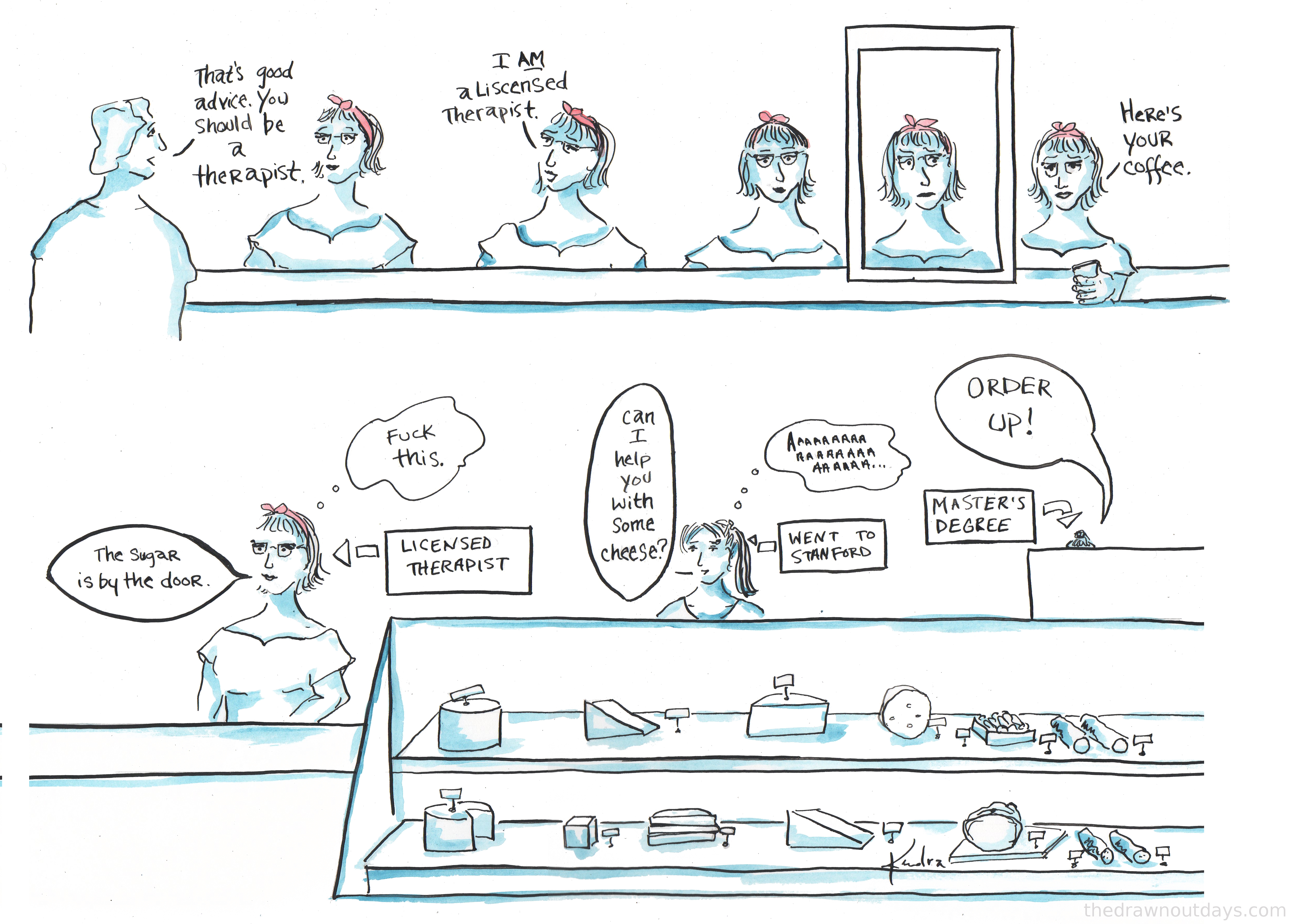
I went to a delightful potluck dinner where I was the only medical student (something of a rarity these days). The sun went down while we were eating, and after clearing the dishes we stretched out on the motley assortment of chairs, sofas, and pillows. In hushed tones, people started talking about their work situations. One had graduated with a degree in graphic design and could hardly find any work. Another had returned from a Fulbright fellowship and was unemployed. Several others had struck out looking for full-time employment. The job market is awful for people my age.
Their concerns felt a bit distant, because I'm still several years removed from the working world. But does being a medical student insulate oneself from the dispiriting economic realities of the day? It made me reflect upon how we choose our careers.
At the well-endowed university where I studied undergrad, at least a dozen professors knew me personally and were happy to meet with me and give career advice. There was also a well-staffed career advising center. For example, I stopped by the center to learn more about health professions. There I found an enormous binder of questionnaires filled out by alumni working in fields like medicine, podiatry, hospital administration, and epidemiology. Their write-ups included where they trained, why they find their work satisfying, what their average workday looks like, their salary range, what tips they have for undergraduates, etc. Many questionnaires also included contact info so that I could get in touch them and talk things over. Even with all of these resources available, I debated throughout my undergraduate years whether medical school was the right path for me.
Now I interact with undergraduates at other schools who have dramatically fewer career resources available to them. Sometimes they ask me for career advice. It unnerves me that some students I meet are basing their career choices on what I perceive as incomplete or inaccurate information.
And yet, can someone make a truly well-considered decision about whether becoming a physician is for them? It's hard to even figure out things like how much medical school will cost. Last year, Republicans in the House suddenly eliminated subsidized loans for medical students, meaning that new federal loans accrue interest during medical school and residency (at interest rates of 6.8% and 7.9%). This tacked on tens of thousands of dollars to the debt load that medical students will carry. Medical schools keep hiking tuition, and even the scholarships they offer students can be reduced or yanked after first year. It's increasingly common for students to graduate with over $200,000 in debt, financed at subprime interest rates. As that figure soars higher, it becomes increasingly difficult to cover interest payments and still make a dent in the loan principal.
Beyond the cost of education, the financial state of the profession is precarious. Medicare and private insurance reimbursement rates have been plummeting, and medical providers with substantially less training (nurse practitioners and physician assistants) are increasingly displacing doctors. If a student entering medical school today enters primary care, will he be able to pay off his loans within a reasonable timeframe? I can't make much of a prediction. Physicians are at the fickle mercy of legislators and private insurers. Furthermore, physicians' professional ethics and reluctance to organize leaves them particularly vulnerable to getting picked on.
And it's hard to know whether one will fit in the medical culture until one is in it. This field is extremely demanding. Some people get burned out. Some people realize it's not for them. Some people regret the specialty they train in. Some people get sick or injured and lack the physical stamina to proceed with their training. The thing is that once you've started, you can't really stop.
I don't have a good answer for the undergrads who seek my advice on whether to go into medicine. People will always need doctors, and doctors will always possess a unique means of serving their fellow man. But entering the medical profession is increasingly risky. It is a tremendous investment with uncertain reward. I hope for all of our sakes that it works out.
I went to a delightful potluck dinner where I was the only medical student (something of a rarity these days). The sun went down while we were eating, and after clearing the dishes we stretched out on the motley assortment of chairs, sofas, and pillows. In hushed tones, people started talking about their work situations. One had graduated with a degree in graphic design and could hardly find any work. Another had returned from a Fulbright fellowship and was unemployed. Several others had struck out looking for full-time employment. The job market is awful for people my age.
Their concerns felt a bit distant, because I'm still several years removed from the working world. But does being a medical student insulate oneself from the dispiriting economic realities of the day? It made me reflect upon how we choose our careers.
At the well-endowed university where I studied undergrad, at least a dozen professors knew me personally and were happy to meet with me and give career advice. There was also a well-staffed career advising center. For example, I stopped by the center to learn more about health professions. There I found an enormous binder of questionnaires filled out by alumni working in fields like medicine, podiatry, hospital administration, and epidemiology. Their write-ups included where they trained, why they find their work satisfying, what their average workday looks like, their salary range, what tips they have for undergraduates, etc. Many questionnaires also included contact info so that I could get in touch them and talk things over. Even with all of these resources available, I debated throughout my undergraduate years whether medical school was the right path for me.
Now I interact with undergraduates at other schools who have dramatically fewer career resources available to them. Sometimes they ask me for career advice. It unnerves me that some students I meet are basing their career choices on what I perceive as incomplete or inaccurate information.
Undergrad #1: "I was pre-med, but then Obamacare passed. It meant I would get paid so little if I became a doctor that I needed to switch careers. Now I'm planning to go into environmental law."
Me: "Lawyers coming out of law school are finding that it's a really tight job market. If money's an issue, are you sure that's the route you want to go?"
Undergrad #1: "Well, so long as I'm going to pick between sinking ships, I might as well do law."
___________
Undergrad #2: "I've been debating between med school and PA [physician assistant] school. As a PA I'd know about as much medicine as a doctor, but it's only 2 or 3 years of training."
Me: "Maybe this will be helpful for you when you're weighing your decision: I'm buddies with some PA students, and we find that PA school and medical school have pretty different aims. Becoming a physician involves learning medicine in much more depth and breadth than a PA, and that's why it takes so much longer to become a doctor."
Undergrad #2: "Yeah, but I really get medicine, so even if they don't teach us as much, I'm still going to learn it all."
And yet, can someone make a truly well-considered decision about whether becoming a physician is for them? It's hard to even figure out things like how much medical school will cost. Last year, Republicans in the House suddenly eliminated subsidized loans for medical students, meaning that new federal loans accrue interest during medical school and residency (at interest rates of 6.8% and 7.9%). This tacked on tens of thousands of dollars to the debt load that medical students will carry. Medical schools keep hiking tuition, and even the scholarships they offer students can be reduced or yanked after first year. It's increasingly common for students to graduate with over $200,000 in debt, financed at subprime interest rates. As that figure soars higher, it becomes increasingly difficult to cover interest payments and still make a dent in the loan principal.
Beyond the cost of education, the financial state of the profession is precarious. Medicare and private insurance reimbursement rates have been plummeting, and medical providers with substantially less training (nurse practitioners and physician assistants) are increasingly displacing doctors. If a student entering medical school today enters primary care, will he be able to pay off his loans within a reasonable timeframe? I can't make much of a prediction. Physicians are at the fickle mercy of legislators and private insurers. Furthermore, physicians' professional ethics and reluctance to organize leaves them particularly vulnerable to getting picked on.
And it's hard to know whether one will fit in the medical culture until one is in it. This field is extremely demanding. Some people get burned out. Some people realize it's not for them. Some people regret the specialty they train in. Some people get sick or injured and lack the physical stamina to proceed with their training. The thing is that once you've started, you can't really stop.
I don't have a good answer for the undergrads who seek my advice on whether to go into medicine. People will always need doctors, and doctors will always possess a unique means of serving their fellow man. But entering the medical profession is increasingly risky. It is a tremendous investment with uncertain reward. I hope for all of our sakes that it works out.
02 January 2013
Diagnosis III
A longtime patient had come in complaining of progressive fatigue, weakness, and numbness in her hands and feet. Her primary-care physician and I were taking a few seconds to skim her medical chart before we stopped by her room to examine her.
I glanced at the patient's weight and noticed that she was borderline obese. A potential diagnosis came together in my mind. "Has this patient ever had gastric bypass surgery?" I asked.
Him: "No."
Me: "Darn."
Him: "Why do you ask?"
Me: "I was wondering if maybe she has a vitamin deficiency, like B12, that's causing her symptoms." Some types of gastric bypass, such as Roux-en-Y procedures, remove some of the small intestine, thus reducing absorption of certain critical vitamins. Patients are supposed to take hefty vitamin supplements for life as a result.
Him: "It was a nice thought."
We went in to see the patient. She was very unhappy because she felt like she had no energy. Her family and job were stressful. And she was disappointed with her weight. "Even after getting that gastric bypass, I still weigh too much."
The doctor's eyes lit up. "How long ago was your gastric bypass?" he asked.
"It happened maybe 4 years back," the patient responded.
"I assume after your procedure they prescribed a special mega-vitamin."
"Yeah, but I didn't like it. I stopped taking it maybe half a year ago."
I couldn't stop myself from grinning.
Although I'm not skilled enough to be seeing patients entirely on my own, sometimes I've been able to make diagnoses that the doctors I'm with have overlooked. Part of the reason is that my training is uneven. In medical school, we spend a lot of time learning diseases that are rarely encountered in clinical practice. We also have seen so few patients that we have little sense of what is common and what is uncommon, which diseases make sense and which ones don't. When I see a patient, the list of diseases I'm considering differs from that of a seasoned physician.
But sometimes the patient doesn't have the disease a seasoned physician expects, and these are the times I get to shine. Sometimes, two minds are better than one. I wouldn't have expected it, but I think that patients get better care when they are examined by both a physician and a medical student as opposed to only a physician.
I glanced at the patient's weight and noticed that she was borderline obese. A potential diagnosis came together in my mind. "Has this patient ever had gastric bypass surgery?" I asked.
Him: "No."
Me: "Darn."
Him: "Why do you ask?"
Me: "I was wondering if maybe she has a vitamin deficiency, like B12, that's causing her symptoms." Some types of gastric bypass, such as Roux-en-Y procedures, remove some of the small intestine, thus reducing absorption of certain critical vitamins. Patients are supposed to take hefty vitamin supplements for life as a result.
Him: "It was a nice thought."
We went in to see the patient. She was very unhappy because she felt like she had no energy. Her family and job were stressful. And she was disappointed with her weight. "Even after getting that gastric bypass, I still weigh too much."
The doctor's eyes lit up. "How long ago was your gastric bypass?" he asked.
"It happened maybe 4 years back," the patient responded.
"I assume after your procedure they prescribed a special mega-vitamin."
"Yeah, but I didn't like it. I stopped taking it maybe half a year ago."
I couldn't stop myself from grinning.
Although I'm not skilled enough to be seeing patients entirely on my own, sometimes I've been able to make diagnoses that the doctors I'm with have overlooked. Part of the reason is that my training is uneven. In medical school, we spend a lot of time learning diseases that are rarely encountered in clinical practice. We also have seen so few patients that we have little sense of what is common and what is uncommon, which diseases make sense and which ones don't. When I see a patient, the list of diseases I'm considering differs from that of a seasoned physician.
But sometimes the patient doesn't have the disease a seasoned physician expects, and these are the times I get to shine. Sometimes, two minds are better than one. I wouldn't have expected it, but I think that patients get better care when they are examined by both a physician and a medical student as opposed to only a physician.
27 December 2012
Money and medicine: the Nexium swindle
If you live in the United States, you have almost certainly encountered advertisements for Nexium (esomeprazole), a prescription medication for heartburn relief. Its ad slogan is "the purple pill." (If you live in any other developed country, your government will have forbidden advertising a prescription medication over the television.)
Nexium is a drug that shouldn't exist. It contains the exact same active ingredient*, in the exact same amount, as an older drug, Prilosec. Prilosec (omeprazole) is currently available over-the-counter as a relatively inexpensive generic drug. But Nexium is currently the third-highest-selling prescription medication in the U.S., with sales of over $6 billion a year.
How could this have happened?
The abbreviated version of the story is that years ago, AstraZeneca, which originally manufactured Prilosec, recognized that it would lose billions of dollars in sales once Prilosec lost its patent protection. And so, it developed Nexium and set in motion an enormous advertising campaign. It gave incentives to doctors and patients who switched their prescriptions from Prilosec to Nexium. The plan worked beautifully. This "Nexium swindle" is just one of many unethical but legal practices in the pharmaceutical industry that each year net tens of billions (possibly hundreds of billions) of extra revenue.
Many issues in health care (doctor shortages, expensive health insurance, steep medical school tuition, difficulty in getting a primary care physician, burnout amongst medical providers) really could be solved with more money. And yet Congress, under pressure from the pharmaceutical lobby, has mandated that Medicare pay full price for prescription medications. Congress also forbade Medicare from keeping a formulary of preferred drugs. It amounts to a massive ongoing handout to the pharmaceutical industry.
We ought to stop paying for useless drugs like Nexium, which have excellent and dramatically less expensive alternatives. If every patient on Nexium were switched to Prilosec (which is virtually the same drug), there would be enough money to pay for every current medical student's tuition, with billions of dollars to spare. And that's just one drug of many.
America is being scammed, and very few people realize it.
___________
*The key difference between the two drugs is that omeprazole contains an inactive ingredient that is absent in esomeprazole. For those who know a bit of organic chemistry, omeprazole contains a racemic mixture while esomeprazole has only the active enantiomer. Unsurprisingly, the manufacturer has had a difficult time showing any difference in effectiveness between drugs.
Nexium is a drug that shouldn't exist. It contains the exact same active ingredient*, in the exact same amount, as an older drug, Prilosec. Prilosec (omeprazole) is currently available over-the-counter as a relatively inexpensive generic drug. But Nexium is currently the third-highest-selling prescription medication in the U.S., with sales of over $6 billion a year.
How could this have happened?
The abbreviated version of the story is that years ago, AstraZeneca, which originally manufactured Prilosec, recognized that it would lose billions of dollars in sales once Prilosec lost its patent protection. And so, it developed Nexium and set in motion an enormous advertising campaign. It gave incentives to doctors and patients who switched their prescriptions from Prilosec to Nexium. The plan worked beautifully. This "Nexium swindle" is just one of many unethical but legal practices in the pharmaceutical industry that each year net tens of billions (possibly hundreds of billions) of extra revenue.
Many issues in health care (doctor shortages, expensive health insurance, steep medical school tuition, difficulty in getting a primary care physician, burnout amongst medical providers) really could be solved with more money. And yet Congress, under pressure from the pharmaceutical lobby, has mandated that Medicare pay full price for prescription medications. Congress also forbade Medicare from keeping a formulary of preferred drugs. It amounts to a massive ongoing handout to the pharmaceutical industry.
We ought to stop paying for useless drugs like Nexium, which have excellent and dramatically less expensive alternatives. If every patient on Nexium were switched to Prilosec (which is virtually the same drug), there would be enough money to pay for every current medical student's tuition, with billions of dollars to spare. And that's just one drug of many.
America is being scammed, and very few people realize it.
___________
*The key difference between the two drugs is that omeprazole contains an inactive ingredient that is absent in esomeprazole. For those who know a bit of organic chemistry, omeprazole contains a racemic mixture while esomeprazole has only the active enantiomer. Unsurprisingly, the manufacturer has had a difficult time showing any difference in effectiveness between drugs.
26 December 2012
"The Woman Who Decided to Die", by Ronald Munson
Perhaps I feel partial to this book because Prof. Munson's introduction to medical practice came the same way mine did: through the lens of clinical ethics. Munson is not a physician, but a bioethicist. His book, "The Woman Who Decided to Die," features 10 vignettes of striking, yet representative ethical predicaments that he has encountered over his career. Munson is a gifted writer, and this book benefits from his succinct, rich, and approachable form of narrative.
The format of the chapters is straightforward: in each, he tells the story of a patient he has worked with. Then, he devotes a couple of pages to the ethical issues inherent to the case, and how doctors approach these issues clinically. For example, a convicted murderer is admitted to the ICU with a failing heart. Prof. Munson is called in for an emergency consultation to determine whether the patient should be put on the transplant list. Should a murderer get a heart before someone innocent?
Perhaps surprisingly for a book about ethics, the book vividly portrays the patient's stories, through the help of lengthy interviews with the patients. Munson also conveys very well the art of medicine. Through his writing we witness the thought process going through the minds of doctors, and the delicate and careful ways that they elicit information from their patients and provide guidance. The book discusses complex issues in medicine in a way that non-scientists can understand, which is rare.
Prof. Munson has written an excellent book. I heartily recommend it as an introduction to clinical medicine and bioethics.
The format of the chapters is straightforward: in each, he tells the story of a patient he has worked with. Then, he devotes a couple of pages to the ethical issues inherent to the case, and how doctors approach these issues clinically. For example, a convicted murderer is admitted to the ICU with a failing heart. Prof. Munson is called in for an emergency consultation to determine whether the patient should be put on the transplant list. Should a murderer get a heart before someone innocent?
Perhaps surprisingly for a book about ethics, the book vividly portrays the patient's stories, through the help of lengthy interviews with the patients. Munson also conveys very well the art of medicine. Through his writing we witness the thought process going through the minds of doctors, and the delicate and careful ways that they elicit information from their patients and provide guidance. The book discusses complex issues in medicine in a way that non-scientists can understand, which is rare.
Prof. Munson has written an excellent book. I heartily recommend it as an introduction to clinical medicine and bioethics.
19 December 2012
Now, go pee in this cup
Some moments in medical school are surreal.
Our morning lecture concerned urinalysis (a standard set of important laboratory tests done on urine samples). We were all issued specimen cups and instructed to obtain urine samples (i.e. go pee in our cups). Throughout lecture, students slipped out of the auditorium and returned toting transparent containers that now were partly filled. When lecture ended, we tromped upstairs, specimen cups still in hand, and then as a group performed medical assays on our urine. Since most people's urine was normal, we hunted for classmates whose urine had abnormal findings, like crystals, blood, nitrites, or white blood cells.
It's entirely sensible that this activity was conducted the way it was. We need to learn how to perform urinalysis, and for technical reasons the urine ought to be fresh. We're at a stage in our training in which we're expected to be professional and comfortable handling bodily fluids.
But the image of me and my classmates, walking the halls of our school each carrying a plastic cup filled with his own urine, is pretty weird. Just another day in the life of a medical student.
Our morning lecture concerned urinalysis (a standard set of important laboratory tests done on urine samples). We were all issued specimen cups and instructed to obtain urine samples (i.e. go pee in our cups). Throughout lecture, students slipped out of the auditorium and returned toting transparent containers that now were partly filled. When lecture ended, we tromped upstairs, specimen cups still in hand, and then as a group performed medical assays on our urine. Since most people's urine was normal, we hunted for classmates whose urine had abnormal findings, like crystals, blood, nitrites, or white blood cells.
It's entirely sensible that this activity was conducted the way it was. We need to learn how to perform urinalysis, and for technical reasons the urine ought to be fresh. We're at a stage in our training in which we're expected to be professional and comfortable handling bodily fluids.
But the image of me and my classmates, walking the halls of our school each carrying a plastic cup filled with his own urine, is pretty weird. Just another day in the life of a medical student.
17 December 2012
Needless suffering
I attended a talk by Dr. Howard Koh, the current Assistant Secretary for Health. While practicing as a physician, he encountered too much of what he called "needless suffering." He gave as an example a young father whose potentially-treatable cancer had been diagnosed too late, because he lacked health insurance. Dr. Koh decide that he ought to enter public health and policy, so that he could improve the way health care is delivered and help many lives.
Many of our country's children suffer needlessly, whether from violence, from poverty, from abuse, from preventable diseases, from motor vehicle accidents, from broken schools, from obesity, from broken homes, from lack of opportunity, and on and on. I say "needlessly" because many of these problems could be at least partly fixed, if only we made doing so more of a priority.
And yet we are reversing past gains. The life expectancy for certain segments of our population has been dropping over the past years. For example, the life expectancy of white women without a high school diploma was 5 years less in 2008 than it was in 1990. We are needlessly losing ground.
Our country has united in mourning the 20 children and 6 adults in Newtown, CT whose lives were cut short. Our profound feeling of loss ought to remind us that life is precious, and that one of our highest callings is to love our fellow man and protect our youngest. I hope that their memory will compel us to alleviate that suffering which needlessly afflicts those among us. Our work is cut out for us.
16 December 2012
Book recommendations
I like reading books about medicine, and I have found some of them
particularly gripping and enlightening. You might enjoy them too. All of
these books were written for a general audience.
Practice of medicine
-"Complications," by Atul Gawande
-"Incidental Findings," by Danielle Ofri
-"Better," by Atul Gawande
Cancer
"The Emperor of All Maladies," by Siddartha Mukherjee
Neurology
"The Man Who Mistook His Wife for a Hat," by Oliver Sacks
Medical ethics
-"The Woman Who Decided to Die," by Ronald Munson
Medicine in literature
-"The Plague," by Albert Camus
Big Pharma
-"White Coat, Black Hat," by Carl Elliott
-"The Truth about the Drug Companies," by Marcia Angell
Medical errors
-"Internal Bleeding," by Robert Wachter and Kaveh Shojania
Infectious disease
-"The Great Influenza," by John Barry
-"The Coming Plague," by Laurie Garrett
-"The Hot Zone," by Richard Preston
-"House on Fire: The Fight to Eradicate Smallpox," by William Foege
Endocrinology
-"Why Zebras Don't Get Ulcers," by Robert Sapolsky
Medicine during wartime
-"Long Walk Through War," by Klaus Huebner
Emergency medicine
-"The Blood of Strangers," by Frank Huyler
Practice of medicine
-"Complications," by Atul Gawande
-"Incidental Findings," by Danielle Ofri
-"Better," by Atul Gawande
Cancer
"The Emperor of All Maladies," by Siddartha Mukherjee
Neurology
"The Man Who Mistook His Wife for a Hat," by Oliver Sacks
Medical ethics
-"The Woman Who Decided to Die," by Ronald Munson
Medicine in literature
-"The Plague," by Albert Camus
Big Pharma
-"White Coat, Black Hat," by Carl Elliott
-"The Truth about the Drug Companies," by Marcia Angell
Medical errors
-"Internal Bleeding," by Robert Wachter and Kaveh Shojania
Infectious disease
-"The Great Influenza," by John Barry
-"The Coming Plague," by Laurie Garrett
-"The Hot Zone," by Richard Preston
-"House on Fire: The Fight to Eradicate Smallpox," by William Foege
Endocrinology
-"Why Zebras Don't Get Ulcers," by Robert Sapolsky
Medicine during wartime
-"Long Walk Through War," by Klaus Huebner
Emergency medicine
-"The Blood of Strangers," by Frank Huyler
14 December 2012
Today's events
I was touched by our president's heartfelt remarks on today's shooting at a Connecticut elementary school:
In reflecting upon this tragedy, I see the deceased not only as victims of gun violence but as victims of mental illness. Those of sound mind do not massacre children.
As we reflect on how we can prevent future violence, I submit that in addition to tightening up our gun-control laws (why can people still lawfully obtain high-capacity magazines?), we might combat criminal insanity by strengthening our country's debilitated and woefully underfunded social support programs. Making mental health treatment more accessible will prevent some would-be shooters from ever having the intention to kill.
My thoughts are with the victims and their families.
In reflecting upon this tragedy, I see the deceased not only as victims of gun violence but as victims of mental illness. Those of sound mind do not massacre children.
As we reflect on how we can prevent future violence, I submit that in addition to tightening up our gun-control laws (why can people still lawfully obtain high-capacity magazines?), we might combat criminal insanity by strengthening our country's debilitated and woefully underfunded social support programs. Making mental health treatment more accessible will prevent some would-be shooters from ever having the intention to kill.
My thoughts are with the victims and their families.
 |
| (from "Willa's World") |
11 December 2012
Money and medicine: medical schools and primary care
I attended a talk by the dean of admissions of one of the most competitive medical schools nationwide. The topic was primary care and community health. He talked at length about how not enough medical students were entering primary care. He put up some graphs showing that the most lucrative specialties tend to be the most competitive ones, with primary care among the lowest-paying and least-competitive. He said that medical schools need to be making primary care more appealing. And he talked about how, in his long tenure as dean of admissions, he has been steadfastly committed to selecting those applicants who are committed to becoming the next generation of leaders in primary care.
I went up to the dean afterwards and alluded to the fact that nearly all graduates from his medical school go into medical specialties instead of primary care. Has his school considered creating a loan forgiveness program for students who pursue careers in primary care, giving them an added incentive to enter the field?
His response: "There's no need for such a program, because I'm confident that our medical students don't choose their specialties based on financial considerations."
Me: "But during your talk you put up a graph showing that medical students nationwide do exactly that."
Dean of admissions: "Our graduates have some of the lowest debt levels in the country, so financial constraints aren't a concern."
Me: "If financial constraints aren't a concern, and if you're admitting students based on their likelihood of going into primary care, then why are so many of those admitted students going into specialties? Is it because it's difficult to predict what specialty an applicant will eventually pursue?"
Dean of admissions: "Not at all. We're quite good at picking the right students..."
And so, this fruitless conversation dragged on for longer than it should have.
The dean of admissions may well care passionately about primary care—after all, he cared enough to give a talk on that topic. But his school certainly doesn't see its mission as training primary care doctors, a notion borne out by the careers its graduates enter. And why would the school care about primary care? Primary care doctors tend not to make the big-deal research discoveries that net Nobel Prizes. They tend not to accrue the sort of wealth that would someday allow them to endow professorships. They tend not to invent new procedures and new drugs. Their work goes largely unnoticed, except by the patients they care for.
If schools truly cared about training primary care doctors, then they would reduce the financial barriers to entering primary care. They could do so by defraying the tuition of those who commit to enter primary care, or by forgiving some of the loans of those students who enter primary care. In fact, some top law schools do exactly this for those students who commit to entering careers in public service or as public defenders. Some business schools do it for MBAs who work for non-profits.
But I don't think most medical schools care, and this ambivalence rubs off on its students. It's one of the contributors to the dearth of American medical students entering primary care.
More on money and medicine in subsequent posts.
I went up to the dean afterwards and alluded to the fact that nearly all graduates from his medical school go into medical specialties instead of primary care. Has his school considered creating a loan forgiveness program for students who pursue careers in primary care, giving them an added incentive to enter the field?
His response: "There's no need for such a program, because I'm confident that our medical students don't choose their specialties based on financial considerations."
Me: "But during your talk you put up a graph showing that medical students nationwide do exactly that."
Dean of admissions: "Our graduates have some of the lowest debt levels in the country, so financial constraints aren't a concern."
Me: "If financial constraints aren't a concern, and if you're admitting students based on their likelihood of going into primary care, then why are so many of those admitted students going into specialties? Is it because it's difficult to predict what specialty an applicant will eventually pursue?"
Dean of admissions: "Not at all. We're quite good at picking the right students..."
____________
And so, this fruitless conversation dragged on for longer than it should have.
The dean of admissions may well care passionately about primary care—after all, he cared enough to give a talk on that topic. But his school certainly doesn't see its mission as training primary care doctors, a notion borne out by the careers its graduates enter. And why would the school care about primary care? Primary care doctors tend not to make the big-deal research discoveries that net Nobel Prizes. They tend not to accrue the sort of wealth that would someday allow them to endow professorships. They tend not to invent new procedures and new drugs. Their work goes largely unnoticed, except by the patients they care for.
If schools truly cared about training primary care doctors, then they would reduce the financial barriers to entering primary care. They could do so by defraying the tuition of those who commit to enter primary care, or by forgiving some of the loans of those students who enter primary care. In fact, some top law schools do exactly this for those students who commit to entering careers in public service or as public defenders. Some business schools do it for MBAs who work for non-profits.
But I don't think most medical schools care, and this ambivalence rubs off on its students. It's one of the contributors to the dearth of American medical students entering primary care.
More on money and medicine in subsequent posts.
10 December 2012
Money and medicine, introduction
From a well-written Business Week article on concierge medicine [emphasis mine]:
The [Affordable Care Act] will enable 30 million previously uninsured people to get coverage through an expansion of Medicaid. They’ll need primary care, but it’s not yet clear who will give it to them. By 2020, the Association of American Medical Colleges estimates, there will be 45,000 fewer primary-care doctors than the U.S. needs. “For the last 13 years, very few students have been going into it,” says Patrick Dowling, chairman of the department of family medicine at the University of California-Los Angeles’s David Geffen School of Medicine. “What motivates medical school students is income, just like everyone else.”
What's supposed to set physicians apart from other professions is a deeply-held code of ethics, which demands that one place the patient's interests ahead of one's own. If Prof. Dowling is correct that income truly is what motivates medical students, "just like everyone else," then this code of ethics no longer applies. Medicine is simply a business, its physicians no different from financiers and salesmen. It appears that Prof. Dowling has ceased to believe in his profession.
In my next posts, I will explore money and medicine. What motivates medical students, if not income? Why, when our country spends the most (per person, in absolute expenditure, and as share of GDP) on health care in the world, is America's health so lackluster? Where does the money go? How can the system be improved? What will the Affordable Care Act do to medicine? I also invite you to write a comment about what topics might interest you.
05 December 2012
A sad day
The purpose of the present Convention is to promote, protect and ensure the full and equal enjoyment of all human rights and fundamental freedoms by all persons with disabilities, and to promote respect for their inherent dignity.
—from the United Nations Convention on the Rights of Persons With Disabilities, an international treaty that came up for ratification in the Senate yesterday. 126 countries have already ratified.
____________
This is one of the saddest days I’ve seen in almost 28 years in the Senate, and it needs to be a wake-up call about a broken institution that’s letting down the American people.
—Sen. John Kerry (D-MA), after Republican senators yesterday voted down the ratification of the treaty.
____________
According to the Kaiser Family Foundation, other international treaties pertinent to global health that the Senate has also declined to ratify:
- the Convention on the Elimination of All Forms of Discrimination Against Women (CEDAW);
- the Convention on the Rights of the Child (CRC);
- the Convention on Biological Diversity;
- the Kyoto Protocol to the United Nations Framework Convention on Climate Change;
- the Stockholm Convention on Persistent Organic Pollutants (POPs);
- the WHO Framework Convention on Tobacco Control (WHO FCTC);
- the Cartagena Protocol on Biosafety to the United Nations Convention on Biological Diversity;
- the Convention on the Protection and Use of Transboundary Watercourses and International Lakes (Water Convention);
- the London Protocol on Water and Health to the 1992 Convention on the Protection and Use of Transboundary Watercourses and International Lakes; and
- the Ottawa Treaty (Mine Ban Treaty).
____________
The United States can hardly consider itself a world leader in health when it abandons so many worthy global health efforts. And now, in rejecting the United Nations Convention on the Rights of Persons With Disabilities, we have deserted the cause of those least able to help themselves. A sad day indeed.
02 December 2012
This is your brain on football
From a previous post in January:
Football seems to subject its players to enough physical and neurological risk that I expect I'll discourage my future patients from joining a competitive football team. Friends of mine who played Division I college football loved it and have gone on to play professionally. They continue to live and breathe football. But I noticed a toll—frequent concussions, dramatic injuries and surgeries, shocking addiction to painkillers, and a difficulty in balancing the competing demands of being a student and of being a quasi-professional athlete.
Scientists are finding that the constant hits (even "microtraumas" that don't rise to the level of concussions) that football players endure can cause chronic traumatic encephalopathy (CTE). CTE is a progressive, untreatable, dramatic, and ultimately fatal decay of the brain that can only be diagnosed post-mortem. Researchers are increasingly conducting autopsies on NFL players and college football players, and they are finding shockingly widespread evidence of CTE. Even deceased players in their 20s and 30s are turning up with CTE, which is otherwise seen only in the elderly. The science in this field is preliminary, yet it is increasingly clear that professional, college, and high school football is a tremendously risky endeavor.
I really do enjoy gridiron football, and on the brisk evening of a big college game I was one of the shirtless guys in the stands wearing body paint. Yet recently I've stopped attending games and I even feel conflicted about cheering my home team while I watch on TV. Wouldn't it make me a hypocrite to say one thing to my patients and do another? Am I taking all of this too seriously?
Moments ago, a big-deal paper out of Boston University (BU) was released by the journal Brain. The BU team discovered 15 previously-unknown cases of CTE in former NFL players. That means that of the 34 brains of deceased NFL players examined so far by the BU team, 33 have been found on autopsy to have CTE. The team also diagnosed CTE in some football players who didn't play football beyond college or high school, as well as in some NHL hockey players. The paper also looked at controls (patients who played sports besides hockey or pro football) and found few with CTE. The team also catalogued the devastating neurological symptoms suffered by the players with CTE, like depression, explosivity, and dementia. It strikes me as a thorough and well-done paper with major findings.
In my mind, the release of this paper is a watershed moment. The science on CTE is in. Football clearly destroys some of its players' brains. The questions at this point are how many of its players are affected, and how badly.
I don't feel conflicted anymore. Until the sport changes, I'm done with following football.
28 November 2012
Insurance
A New York Times article a few years back tried to find out why health insurance companies didn't cover the cost of test strips for diabetics who needed to check their blood sugar levels. Test strips are fairly cheap, and without them, it's impossible to control one's blood sugar. Uncontrolled diabetes can eventually lead to lots of bad medical problems, like kidney failure, limb amputation, and cardiovascular disease, all of which are quite expensive. Wouldn't it be profitable for insurance companies to cover test strips now and avoid complications later?
The answer the Times found was a cynical but rational one. People spend an average of something like seven years with their health insurance company before switching to another (perhaps by changing jobs, or by their employer changing health insurers). If one insurance company provided test strips free of charge, the savings in eventual health costs would be passed on to that company's competitors. When insurance companies emphasize prevention, they lose money.
For years I've had an idea that I've never seen anyone suggest. What if your health insurance company also provided your life insurance? That way, there would be some added profit incentive for your insurance company to keep you alive for longer.
The answer the Times found was a cynical but rational one. People spend an average of something like seven years with their health insurance company before switching to another (perhaps by changing jobs, or by their employer changing health insurers). If one insurance company provided test strips free of charge, the savings in eventual health costs would be passed on to that company's competitors. When insurance companies emphasize prevention, they lose money.
For years I've had an idea that I've never seen anyone suggest. What if your health insurance company also provided your life insurance? That way, there would be some added profit incentive for your insurance company to keep you alive for longer.
21 November 2012
Foresight
HERDSMANI find Oedipus Rex tough to read, because everyone but Oedipus sees where things are headed. Oedipus doggedly investigates the death of the king. He is blindsided (and blinded) by the sudden revelation (see above) that he had unknowingly killed the king (his father) and wed his mother. Throughout the play, Oedipus is a step behind everyone else. He's the last to know the truth.
If you are in fact what this man says,
God have pity on you! You were born to misery.
OEDIPUS
Oh! Oh! All come to pass, all true!
A patient came in with rapidly progressive weakness of recent onset. In his usual state of health just months ago, he could hardly walk without falling and could barely summon the strength and dexterity required to button his shirt. He wanted to know why.
At the start of the visit, the physician and I assembled differential diagnoses in our minds. The physician obtained an excellent patient history, eliciting answers that ruled out some of the diagnoses on our lists. Pretty soon, all of the potentially reversible illnesses on my differential were ruled out. Nothing much seemed to fit the patient's symptoms, except for amyotrophic lateral sclerosis (ALS, also called Lou Gehrig's Disease). It is an awful disease, progressively paralyzing the body's muscles while leaving one's mental faculties intact.
We moved on to the physical examination. The doctor performed tests specific to ALS, and our findings increasingly supported that diagnosis. I was filled with a horrible sense of foreboding. I could tell that within minutes the diagnosis would be confirmed. Given the rapid progression of his disease, he didn't have many more months to live. I steeled myself for the wrenching moment when the patient would be informed.
Our medical training confers upon us some prophetic powers. In making diagnoses, we interpret signs on the body that are inscrutable to most. With our medical knowledge, we can sometimes accurately predict the course of a disease. Like Cassandra and Tiresias of ancient Greece, we issue dire warnings ("if you don't quit drinking, it will kill you!") that often go unheeded.
But as neat as it is to see the future, I now understand that this faculty can be a burden. Like those prophets of old, we were condemned to foretell this patient's tragic fate yet powerless to alter it.
14 November 2012
You can't stay pluripotent forever
The human body contains all kinds of cells: cells that secrete mucus, cells that sense light, cells that make up your skin, cells that make up your brain. But we begin as embryos, which are devoid of these "differentiated" types of cells. No matter how much you dig, you will not find in an early embryo the specialized cell that manufactures your stomach acid. Rather, embryos contain "pluripotent" cells. These remarkable cells, which multiply in number during development, can differentiate into progressively more specialized types of cells. Taken together, the pluripotent cells possess the unique ability to become any type of cell in the body.
Once a pluripotent cell differentiates, it cannot become pluripotent again. A taste bud can't become a sweat gland. Its job is ordained.
As an undergraduate, I had a romantic image of myself as doctor. I had arrayed in my mind brief snapshots, as though from a movie, of myself (with grayed temples and long white coat) performing manifold deeds:
I used to think that to become "super-doctor," I needed to enter the medical specialty that offered the broadest scope of practice. The obvious choice was family medicine, which includes basic surgeries, childbirth, and treating patients of all ages. Family medicine physicians excel when working in sparsely-populated areas, where their broad set of skills proves especially valuable.
But recently I've begun valuing depth over breadth. When I shadow specialists, I find that within their specialty, they tend to outperform non-specialists. Pediatric hospitalists are particularly good at taking care of hospitalized pediatric patients. A knee surgeon is particularly good at operating on knees. An oncologist is particularly good at treating cancer. I feel I'd serve my patients best if I too focused on some segment of medicine that captures my particular interests and plays to my strengths.
It's hard to stomach that someday I will probably see either adult patients or pediatric patients, but not both. I entered medicine because I wanted to help all people, not just those with gastric cancer, or with cataracts, or who are under the age of 18.
Being a medical student is an exciting time. We study all disciplines of medicine. We perform mandatory clerkships in all of the core medical specialties. During fourth year, we can take electives in whatever field we want. But we cannot forever remain medical students. Eventually we have to choose a path, and leave behind options once open to us. I take solace in some sagely advice I once had received: "You can't stay pluripotent forever." For now, I intend to enjoy this time of limitless potential.
Once a pluripotent cell differentiates, it cannot become pluripotent again. A taste bud can't become a sweat gland. Its job is ordained.
As an undergraduate, I had a romantic image of myself as doctor. I had arrayed in my mind brief snapshots, as though from a movie, of myself (with grayed temples and long white coat) performing manifold deeds:
-counseling a newly pregnant woman on prenatal careAlthough a doctor's license technically allows him to practice any kind of medicine, what I had barely grasped was that a doctor's specialty largely dictates which diseases he does (or does not) treat. Internal medicine doctors don't deliver children. A spine surgeon will not medically manage a thyroid disorder. A pathologist doesn't see patients in outpatient clinic.
-uncovering a tricky diagnosis in an emergency room patient
-delivering a newborn child
-helping a teenager overcome an eating disorder
-tailoring a cancer treatment to a patient's genetic signature
-leading a community in the face of a frightening pandemic
-performing a circumcision
-treating patients in a refugee camp
I used to think that to become "super-doctor," I needed to enter the medical specialty that offered the broadest scope of practice. The obvious choice was family medicine, which includes basic surgeries, childbirth, and treating patients of all ages. Family medicine physicians excel when working in sparsely-populated areas, where their broad set of skills proves especially valuable.
But recently I've begun valuing depth over breadth. When I shadow specialists, I find that within their specialty, they tend to outperform non-specialists. Pediatric hospitalists are particularly good at taking care of hospitalized pediatric patients. A knee surgeon is particularly good at operating on knees. An oncologist is particularly good at treating cancer. I feel I'd serve my patients best if I too focused on some segment of medicine that captures my particular interests and plays to my strengths.
It's hard to stomach that someday I will probably see either adult patients or pediatric patients, but not both. I entered medicine because I wanted to help all people, not just those with gastric cancer, or with cataracts, or who are under the age of 18.
Being a medical student is an exciting time. We study all disciplines of medicine. We perform mandatory clerkships in all of the core medical specialties. During fourth year, we can take electives in whatever field we want. But we cannot forever remain medical students. Eventually we have to choose a path, and leave behind options once open to us. I take solace in some sagely advice I once had received: "You can't stay pluripotent forever." For now, I intend to enjoy this time of limitless potential.
07 November 2012
Home birth
Sometimes I find myself in arguments on medical subjects with non-medical people (for example, with seatmates on airplanes). One argument concerned "natural" home birth. My stance is that if I were a pregnant woman, I would be quite uncomfortable with having my birth at home.*
Pregnancy and birth is a wonderful, yet involved, process. Pregnancy stresses the female body, altering the homeostasis (the equilibrium) of many of the body's systems. For example, pregnant women are more likely to experience blood clots, in part because of a change in their hormones. They have to urinate more often. Some parts of the pregnant woman's brain grow new neurons (which is actually a huge deal, because adults weren't previously thought to be able to grow new brain tissue). Towards the end of the pregnancy, the gigantic uterus competes with the lungs for space in the body, making breathing more difficult. The spine has to adjust to carrying more weight. The heart is more likely to arrest. The list goes on.
Childbirth especially places the body under stress. Sometimes, deliveries have complications. Arterioles can rupture, causing hemorrhage. The fetus can be positioned the wrong way in the birth canal. The fetus's umbilical cord can wrap around its neck, strangling it. The variety of potential complications is substantial. Fortunately, obstetricians can do quite a lot to resolve these complications when they arise, sparing the life of the mother and the child. What is frightening is that grave complications can come on suddenly and without warning, and they need to be dealt with emergently.
As I alluded to in my recent post on diagnosis, when approaching a complex matter, it often helps to break it down into its simpler, constituent parts. Those working on maternal mortality worldwide have done just that. There is a "three-delay" model of contributors to maternal mortality in complicated deliveries:
1. delay in recognizing problems in labor and deciding to seek medical help;
2. delay in reaching a skilled medical facility; and
3. delay in obtaining the appropriate intervention on arrival.
The trouble with home birth (relative to at a hospital or a birth center) is that it definitely delays number 2 and usually delays numbers 1 and 3. Delays in medicine are costly. Regarding strokes, neurologists say that "time is brain." Regarding heart attacks, cardiologists say that "time is muscle." I am coining the aphorism that in obstetrics, "time is life"—that of the mother and that of the fetus.
To be sure: most low-risk pregnancies result in uncomplicated deliveries, whether in one's home or in a hospital. It's when a delivery doesn't go smoothly that one will want to quickly find herself in the hands of a skilled physician.
* Summary statement of the American College of Obstetrics and Gynecology's Feb. 2011 position paper on planned home birth:
Pregnancy and birth is a wonderful, yet involved, process. Pregnancy stresses the female body, altering the homeostasis (the equilibrium) of many of the body's systems. For example, pregnant women are more likely to experience blood clots, in part because of a change in their hormones. They have to urinate more often. Some parts of the pregnant woman's brain grow new neurons (which is actually a huge deal, because adults weren't previously thought to be able to grow new brain tissue). Towards the end of the pregnancy, the gigantic uterus competes with the lungs for space in the body, making breathing more difficult. The spine has to adjust to carrying more weight. The heart is more likely to arrest. The list goes on.
Childbirth especially places the body under stress. Sometimes, deliveries have complications. Arterioles can rupture, causing hemorrhage. The fetus can be positioned the wrong way in the birth canal. The fetus's umbilical cord can wrap around its neck, strangling it. The variety of potential complications is substantial. Fortunately, obstetricians can do quite a lot to resolve these complications when they arise, sparing the life of the mother and the child. What is frightening is that grave complications can come on suddenly and without warning, and they need to be dealt with emergently.
As I alluded to in my recent post on diagnosis, when approaching a complex matter, it often helps to break it down into its simpler, constituent parts. Those working on maternal mortality worldwide have done just that. There is a "three-delay" model of contributors to maternal mortality in complicated deliveries:
1. delay in recognizing problems in labor and deciding to seek medical help;
2. delay in reaching a skilled medical facility; and
3. delay in obtaining the appropriate intervention on arrival.
The trouble with home birth (relative to at a hospital or a birth center) is that it definitely delays number 2 and usually delays numbers 1 and 3. Delays in medicine are costly. Regarding strokes, neurologists say that "time is brain." Regarding heart attacks, cardiologists say that "time is muscle." I am coining the aphorism that in obstetrics, "time is life"—that of the mother and that of the fetus.
To be sure: most low-risk pregnancies result in uncomplicated deliveries, whether in one's home or in a hospital. It's when a delivery doesn't go smoothly that one will want to quickly find herself in the hands of a skilled physician.
* Summary statement of the American College of Obstetrics and Gynecology's Feb. 2011 position paper on planned home birth:
Although the Committee on Obstetric Practice believes that hospitals and birthing centers are the safest setting for birth, it respects the right of a woman to make a medically informed decision about delivery. Women inquiring about planned home birth should be informed of its risks and benefits based on recent evidence. Specifically, they should be informed that although the absolute risk may be low, planned home birth is associated with a twofold to threefold increased risk of neonatal death when compared with planned hospital birth. Importantly, women should be informed that the appropriate selection of candidates for home birth; the availability of a certified nurse–midwife, certified midwife, or physician practicing within an integrated and regulated health system; ready access to consultation; and assurance of safe and timely transport to nearby hospitals are critical to reducing perinatal mortality rates and achieving favorable home birth outcomes.
06 November 2012
The evacuation of NYU Langone hospital
An NYU medical student recounts the emergency evacuation of his academic teaching hospital after Hurricane Sandy. I can hardly imagine how frightening that experience would be.
I respectfully disagree with one assertion in his account:
The loss of backup power generators was quite "thinkable". It happened in New Orleans hospitals during Hurricane Katrina, and Manhattan is known to be at risk for flooding from storms (especially NYU, which is close to shore). Although the evacuation of NYU Langone and Bellevue hospitals is a story of how the medical community came together during trying times to save their patients, it also is a lesson in how foresight and preparedness go quite a long way.
I respectfully disagree with one assertion in his account:
Last Monday night, these buildings flooded, and PSE&G shut off electricity to all buildings below 40th Street. And then, as you've probably heard, the unthinkable occurred: the hospital's backup power generator failed.
31 October 2012
A tradition of mentorship
A friend was working an overnight shift in the ER for one of her mandatory rotations, so I popped in to observe. The ER was surprisingly quiet. A classmate was also observing that night, and like me, he was standing around, bored. We spotted an electrocardiogram (EKG) readout lying on a desk where a resident was working, and we asked him if we could take a stab at interpreting it (an electrocardiogram tracks the electrical activity of the heart, and a skilled interpreter can use it to reliably diagnose heart problems). He handed us not only that piece of paper, but the EKGs from some other patients who were in the ER. "I'm going to see a patient," he said, "and when I come back, tell me your results and whether any of these people is having an emergency."
At that point, we had learned only the basics of reading EKGs. We wrestled with the readout, trying to flesh out the story told by the squiggly gyrations of the EKG lines. We opened a textbook on cardiac disease and reviewed the way certain diseases of the heart express themselves on an EKG.
The resident returned and quizzed us on our findings. Then, he shared strategies for reading EKGs that he'd picked up over the years. The three of us read through the EKGs together. In a final flourish, he picked up a new patient's complicated EKG readout and accurately diagnosed a subtle type of abnormality in the heart's electrical conduction.
Medical residents are extremely busy people. Even though this resident had never met us and probably would never see us again, he happily took some time out of his night to teach us. This tradition of mentorship seems omnipresent in medicine. Most doctors enjoy having medical students shadow them so they can share so-called "clinical pearls" of wisdom. They do so because they remember a time when they were medical students, when doctors went out of their way to teach them. Although an academic medical center like my school tends to attract those most inclined to teach, even when I am out in the community I find that doctors are eager to share what they know.
Another element of teaching on the wards is called "pimping." During rounds (when the full medical team convenes), the more senior person quizzes the more junior person on medical factoids until the more junior person misses a question. Pimping does a few things: it gives both people a chance to show what they know. It (supposedly) teaches. It motivates people to go home and study so that they don't get humiliated.
Pimping also puts the more junior person in their place. The teaching that goes on in the wards is only a one-way exchange of knowledge, from teacher to student. If the teacher makes a mistake, it isn't considered appropriate for the student to correct him. And so, a paradox is at play here. Teaching elevates the student, improving his level of knowledge. Yet how doctors teach fortifies the pervasive perception within medicine that those who are most senior are universally more knowledgeable, and that level of seniority automatically dictates the amount of respect one commands. Teaching students on the wards is both selfless and self-serving, humble and haughty.
That doctors have good job security contributes to their willingness to teach. Doctors don't have to worry that the person they are helping will someday be their replacement.
My sense is that medicine outshines other professions in its long-held tradition of mentorship. My superiors' consistent eagerness to teach me makes medicine refreshing. As for my time in the ER, I couldn't think of a better way to learn how to read EKGs.
 |
| A 12-lead EKG (like the one we interpreted) in a normal patient. |
At that point, we had learned only the basics of reading EKGs. We wrestled with the readout, trying to flesh out the story told by the squiggly gyrations of the EKG lines. We opened a textbook on cardiac disease and reviewed the way certain diseases of the heart express themselves on an EKG.
The resident returned and quizzed us on our findings. Then, he shared strategies for reading EKGs that he'd picked up over the years. The three of us read through the EKGs together. In a final flourish, he picked up a new patient's complicated EKG readout and accurately diagnosed a subtle type of abnormality in the heart's electrical conduction.
Medical residents are extremely busy people. Even though this resident had never met us and probably would never see us again, he happily took some time out of his night to teach us. This tradition of mentorship seems omnipresent in medicine. Most doctors enjoy having medical students shadow them so they can share so-called "clinical pearls" of wisdom. They do so because they remember a time when they were medical students, when doctors went out of their way to teach them. Although an academic medical center like my school tends to attract those most inclined to teach, even when I am out in the community I find that doctors are eager to share what they know.
Another element of teaching on the wards is called "pimping." During rounds (when the full medical team convenes), the more senior person quizzes the more junior person on medical factoids until the more junior person misses a question. Pimping does a few things: it gives both people a chance to show what they know. It (supposedly) teaches. It motivates people to go home and study so that they don't get humiliated.
Pimping also puts the more junior person in their place. The teaching that goes on in the wards is only a one-way exchange of knowledge, from teacher to student. If the teacher makes a mistake, it isn't considered appropriate for the student to correct him. And so, a paradox is at play here. Teaching elevates the student, improving his level of knowledge. Yet how doctors teach fortifies the pervasive perception within medicine that those who are most senior are universally more knowledgeable, and that level of seniority automatically dictates the amount of respect one commands. Teaching students on the wards is both selfless and self-serving, humble and haughty.
That doctors have good job security contributes to their willingness to teach. Doctors don't have to worry that the person they are helping will someday be their replacement.
My sense is that medicine outshines other professions in its long-held tradition of mentorship. My superiors' consistent eagerness to teach me makes medicine refreshing. As for my time in the ER, I couldn't think of a better way to learn how to read EKGs.
24 October 2012
Sweat the small stuff
Our professor began our small group session, on how to properly examine a patient with lung disease, by leaping onto a table. He held up his hands and explained that we would get started soon, after he returned a phone call from a patient. In one bound, he leapt down from the table and exited the room.
My classmates and I were mystified. We had never met this physician before. Although he was at least 65 years old, he had hopped off of the impressively high table with a gymnast's ease. He wore a white coat, tie, and dress shoes, and rather incongruously, a bright orange baseball cap.
After a few minutes he returned and hopped yet again onto the table. He held up his hands. "What's different about me?"
We all noticed that his baseball cap was gone. I mentioned that something looked different about his tie. That was it.
The doctor explained that he had altered his appearance dramatically. He had switched from a blue necktie to a red one. His wedding ring had switched from his left hand to his right, and his wristwatch vice versa. He had even changed out of his dress shoes, into loafers.
"One of the most important parts of the patient examination is 'inspection,'" he said. "You're now at a stage in your medical training where you need to start looking for subtle visual details. Otherwise, you'll miss something important in a patient."
And so, as a group we inspected a set of lung-disease patients with an eye for detail. We spotted tiny surgical scars that suggested that the patients' lungs had been biopsied. We noticed the "buffalo hump" (an accumulation of fat on the back of the neck) that is the signature of high doses of corticosteroids. We watched one patient who was breathing quite fast, and another who coughed constantly and whose neck muscles were pathologically straining to help her inspire. We listened with our stethoscopes to the 'crackles' at the base of one patient's lungs. The crackles sounded like the faint popping of bubble-wrap.
Slowly, without the patients saying a word, we began to piece together what diseases they might have and what their life story might be. Our spry professor had mischievously taught us a good lesson.
My classmates and I were mystified. We had never met this physician before. Although he was at least 65 years old, he had hopped off of the impressively high table with a gymnast's ease. He wore a white coat, tie, and dress shoes, and rather incongruously, a bright orange baseball cap.
After a few minutes he returned and hopped yet again onto the table. He held up his hands. "What's different about me?"
We all noticed that his baseball cap was gone. I mentioned that something looked different about his tie. That was it.
The doctor explained that he had altered his appearance dramatically. He had switched from a blue necktie to a red one. His wedding ring had switched from his left hand to his right, and his wristwatch vice versa. He had even changed out of his dress shoes, into loafers.
"One of the most important parts of the patient examination is 'inspection,'" he said. "You're now at a stage in your medical training where you need to start looking for subtle visual details. Otherwise, you'll miss something important in a patient."
And so, as a group we inspected a set of lung-disease patients with an eye for detail. We spotted tiny surgical scars that suggested that the patients' lungs had been biopsied. We noticed the "buffalo hump" (an accumulation of fat on the back of the neck) that is the signature of high doses of corticosteroids. We watched one patient who was breathing quite fast, and another who coughed constantly and whose neck muscles were pathologically straining to help her inspire. We listened with our stethoscopes to the 'crackles' at the base of one patient's lungs. The crackles sounded like the faint popping of bubble-wrap.
Slowly, without the patients saying a word, we began to piece together what diseases they might have and what their life story might be. Our spry professor had mischievously taught us a good lesson.
17 October 2012
Nobel Prize for Economics
This year's "Nobel Prize for Economics" (see footnote) went to Alvin
Roth and Lloyd Shapley. They studied ways to design markets that efficiently match up agents according to their preferences. Medical
students like myself are indebted to these two economists for their
hand in setting up and refining "the Match," the process whereby medical
students are assigned to residency programs.
Medical students apply to residency programs and then rank, in order, their list of preferences. Residency programs also submit a ranked list of their preferences among applicants. Sometime in the spring, a computer processes the preferences and assigns students to programs.
The algorithm used is quite elegant and favors student preferences to the greatest extent possible. It is always to a student's advantage to rank his choices according to his actual preferences. Roth even helped refine the Match to allow couples to match jointly.
It's cool how the application of economic theory has made the lives of medical students like myself less stressful. Now, if only the process of getting into medical school had been that straightforward.
------
Historical footnote: Alfred Nobel endowed in his will an annual set of prizes to be awarded "for outstanding achievements in physics, chemistry, medicine, literature, and for work in peace." The prize for economics was set up many decades later by a Swedish bank, but it is still considered a "Nobel Prize."
Medical students apply to residency programs and then rank, in order, their list of preferences. Residency programs also submit a ranked list of their preferences among applicants. Sometime in the spring, a computer processes the preferences and assigns students to programs.
The algorithm used is quite elegant and favors student preferences to the greatest extent possible. It is always to a student's advantage to rank his choices according to his actual preferences. Roth even helped refine the Match to allow couples to match jointly.
It's cool how the application of economic theory has made the lives of medical students like myself less stressful. Now, if only the process of getting into medical school had been that straightforward.
------
Historical footnote: Alfred Nobel endowed in his will an annual set of prizes to be awarded "for outstanding achievements in physics, chemistry, medicine, literature, and for work in peace." The prize for economics was set up many decades later by a Swedish bank, but it is still considered a "Nobel Prize."
10 October 2012
Diagnosis II
A patient at the free clinic complained that over the past few years he had lost most of his ability to taste and smell. "I put lots of spices on my food, but it barely tastes like anything."
The patient clearly had "hyposmia," a decreased sense of smell. It's potentially worrisome, because it can be an early sign of degenerative brain diseases like Parkinson's and Alzheimer's. It could also be a symptom of a brain tumor. I wanted to get to the bottom of whatever was going on. How could I approach this diagnosis?
I did so by breaking the action of smelling into its constituent parts.
Although the patient couldn't remember the name of the spray, it didn't matter. I now knew that the patient had conductive hyposmia. We ended up prescribing him a nasal steroid, which would help improve breathing through his nose. And he didn't need to get a head CT, which is expensive and would needlessly expose him to a hefty dose of radiation. I made this diagnosis methodically, drawing on my knowledge of the mechanisms of disease.
I've learned how to formulate diagnoses by reading textbooks and medical journal articles entirely about how to do them properly. Diagnosis as a stand-alone academic subject has been given only a superficial treatment in our classes. I like studying it on my own because I see the art of diagnosis as fundamental to the practice of medicine.
The patient clearly had "hyposmia," a decreased sense of smell. It's potentially worrisome, because it can be an early sign of degenerative brain diseases like Parkinson's and Alzheimer's. It could also be a symptom of a brain tumor. I wanted to get to the bottom of whatever was going on. How could I approach this diagnosis?
I did so by breaking the action of smelling into its constituent parts.
- First, air carrying a scent is transported to the bridge of the nose, where olfactory receptors reside.
- Next, the olfactory receptors fire. They send a signal along nerves that traverse the skull and enter the brain.
- Conductive: a problem getting air to the olfactory receptor. Usually treatable.
- Sensorineural: A problem affecting the olfactory receptors, the nerves, the skull, or the brain. Usually permanent.
Although the patient couldn't remember the name of the spray, it didn't matter. I now knew that the patient had conductive hyposmia. We ended up prescribing him a nasal steroid, which would help improve breathing through his nose. And he didn't need to get a head CT, which is expensive and would needlessly expose him to a hefty dose of radiation. I made this diagnosis methodically, drawing on my knowledge of the mechanisms of disease.
I've learned how to formulate diagnoses by reading textbooks and medical journal articles entirely about how to do them properly. Diagnosis as a stand-alone academic subject has been given only a superficial treatment in our classes. I like studying it on my own because I see the art of diagnosis as fundamental to the practice of medicine.
03 October 2012
'Incidental Findings', by Danielle Ofri
In this collection of essays, Dr. Danielle Ofri muses on transitions: of maturing into an attending physician, of becoming a caretaker to her patients, of becoming a mother, and of becoming a patient.
Ofri's interactions with her patients evoke powerful memories from her past. While working a brief stint as an internal medicine physician at a Catholic medical center, one of her patients has an unwanted pregnancy and wants an abortion. Ofri is forbidden from referring her to an abortion center, but feels conflicted. Ofri reveals to the reader her experience of undergoing an abortion as a frightened seventeen-year-old. Ofri decides that helping her patient is more important than following clinic policy. She refers her patient to an abortion clinic and helps the patient through an emotional trying time.
In another story, Ofri describes a bright 20-year-old patient who has no medical problems but lacks the ambition to go to college. Ofri encourages him to pursue higher education. They set up follow-up appointments, in which Ofri tutors him on his SAT.
The stories cut at the heart of the issues clinicians face. With the tremendous demands on clinicans' time, how can we still take care of the emotional needs of our patients? How can a doctor overcome his hospital's impersonal rules? How much should we reveal about ourselves to patients? How much can we trust what our patients say? Ofri parses these issues in an insightful and personal way. The "incidental findings" of the book's title are the unexpected life lessons Ofri gets from practicing medicine.
In these essays, Ofri is finding her voice as a writer. She experiments with different writing styles, and a few of the chapters are clunky as a result. Still, the richness of Ofri's perspective made reading this book worthwhile. I enthusiastically recommend this little book.
-----
Note: I also reviewed Dr. Ofri's "Medicine in Translation" last month. I enjoyed them both, yet "Incidental Findings" seems the stronger of the two.
Ofri's interactions with her patients evoke powerful memories from her past. While working a brief stint as an internal medicine physician at a Catholic medical center, one of her patients has an unwanted pregnancy and wants an abortion. Ofri is forbidden from referring her to an abortion center, but feels conflicted. Ofri reveals to the reader her experience of undergoing an abortion as a frightened seventeen-year-old. Ofri decides that helping her patient is more important than following clinic policy. She refers her patient to an abortion clinic and helps the patient through an emotional trying time.
In another story, Ofri describes a bright 20-year-old patient who has no medical problems but lacks the ambition to go to college. Ofri encourages him to pursue higher education. They set up follow-up appointments, in which Ofri tutors him on his SAT.
The stories cut at the heart of the issues clinicians face. With the tremendous demands on clinicans' time, how can we still take care of the emotional needs of our patients? How can a doctor overcome his hospital's impersonal rules? How much should we reveal about ourselves to patients? How much can we trust what our patients say? Ofri parses these issues in an insightful and personal way. The "incidental findings" of the book's title are the unexpected life lessons Ofri gets from practicing medicine.
In these essays, Ofri is finding her voice as a writer. She experiments with different writing styles, and a few of the chapters are clunky as a result. Still, the richness of Ofri's perspective made reading this book worthwhile. I enthusiastically recommend this little book.
-----
Note: I also reviewed Dr. Ofri's "Medicine in Translation" last month. I enjoyed them both, yet "Incidental Findings" seems the stronger of the two.
25 September 2012
Diagnosis
Our patient had become increasingly socially withdrawn, emotionless, and impulsive. He had started falling with increasing frequency, not even bothering anymore to put out his hands to break his fall. And he had been taken to specialist after specialist, undergoing test after test. But each doctor was stumped as to what disease (or diseases) might be responsible. The patient had been referred to the clinic where I was observing, desperately seeking answers.
I largely watched as a more senior medical student conducted a lengthy and thorough interview and exam. By the end, both of us were leaning towards the same diagnosis: progressive supranuclear palsy. It is a progressive degenerative brain disease, and an insidious one at that. It causes dementia and impairs motor function, slowly paralyzing the muscles involved in gaze, talking, and swallowing, and causing frequent, spectacular falls. There is neither a cure nor an effective treatment (although some therapies are currently in development). Most patients die of complications from it within years. Very few doctors know about the disease or know how to pick up on the disease's subtle signs, often misdiagnosing it as Parkinson's. To be fair, the patient's condition was less advanced when she saw her previous physicians, which would have made the disease harder to recognize then.
The medical student presented to the attending physician, who became even more certain than we were that the patient had progressive supranuclear palsy. It was time to broach the news to the patient and his family. I thought that this would be a devastating moment: learning that you (or your loved one) are afflicted with an incurable, progressive, and tragic disease. In large part, the patient and his family responded as though a burden had been lifted. They had finally gotten a satisfying conclusion to their quest for a diagnosis, and now they could predict what might happen to the patient in the coming years. Above all, they were relieved that something finally explained what was going on: that a known disease was responsible for the befuddling combination of behavioral and motor problems that were increasingly affecting the patient. Within this tiny snapshot of time, the family responded bravely to the news of the diagnosis.
Getting the diagnosis here was a help for the family. Had the correct diagnosis been given earlier, the family could have avoided a lot of hassle, expense, and anxiety.
I'm considering neurology more seriously as a specialty, fully aware that many of the conditions I would be dealing with are largely incurable and untreatable. Where I think I could make a difference is in making the right diagnosis where others might stumble.
I largely watched as a more senior medical student conducted a lengthy and thorough interview and exam. By the end, both of us were leaning towards the same diagnosis: progressive supranuclear palsy. It is a progressive degenerative brain disease, and an insidious one at that. It causes dementia and impairs motor function, slowly paralyzing the muscles involved in gaze, talking, and swallowing, and causing frequent, spectacular falls. There is neither a cure nor an effective treatment (although some therapies are currently in development). Most patients die of complications from it within years. Very few doctors know about the disease or know how to pick up on the disease's subtle signs, often misdiagnosing it as Parkinson's. To be fair, the patient's condition was less advanced when she saw her previous physicians, which would have made the disease harder to recognize then.
The medical student presented to the attending physician, who became even more certain than we were that the patient had progressive supranuclear palsy. It was time to broach the news to the patient and his family. I thought that this would be a devastating moment: learning that you (or your loved one) are afflicted with an incurable, progressive, and tragic disease. In large part, the patient and his family responded as though a burden had been lifted. They had finally gotten a satisfying conclusion to their quest for a diagnosis, and now they could predict what might happen to the patient in the coming years. Above all, they were relieved that something finally explained what was going on: that a known disease was responsible for the befuddling combination of behavioral and motor problems that were increasingly affecting the patient. Within this tiny snapshot of time, the family responded bravely to the news of the diagnosis.
Getting the diagnosis here was a help for the family. Had the correct diagnosis been given earlier, the family could have avoided a lot of hassle, expense, and anxiety.
I'm considering neurology more seriously as a specialty, fully aware that many of the conditions I would be dealing with are largely incurable and untreatable. Where I think I could make a difference is in making the right diagnosis where others might stumble.
19 September 2012
Where Are Today's Philosopher-Physicians?
I recently finished "The Man Who Mistook His Wife for a Hat", by neurologist and popular author Oliver Sacks. It is about the philosophical ramifications of his patients' diseases.
Sacks attended medical school in England and graduated in the late 1950s. I wonder, is my medical education engendering scholarly thought in a way that might produce writer-thinkers like Prof. Sacks? The answer is no. There are notable physician-writers of the present day (Atul Gawande, Danielle Ofri, Abraham Verghese, and Siddartha Mukherjee come to mind), but they strike me as an exception to the rule.
Part of the problem is medical education. We learn the mechanisms of disease and of treatment in thorough detail. But there is little discussion of the wider consequences of what we're learning. The humanities are virtually divorced from my medical education. My school spends about 2 hours of lecture on clinical ethics, with no opportunity to receive further instruction. We are not taught about the history of medicine, or of the philosophy of the mind-body problem, or of the mathematical underpinnings of diagnostic medicine. We learn little about the laws, corporations, and political systems that govern the practice of medicine, about other countries' medical systems, about ways to implement population-scale interventions that prevent disease in the first place. There is so much medicine to learn that we are reduced to learning it in a vacuum, isolated from the fascinating scholarly fields that border, affect, and inform medicine. In many respects, medical school feels like trade school, like learning how to repair cars. We are expected to be learners, but not scholars.
Aren't we missing something substantial? Authors, poets, and philosophers have spent millennia grappling with death and illness, understanding how to make sense of the human experience and how to understand our interactions with others and with ourselves. It offers something that science cannot (and I say this as an undergraduate science major): it offers resiliency, insight, and perspective. When our medical education teaches science at the expense of the humanities, doesn't it also untether itself from humanity? Is it wise for our healers to be ignorant in literature and philosophy? Indeed, can those ignorant of literature and philosophy even be healers?
Part of the problem too is the medical admissions process. Getting into medical school demands that one excel at conventionality. Prerequisites are science and math classes, and applicants are strongly encouraged to net publications and shadow physicians. It demands that an applicant check boxes well, and that they be a scientific kind of thinker. Yet the pre-med process boxes out creative and compassionate thinkers that could innovate the field. The medical profession is beginning to recognize this problem, and is retooling the MCAT to emphasize ethics and social sciences. At the end of the day, though, the MCAT is just a multiple-choice test. Multiple-choice tests demand uniformity of thought, which is the exact opposite of creative thought. Fittingly, virtually every exam I've taken as a medical student has been multiple-choice.
The question really comes down to our identity: what do doctors believe a physician should strive to be? I think most doctors would say, a physician works in a medical setting in the care and treatment of patients. Medical school is structured around this particular mission, and it tends to accept those applicants that abide by it.
My view of medicine's aims is more expansive. I believe that physicians should improve the plight of man, using a knowledge of science as well as whatever other tools are available to them. This could be through patient care, through politics, through education, through research—anything. If medical schools were to adopt this far-reaching mission, and to teach students through that lens, medical education would necessarily look dramatically different. I think our country would look dramatically different, too, and for the better.
I'm hardly the first to believe that medicine should broaden its "scope of practice". The field of pathology, a branch of medicine that involves little patient interaction, was partly founded by Rudolf Virchow. Virchow also founded "social medicine," a nearly nonexistent branch of medicine that studies and addresses the societal determinants of disease (like famine, war, and public policy). In his words, "The physicians are the natural attorneys of the poor, and social problems fall to a large extent within their jurisdiction." Though written over 150 years ago, I believe they hold quite true today.
- A patient with Korsakoff's Syndrome (severe damage to the memory-forming regions of the brain, due to a vitamin deficiency) lacks the ability to create new explicit memories. Decades after World War II has ended, he does not realize that time has passed beyond the year 1945. He knows himself only as a young man, and has entirely lost his own adult identity. Can someone really "live" if they don't know who they are, and if they have no ability to gain new knowledge or modify their personal narrative and sense of self?
- One patient with Tourette Syndrome finds that his nervous tics enhance his talent as a session drummer, forming the basis of wild improvisations that bring him musical acclaim. Since it is benefiting the patient, should Tourette Syndrome here be considered a disease? Should the Tourette Syndrome be treated? To what extent does Tourette Syndrome define the patient's personality?
- Another patient is mentally retarded but displays a remarkable spiritual and poetic wholeness that gives her life substance. Is it fair to consider her mental faculties as diminished? Are our psychological and neurological tests able to capture her strengths?
- An elderly patient's new-onset seizure disorder makes her to see vivid flashbacks of her forgotten early childhood, unearthing pleasant memories that had long been buried. During her seizures she can accurately picture her parents, who died when she was age 4, as never before. The memories of her halcyon days of youth put her at ease in her waning days. Her case, among others, suggests that humans have a virtually unlimited faculty for storing memory. We seem to be limited only in our ability to recall those memories, an ability that can be paradoxically enhanced by debilitating diseases.
Sacks attended medical school in England and graduated in the late 1950s. I wonder, is my medical education engendering scholarly thought in a way that might produce writer-thinkers like Prof. Sacks? The answer is no. There are notable physician-writers of the present day (Atul Gawande, Danielle Ofri, Abraham Verghese, and Siddartha Mukherjee come to mind), but they strike me as an exception to the rule.
Part of the problem is medical education. We learn the mechanisms of disease and of treatment in thorough detail. But there is little discussion of the wider consequences of what we're learning. The humanities are virtually divorced from my medical education. My school spends about 2 hours of lecture on clinical ethics, with no opportunity to receive further instruction. We are not taught about the history of medicine, or of the philosophy of the mind-body problem, or of the mathematical underpinnings of diagnostic medicine. We learn little about the laws, corporations, and political systems that govern the practice of medicine, about other countries' medical systems, about ways to implement population-scale interventions that prevent disease in the first place. There is so much medicine to learn that we are reduced to learning it in a vacuum, isolated from the fascinating scholarly fields that border, affect, and inform medicine. In many respects, medical school feels like trade school, like learning how to repair cars. We are expected to be learners, but not scholars.
Aren't we missing something substantial? Authors, poets, and philosophers have spent millennia grappling with death and illness, understanding how to make sense of the human experience and how to understand our interactions with others and with ourselves. It offers something that science cannot (and I say this as an undergraduate science major): it offers resiliency, insight, and perspective. When our medical education teaches science at the expense of the humanities, doesn't it also untether itself from humanity? Is it wise for our healers to be ignorant in literature and philosophy? Indeed, can those ignorant of literature and philosophy even be healers?
Part of the problem too is the medical admissions process. Getting into medical school demands that one excel at conventionality. Prerequisites are science and math classes, and applicants are strongly encouraged to net publications and shadow physicians. It demands that an applicant check boxes well, and that they be a scientific kind of thinker. Yet the pre-med process boxes out creative and compassionate thinkers that could innovate the field. The medical profession is beginning to recognize this problem, and is retooling the MCAT to emphasize ethics and social sciences. At the end of the day, though, the MCAT is just a multiple-choice test. Multiple-choice tests demand uniformity of thought, which is the exact opposite of creative thought. Fittingly, virtually every exam I've taken as a medical student has been multiple-choice.
The question really comes down to our identity: what do doctors believe a physician should strive to be? I think most doctors would say, a physician works in a medical setting in the care and treatment of patients. Medical school is structured around this particular mission, and it tends to accept those applicants that abide by it.
My view of medicine's aims is more expansive. I believe that physicians should improve the plight of man, using a knowledge of science as well as whatever other tools are available to them. This could be through patient care, through politics, through education, through research—anything. If medical schools were to adopt this far-reaching mission, and to teach students through that lens, medical education would necessarily look dramatically different. I think our country would look dramatically different, too, and for the better.
I'm hardly the first to believe that medicine should broaden its "scope of practice". The field of pathology, a branch of medicine that involves little patient interaction, was partly founded by Rudolf Virchow. Virchow also founded "social medicine," a nearly nonexistent branch of medicine that studies and addresses the societal determinants of disease (like famine, war, and public policy). In his words, "The physicians are the natural attorneys of the poor, and social problems fall to a large extent within their jurisdiction." Though written over 150 years ago, I believe they hold quite true today.
12 September 2012
Card-ology
Although I've only played poker once in the past three years, I entered a (free) campus Texas Hold'em poker tournament and won handily. It was shocking. My competitors were devoted poker fans who spoke in poker lingo and followed the competitive poker scene. I, on other hand, was so rusty that I had to ask players to remind me of the order of poker hands. As of writing, I still don't recall if a straight is worth more than a flush. And yet, everything worked. I accurately predicted when to fold, succeeded every time I bluffed, and subtly pressured my opponents into making unwise decisions that I ultimately collected on.
My performance differed from how I fared the few times I had ever played poker, and I wonder if my victory can be attiributed to my transformation into a medical student. Medicine and poker involve managing uncertainty, and most elements of my poker strategy involve skills that I have been honing in medical school.
-----
I've mentioned some of the ways that becoming a physician seems to be changing me, and not always for better. At the same time, though, medical school is maturing and strengthening some parts of my personality and my thinking. Strange that it was a poker tournament that reminded me of that.
My performance differed from how I fared the few times I had ever played poker, and I wonder if my victory can be attiributed to my transformation into a medical student. Medicine and poker involve managing uncertainty, and most elements of my poker strategy involve skills that I have been honing in medical school.
-----
Anchoring: One of the most common pitfalls in making a diagnosis is that we tend to anchor ourselves too strongly to our initial hunches, even in the face of data to the contrary. It's not just physicians who anchor.
For example, you might ask someone: "How many calories are in an apple?"
You might ask a second person: "How many calories are in an apple? 250? 300?"
The second person will tend to give a higher number than the first. An apple actually has about 100 calories. But by suggesting caloric values of 250 and 300, you have subconsciously anchored them to values near those numbers.
Fast-food chains and stores like Walmart use this trick all of the time. The Subway chain prominently advertises how certain subs on its menu are low in fat. But many of their other subs are actually quite high in fat. By advertising that some of their subs are low-fat, they anchor people to the unwarranted belief that Subway subs generally are low in fat. The effect of Subway's advertising is explored in the wonderful book "Mindless Eating", which I previously reviewed.
Doctors must make sure not to follow their initial hunch too doggedly. While playing poker, I was cognizant of how I mustn't get too attached to my hand, even if I've already bet a substantial amount on it. Several times I resisted the urge to keep betting and folded.
Probability and Bayesian inference: In an intriguing case mentioned in a New England Journal of Medicine case report, a neurologist examined a patient who had been diagnosed with multiple sclerosis. Upon questioning, the patient mentioned that both of his brothers had been diagnosed with multiple sclerosis (MS) as well. The neurologist immediately doubted that the disease was MS, because MS is not a very heritable disease. The neurologist knew that if one's sibling has multiple sclerosis, one's odds of having it are only 1 in 25. For all three brothers to have MS was virtually impossible. Sure enough, the neurologist found that what the brothers had was not MS, but instead a rare (autosomal dominant) genetic disease called CADASIL. Probability led to the correct diagnosis.
In poker, if I am one of eight players at the table, I know that in each round there is a 1/8 chance that I have been dealt that round's best hand. This knowledge makes me fold often.
During each round, I ask myself: probabilistically, how strong are my cards relative to the others'? If someone had been dealt a better hand than me, what is the likelihood that they have folded by now? If there were still a person in this round who has better cards than me, what is the likelihood that I could make them fold? Is the way that a particular person is acting consistent with their having a better hand than me?-----
These same types of conditional probability questions are what underpin Bayesian inference, a branch of statistics that impacts decision-making. The best diagnosticians use Bayesian inference, consciously or unconsciously, to arrive at the correct diagnoses.
Reading people and interacting with people: Interacting with patients in clinic is helping me with reading people generally. When I ask a patient if they smoke tobacco and they hesitate, I know that no matter what they say afterwards, they smoke tobacco. I'm learning how to make a patient feel more calm, which means that, by extension, I'm learning how I could make them feel bothered.
In poker, I frustrated one of my opponents by intentionally placing a needlessly high bet against her early in a round. I correctly predicted that she wasn't confident enough in her cards to call my bet, and she angrily folded. Her reaction suggested to me that she would want retribution, and that the next time I placed a large bet she would call. Sure enough, when I placed another large bet against her, she called and lost on a weak hand. A few hands later, she went "all-in" against me to try to get me to fold. I suspected that her hand was probably weaker than mine, and I called. She lost and had to give me all of her chips. Her frustration in the face of mounting pressure got the better of her.
I've mentioned some of the ways that becoming a physician seems to be changing me, and not always for better. At the same time, though, medical school is maturing and strengthening some parts of my personality and my thinking. Strange that it was a poker tournament that reminded me of that.
Subscribe to:
Posts (Atom)